Text to imageArt stylesStyle guide
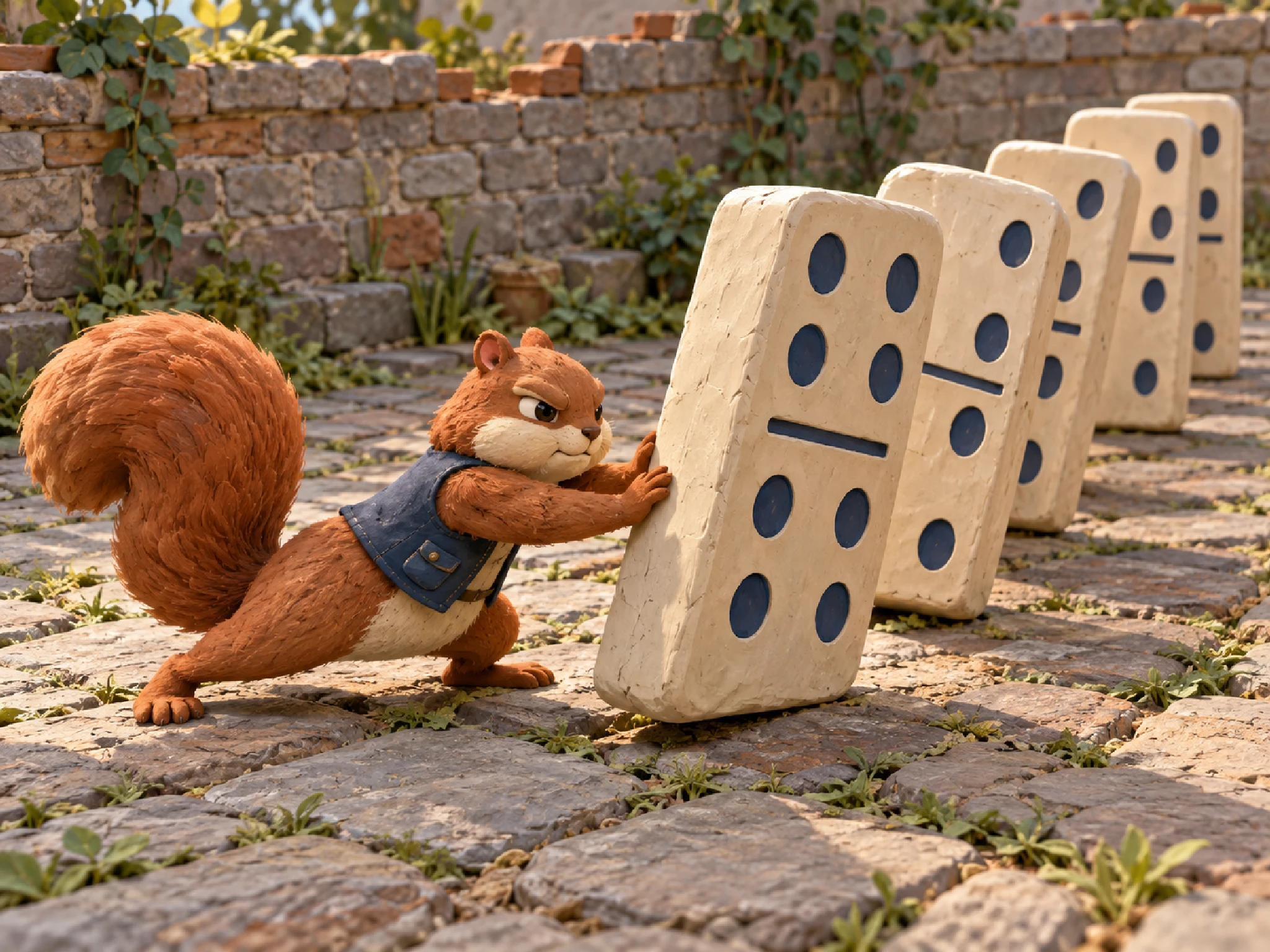
A Squirrel Bracing Falling Dominoes
A squirrel in a work vest braces against an oversized falling domino. Overlapping slabs and thumb-worked clay turn a courtyard mishap into a lively handmade miniature.
Remix this referenceA Squirrel Bracing Falling Dominoes
- Form language
- Build a sculptural clay miniature from softly compressed solids and slightly bowed slabs; retain unevenness where modeled masses join.
- Contour
- Let physical silhouettes supply the contours: softly pinched edges and occasional shallow scallops, without drawn outlines.
- Mark-making
- Use broad thumb sweeps and occasional short modeling-tool drags; vary their pressure naturally instead of repeating a texture stamp.
- Surface rendering
- Keep a matte, softly rubbed finish with shallow dents and visible joins; let rounded tonal transitions describe tangible volume.
Priority
The finished image must visibly read as handbuilt clay, with natural variation permitted throughout the modeling.
What to avoid & what to check
Exact prompt for this example
MODULE OWNERSHIP
subject: Subject count, type, stable proportions and landmarks, resting face geometry, hair shape, physical materials, garment construction and permanent marks. No emotion, movement, color assignment or rendering recipe.
expression: Facial soft-tissue displacement and pupil direction, muscle coordination, regional intensity, asymmetry and onset/peak/release. No head/body pose, stable appearance, skin color or rendering.
gesture: Head/neck/body/limb orientation, joint movement, support, contact and pose-caused occlusion using existing anatomy. No eye/pupil movement, emotion, identity, props inventory or camera.
props: Prop count, type, construction, physical material and scale relative to the subject. Holding/contact belongs to gesture, position to composition, color to palette.
scene: Environment elements, terrain, backdrop/floor presence and structural detail. No canvas positions, camera, lighting, assigned colors or render texture.
camera: Projection, focal-length impression, camera elevation/yaw/roll, viewing distance and crop. No actor pose, world placement, lighting or canvas aspect ratio.
composition: Normalized 0-100% canvas positions, scale in frame, depth/overlap, focal hierarchy and margins. No joint pose, camera projection, rendering, subject/prop inventory or emotion.
palette: Color anchors, hue/saturation/value ranges, colors assigned to parts and approximate color coverage. No illumination direction, shading algorithm, physical material or layout.
lighting: Light-source direction/softness/intensity, ambient illumination, physical shadow direction/length and highlight position. Absence of directional illumination is allowed. No shading technique, palette or material changes.
style: Reusable form abstraction, contour weight/taper/edge quality, medium and mark scale/density/direction, surface rendering and tonal transition technique. No fixed subject proportions, anatomy, identity, expression, pose, palette, light-source direction, camera or layout.
output: Image count, aspect ratio, size, file/alpha requirements and global lettering/logo/watermark restrictions. No background scenery, crop, style, identity or pose.

SUBJECT
inventory: One original anthropomorphic squirrel, actor A; no other characters.
geometry: A compact pear-shaped trunk, generous haunches, small rounded ears, and a broad plume tail distinguish the squirrel.
resting-face: Small oval eyes sit above a short divided muzzle, with a button nose and shallow mouth seam.
appearance: Short fur and a broad cheek patch; a canvas work vest has a wrap front and generous arm openings.

PRIORITY


AVOID


CHECK


EXPRESSION — ACTOR A
brows: Inner brow areas pull down, slightly stronger on the near side.
lids: Upper lids lower into a concentrated narrow opening.
cheeks: Cheeks tighten subtly beside the muzzle.
nose: The nose remains relaxed without a wrinkle or nostril flare.
mouth: Lips press together, with one corner drawn slightly sideways.
jaw: The jaw sets without opening the mouth.
gaze: Pupils track the upper edge of the nearest domino.
coordination: The narrowed eyes lead the effort; mouth tension stays quieter.
timing: Hold the peak of sustained effort before any facial release.

PRIORITY


AVOID


CHECK


GESTURE
head: A extends the neck toward the slab, keeping the chin slightly tucked.
torso: The trunk pitches forward from a low crouch, with the tail sweeping backward as a counterbalance.
limbs: Both forelegs reach forward with bent elbows; the hind legs spread into a firm staggered brace.
contact: Both forepaws press the nearest tilted slab; both hind paws bear on the paving, with no floating support.

PRIORITY


AVOID


CHECK


PROPS
inventory: Seven oversized dominoes, each taller than the squirrel's trunk and head together.
construction: Thick wooden slabs have rounded edges, recessed circular pips, and a shallow dividing groove.

PRIORITY


AVOID


CHECK


SCENE
inventory: A small enclosed courtyard with worn paving, a low brick wall, and weeds between stones.
structure: Uneven paving meets the wall at a narrow raised footing; a few missing bricks interrupt its upper edge.

PRIORITY


AVOID


CHECK


CAMERA
projection: Use a natural perspective with a moderately wide lens impression and restrained near-to-far enlargement.
viewpoint: Look obliquely across the courtyard from just above the squirrel's head height, without camera roll.
crop: Show the whole squirrel and the domino sequence, with a little courtyard remaining around the action.

PRIORITY


AVOID


CHECK


COMPOSITION
placement: Set the squirrel low at left; let the domino sequence sweep diagonally toward the upper right.
depth: Overlap the dominoes at successive depths; the nearest slab partly covers the squirrel's far forearm.
spacing: Make the paw-to-slab junction the focal point, with an open wedge of paving separating the tail from the chain.

PRIORITY


AVOID


CHECK


PALETTE
colors: Use russet, warm cream, ink blue, muted sage, and warm stone gray as the main anchors.
assignment: Russet fur, cream cheek patch and dominoes, ink-blue vest and pips, sage weeds, and stone-gray masonry.
balance: Keep the courtyard subdued; cream slabs form the largest bright passages, with small dark accents.

PRIORITY


AVOID


CHECK


LIGHTING
sources: A broad soft source shines from upper left, supported by gentle ambient fill.
shadows: Short shadows fall toward the right, deepening where paws, slabs, and paving meet.
highlights: Broad restrained highlights touch the upper-left-facing curves and slab edges.

PRIORITY


AVOID


CHECK


STYLE GUIDE
form-language: Build a sculptural clay miniature from softly compressed solids and slightly bowed slabs; retain unevenness where modeled masses join.
contour: Let physical silhouettes supply the contours: softly pinched edges and occasional shallow scallops, without drawn outlines.
mark-making: Use broad thumb sweeps and occasional short modeling-tool drags; vary their pressure naturally instead of repeating a texture stamp.
surface-rendering: Keep a matte, softly rubbed finish with shallow dents and visible joins; let rounded tonal transitions describe tangible volume.

PRIORITY
The finished image must visibly read as handbuilt clay, with natural variation permitted throughout the modeling.

AVOID


CHECK


OUTPUT
format: One finished image, landscape 4:3, 2048 × 1536 pixels, opaque PNG.
restrictions: No lettering, logos, signatures, or watermarks.

PRIORITY


AVOID


CHECK
Model information comes from image provenance. The same prompt may produce a different result.