Text to imageLandscapeStyle guide
Roots in the Dune Face
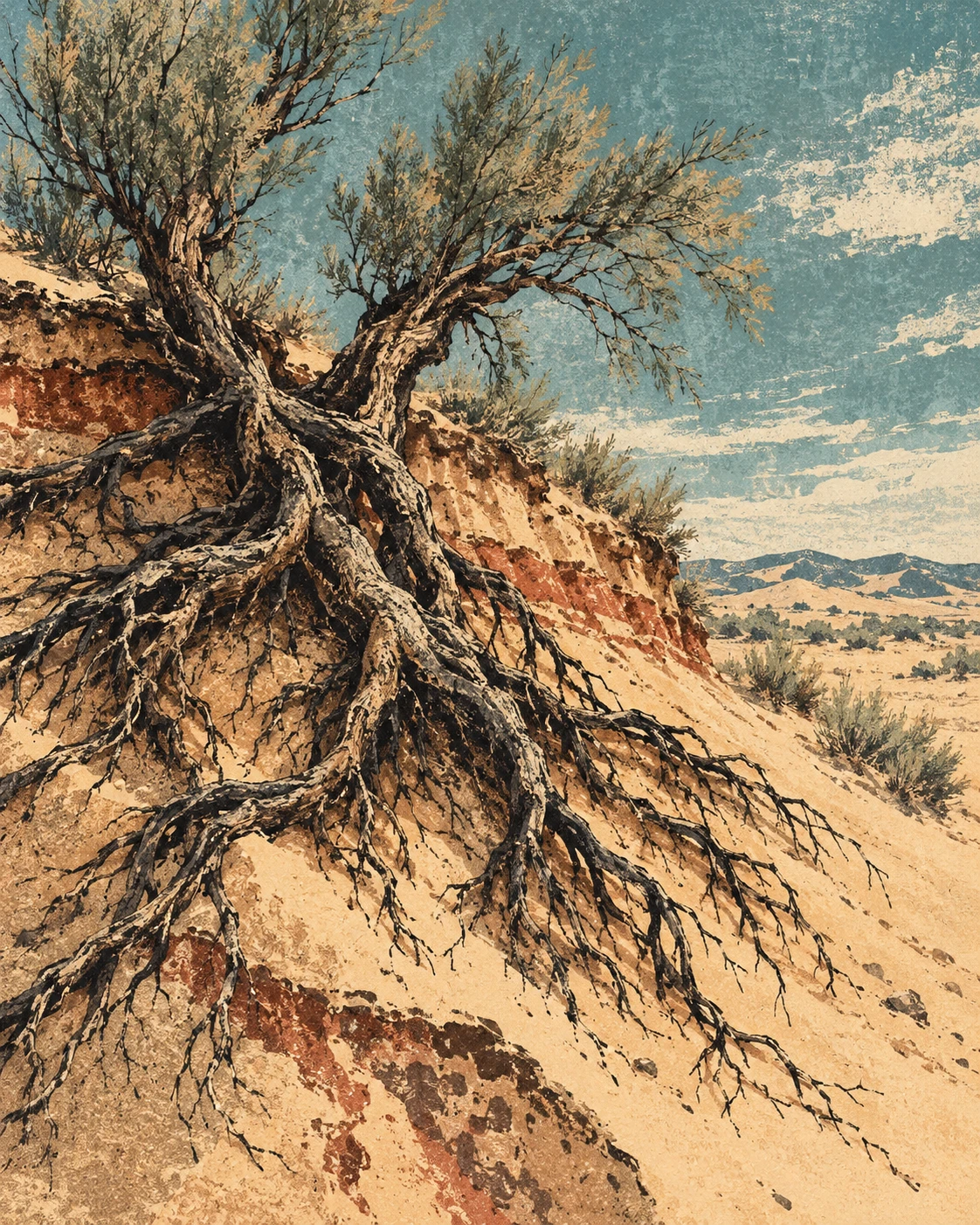
Exposed tamarisk roots lace an eroded dune face, with distant sand ridges beyond. Dragged ink and displaced print layers turn an intimate landscape detail into an experimental poster illustration.
Remix this referenceRoots in the Dune Face
- Form language
- Reduce broad forms to interlocking irregular masses; describe delicate structures with economical branching strokes.
- Contour
- Use blunt, broken print edges beside tapered brush lines; let some boundaries disappear into adjacent masses.
- Mark-making
- Combine rolled-ink drag, broad stencil impressions and occasional displaced second impressions, with natural pressure variation.
- Surface rendering
- Build tone through translucent overprints and dry ink gaps; retain rubbed patches and abrupt changes in ink density.
Priority
Make experimental ink-and-print handling visibly define the finished poster illustration.
What to avoid & what to check
Exact prompt for this example
MODULE OWNERSHIP
subject: Subject count, type, stable proportions and landmarks, resting face geometry, hair shape, physical materials, garment construction and permanent marks. No emotion, movement, color assignment or rendering recipe.
expression: Facial soft-tissue displacement and pupil direction, muscle coordination, regional intensity, asymmetry and onset/peak/release. No head/body pose, stable appearance, skin color or rendering.
gesture: Head/neck/body/limb orientation, joint movement, support, contact and pose-caused occlusion using existing anatomy. No eye/pupil movement, emotion, identity, props inventory or camera.
props: Prop count, type, construction, physical material and scale relative to the subject. Holding/contact belongs to gesture, position to composition, color to palette.
scene: Environment elements, terrain, backdrop/floor presence and structural detail. No canvas positions, camera, lighting, assigned colors or render texture.
camera: Projection, focal-length impression, camera elevation/yaw/roll, viewing distance and crop. No actor pose, world placement, lighting or canvas aspect ratio.
composition: Normalized 0-100% canvas positions, scale in frame, depth/overlap, focal hierarchy and margins. No joint pose, camera projection, rendering, subject/prop inventory or emotion.
palette: Color anchors, hue/saturation/value ranges, colors assigned to parts and approximate color coverage. No illumination direction, shading algorithm, physical material or layout.
lighting: Light-source direction/softness/intensity, ambient illumination, physical shadow direction/length and highlight position. Absence of directional illumination is allowed. No shading technique, palette or material changes.
style: Reusable form abstraction, contour weight/taper/edge quality, medium and mark scale/density/direction, surface rendering and tonal transition technique. No fixed subject proportions, anatomy, identity, expression, pose, palette, light-source direction, camera or layout.
output: Image count, aspect ratio, size, file/alpha requirements and global lettering/logo/watermark restrictions. No background scenery, crop, style, identity or pose.

SUBJECT
inventory: One tamarisk tree with an exposed root system is the principal natural subject; no people or animals.
geometry: A low, forked trunk continues into a spreading root fan, with thick roots dividing into wiry ends.
resting-face: No face is present.
appearance: Weathered bark, fibrous exposed wood and sparse needlelike foliage; minor branching may vary naturally.

PRIORITY


AVOID


CHECK


PROPS
inventory: No separate props.
construction: No prop construction applies.

PRIORITY


AVOID


CHECK


SCENE
inventory: An eroded inland dune, loose sand, a shallow wind-scoured basin, distant dune ridges and open sky.
structure: A scalloped dune face exposes thin sediment bands; its foot opens into an uninterrupted sandy basin.

PRIORITY


AVOID


CHECK


CAMERA
projection: Moderately compressed perspective with a short-telephoto impression.
viewpoint: A close view from below the dune crest, looking obliquely along the exposed face with a level horizon.
crop: Crop through the crown and the dune foot while retaining the root fan and a glimpse of distant terrain.

PRIORITY


AVOID


CHECK


COMPOSITION
placement: The root fan fills the left two-thirds; a narrow opening onto distant land occupies the right.
depth: Roots overlap the dune face; the distant ridges remain subordinate behind this dense foreground.
spacing: Uneven gaps between roots provide small pauses, answered by one spacious interval around the distant horizon.

PRIORITY


AVOID


CHECK


PALETTE
colors: Coal black, warm sand, faded teal and a restrained iron-red accent; mostly muted midvalues.
assignment: Coal black anchors roots and bark; sand tones belong to terrain, teal to sky, and iron red to exposed sediment.
balance: Warm sand dominates, dark roots provide strong contrast, and the cooler sky offers a limited counterweight.

PRIORITY


AVOID


CHECK


LIGHTING
sources: Broad daylight arrives from the upper right, softened by thin cloud, with gentle ambient fill.
shadows: Roots cast short, soft-edged shadows down and left across the dune face.
highlights: Broad highlights catch the upper-right sides of thick roots and projecting sand shelves.

PRIORITY


AVOID


CHECK


STYLE GUIDE
form-language: Reduce broad forms to interlocking irregular masses; describe delicate structures with economical branching strokes.
contour: Use blunt, broken print edges beside tapered brush lines; let some boundaries disappear into adjacent masses.
mark-making: Combine rolled-ink drag, broad stencil impressions and occasional displaced second impressions, with natural pressure variation.
surface-rendering: Build tone through translucent overprints and dry ink gaps; retain rubbed patches and abrupt changes in ink density.

PRIORITY
Make experimental ink-and-print handling visibly define the finished poster illustration.

AVOID


CHECK


OUTPUT
format: One image.
restrictions: One portrait image, 4:5 aspect ratio, 2048 × 2560 pixels, opaque PNG; no lettering, logos or watermarks.

PRIORITY


AVOID


CHECK


FINAL INTEGRATION
scene + camera + composition: The intimate crop should retain enough environmental depth for the image to read as a landscape.
lighting + style: Printed tonal masses should carry the light consistently while preserving expressive irregularity.
Model information comes from image provenance. The same prompt may produce a different result.