Text to imageIllustrationStyle guide
A Cyclist Yields to a Peacock
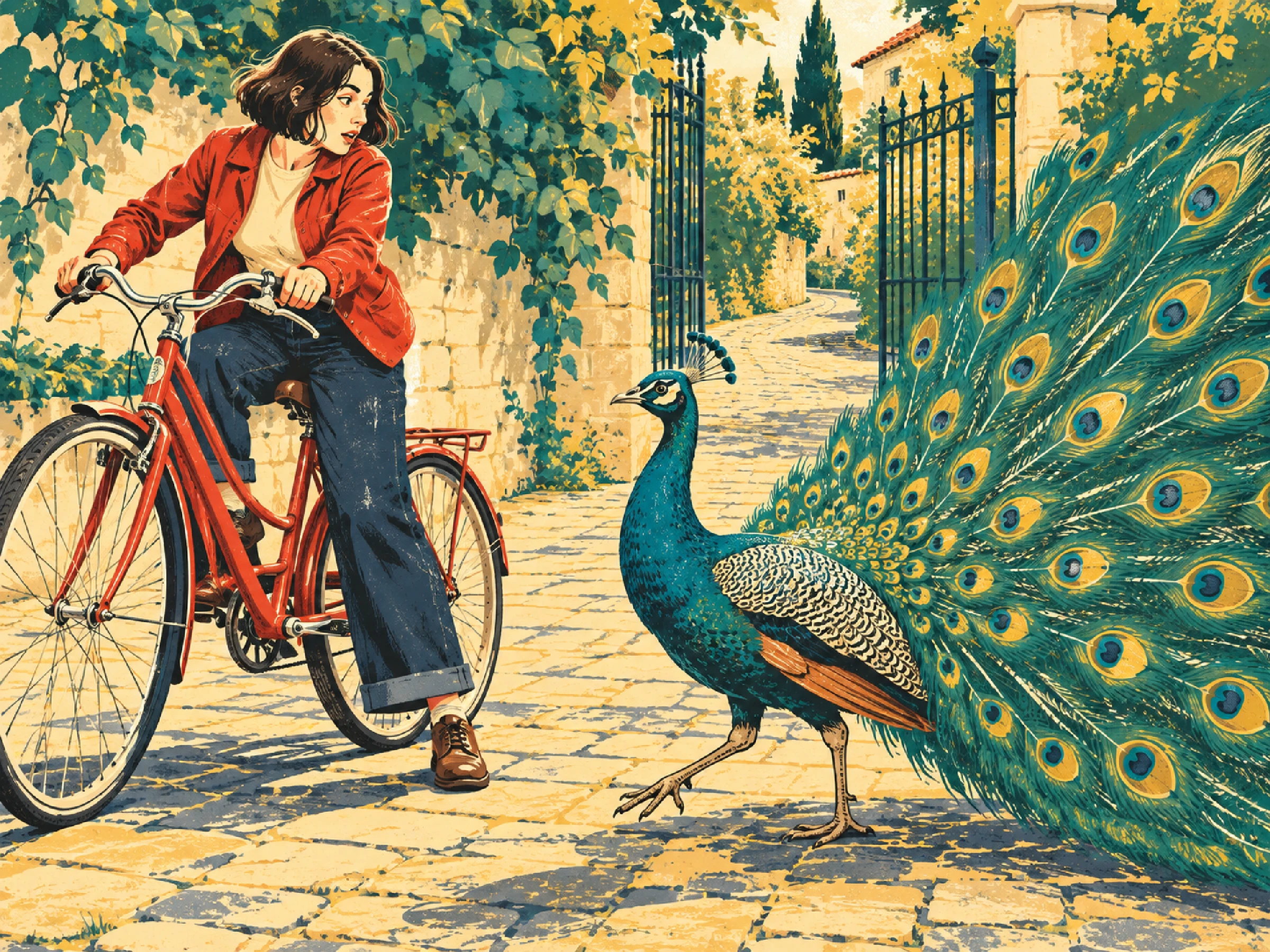
A cyclist brakes in a narrow lane as a peacock leisurely spreads its train. Bold screenprinted shapes and irregular ink overlaps give the encounter a lively rhythm.
Remix this referenceA Cyclist Yields to a Peacock
- Form language
- Build forms from decisive wedges, loops and scalloped masses; alternate broad shapes with narrow interruptions.
- Contour
- Use mostly unoutlined stencil edges, with occasional thick tapered ink contours and small hand-cut irregularities.
- Mark-making
- Screenprinted ink leaves broken passes and loose rake-like accents; let pressure and mark spacing vary naturally.
- Surface rendering
- Use opaque ink layers and selective translucent overprints; resolve tone through shape breaks and uneven ink deposits.
Priority
Preserve the decisive shape rhythms and visibly layered ink of a graphic screen print.
What to avoid & what to check
Exact prompt for this example
MODULE OWNERSHIP
subject: Subject count, type, stable proportions and landmarks, resting face geometry, hair shape, physical materials, garment construction and permanent marks. No emotion, movement, color assignment or rendering recipe.
expression: Facial soft-tissue displacement and pupil direction, muscle coordination, regional intensity, asymmetry and onset/peak/release. No head/body pose, stable appearance, skin color or rendering.
gesture: Head/neck/body/limb orientation, joint movement, support, contact and pose-caused occlusion using existing anatomy. No eye/pupil movement, emotion, identity, props inventory or camera.
props: Prop count, type, construction, physical material and scale relative to the subject. Holding/contact belongs to gesture, position to composition, color to palette.
scene: Environment elements, terrain, backdrop/floor presence and structural detail. No canvas positions, camera, lighting, assigned colors or render texture.
camera: Projection, focal-length impression, camera elevation/yaw/roll, viewing distance and crop. No actor pose, world placement, lighting or canvas aspect ratio.
composition: Normalized 0-100% canvas positions, scale in frame, depth/overlap, focal hierarchy and margins. No joint pose, camera projection, rendering, subject/prop inventory or emotion.
palette: Color anchors, hue/saturation/value ranges, colors assigned to parts and approximate color coverage. No illumination direction, shading algorithm, physical material or layout.
lighting: Light-source direction/softness/intensity, ambient illumination, physical shadow direction/length and highlight position. Absence of directional illumination is allowed. No shading technique, palette or material changes.
style: Reusable form abstraction, contour weight/taper/edge quality, medium and mark scale/density/direction, surface rendering and tonal transition technique. No fixed subject proportions, anatomy, identity, expression, pose, palette, light-source direction, camera or layout.
output: Image count, aspect ratio, size, file/alpha requirements and global lettering/logo/watermark restrictions. No background scenery, crop, style, identity or pose.

SUBJECT
inventory: One adult woman cyclist, A, and one adult male peacock, B.
geometry: A has a lean build and a blunt chin-length bob; B has a small crested head, slender neck and long eyed train.
resting-face: A has a straight nose, broad upper lip and softly squared chin; B has a short tapered beak and small lateral eyes.
appearance: A wears a cotton twill jacket, loose denim trousers and leather lace-up shoes; B has layered feathers.

PRIORITY


AVOID


CHECK


EXPRESSION — ACTOR A
brows: Both brows lift, with the nearer brow slightly higher.
lids: Upper lids rise while lower lids remain lightly engaged.
cheeks: Cheeks remain relaxed without a smile lift.
nose: Nostrils remain relaxed, without wrinkling.
mouth: Lips part into a small, uneven oval.
jaw: The jaw releases slightly, without a full drop.
gaze: Pupils turn toward the peacock's head.
coordination: The lifted brows and widened lids lead the smaller mouth reaction.
timing: Catch the first instant of recognition, before surprise fully opens.

PRIORITY


AVOID


CHECK


EXPRESSION — ACTOR B
brows: No mobile eyebrows; feathers above the visible eye remain smooth and unraised.
lids: The visible eye stays naturally open, without a startled widening or tight squint.
cheeks: Facial feather patches remain uncompressed, without a mammalian cheek lift.
nose: The nostril margin remains undistorted; no nasal flare or wrinkle is added.
mouth: The beak stays gently closed, with an even meeting line and no gape.
jaw: The lower mandible rests against the upper beak without dropping or clenching.
gaze: The visible pupil is directed along the lane beyond the bicycle's front wheel.
coordination: The naturally open eye and closed beak sustain a quiet, unreactive facial state.
timing: Hold the settled neutral apex, with no emerging startle or release.

PRIORITY


AVOID


CHECK


GESTURE
head: A turns her head toward B; B holds its neck upright with its beak directed along the lane.
torso: A shifts her torso backward over the saddle; B keeps its body upright while spreading its train.
limbs: A bends her elbows and lowers one leg; B steps forward with one foot lifted and the other supporting its weight.
contact: A grips both handlebars and squeezes the brake levers; one shoe touches the paving while the other stays on a pedal.

PRIORITY


AVOID


CHECK


PROPS
inventory: One adult-sized city bicycle with a rear carrier and curved handlebars.
construction: A steel step-through frame, rubber tires, wire spokes and a leather saddle; minor fittings may vary naturally.

PRIORITY


AVOID


CHECK


SCENE
inventory: A narrow paved garden lane, a low masonry wall, an open iron gate and climbing foliage.
structure: The lane bends beyond the gate; irregular paving joints and broad leaf clusters give the setting a lived-in character.

PRIORITY


AVOID


CHECK


CAMERA
projection: Moderate perspective with a mild wide-angle impression.
viewpoint: Look diagonally across the lane from slightly above the cyclist's eye level, with no roll.
crop: A medium-wide view includes both full figures and the bicycle; peripheral foliage may leave the frame.

PRIORITY


AVOID


CHECK


COMPOSITION
placement: A and the bicycle occupy the left half; B's broad train fills the right, with its head near their meeting point.
depth: The train overlaps part of the front wheel; the gate and foliage form a quieter rear layer behind the encounter.
spacing: The wheel-to-body gap is the first read, followed by the fan; open paving below gives the overlapping silhouettes room.

PRIORITY


AVOID


CHECK


PALETTE
colors: Deep teal, vermilion, warm butter yellow and paper cream, with sparse near-black accents.
assignment: Teal unites bird and foliage; vermilion marks jacket and bicycle; cream and yellow carry skin, paving, wall and feather eyes.
balance: Light warm fields dominate, with a substantial teal mass, compact vermilion accents and dark trousers and small details.

PRIORITY


AVOID


CHECK


LIGHTING
sources: Broad afternoon light enters from the upper left with soft ambient fill.
shadows: Short, softly edged shadows extend toward the lower right across the paving.
highlights: Restrained highlights touch upper shoulders, the handlebar crest and upper feather edges.

PRIORITY


AVOID


CHECK


STYLE GUIDE
form-language: Build forms from decisive wedges, loops and scalloped masses; alternate broad shapes with narrow interruptions.
contour: Use mostly unoutlined stencil edges, with occasional thick tapered ink contours and small hand-cut irregularities.
mark-making: Screenprinted ink leaves broken passes and loose rake-like accents; let pressure and mark spacing vary naturally.
surface-rendering: Use opaque ink layers and selective translucent overprints; resolve tone through shape breaks and uneven ink deposits.

PRIORITY
Preserve the decisive shape rhythms and visibly layered ink of a graphic screen print.

AVOID


CHECK


OUTPUT
format: One finished illustration, landscape 4:3, 2400 × 1800 pixels, opaque PNG.
restrictions: No lettering, logos or watermarks.

PRIORITY


AVOID


CHECK


FINAL INTEGRATION
gesture + composition: Let the overlaps support the legibility of the braking encounter.
palette + style: Allow ink overlaps to enrich the limited colors while preserving their distinct roles.
Model information comes from image provenance. The same prompt may produce a different result.