Text to imageAnimationStyle guide
Rain Roofs Above the Canyon
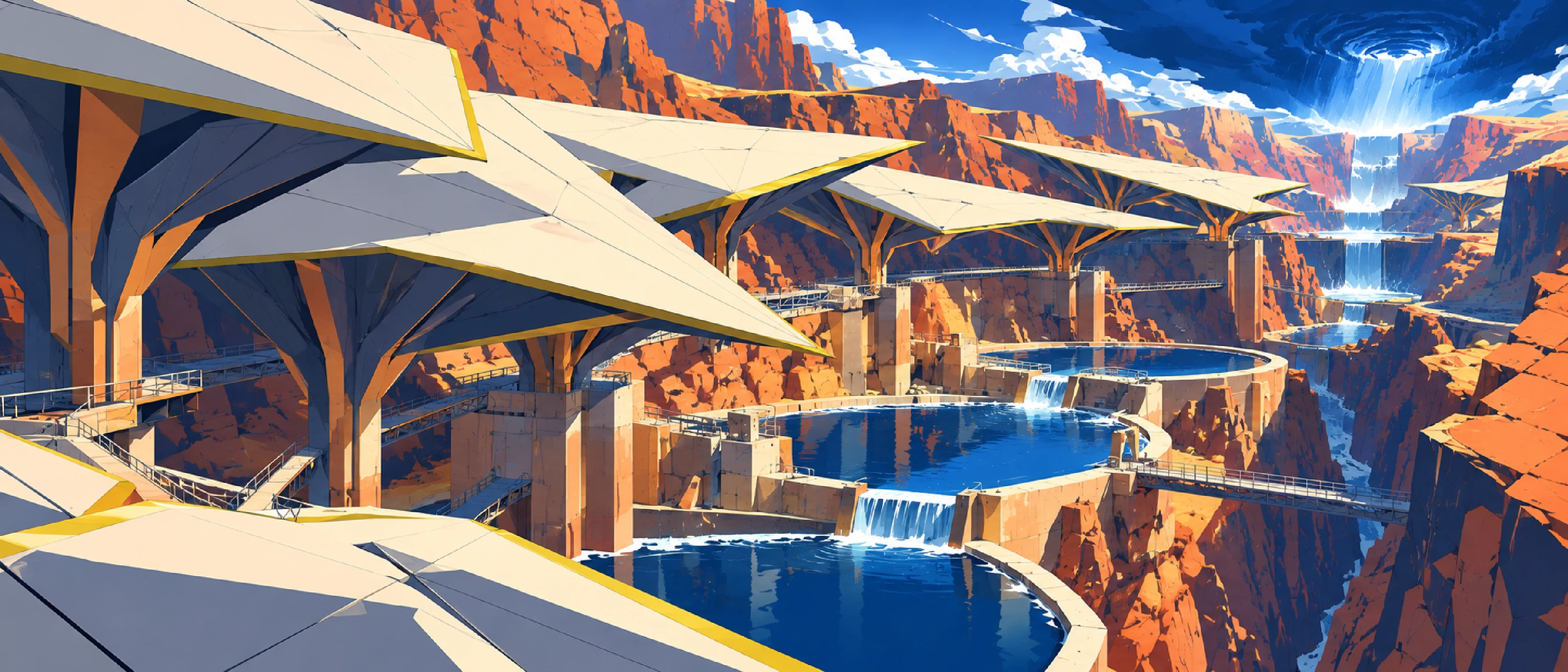
The first rain connects stepped cisterns beneath immense collecting roofs spanning a desert canyon. An angular graphic panorama leads from the dry foreground toward a distant opening filled with rain.
Remix this referenceRain Roofs Above the Canyon
- Form language
- Abstract masses into interlocking wedges and triangular facets, alternating broad unbroken planes with abrupt angular notches.
- Contour
- Use bold exterior contours with strong weight changes, tapered corners and short, sharp interior cuts that stop before enclosing every plane.
- Mark-making
- Place small angular shards and brisk pointed strokes in interrupted clusters; leave broad clean planes unmarked and vary the marks naturally.
- Surface rendering
- Build surfaces from a few sharply separated tonal planes instead of gradients; use occasional jagged edge breaks to keep the graphic finish lively.
Priority
Rendering medium: 2D angular Japanese anime graphic illustration; formal rendering reference: TRIGGER · 2010s · Promare (2019)
What to avoid & what to check
Exact prompt for this example
MODULE OWNERSHIP
subject: Subject count, type, stable proportions and landmarks, resting face geometry, hair shape, physical materials, garment construction and permanent marks. No emotion, movement, color assignment or rendering recipe.
expression: Facial soft-tissue displacement and pupil direction, muscle coordination, regional intensity, asymmetry and onset/peak/release. No head/body pose, stable appearance, skin color or rendering.
gesture: Head/neck/body/limb orientation, joint movement, support, contact and pose-caused occlusion using existing anatomy. No eye/pupil movement, emotion, identity, props inventory or camera.
props: Prop count, type, construction, physical material and scale relative to the subject. Holding/contact belongs to gesture, position to composition, color to palette.
scene: Environment elements, terrain, backdrop/floor presence and structural detail. No canvas positions, camera, lighting, assigned colors or render texture.
camera: Projection, focal-length impression, camera elevation/yaw/roll, viewing distance and crop. No actor pose, world placement, lighting or canvas aspect ratio.
composition: Normalized 0-100% canvas positions, scale in frame, depth/overlap, focal hierarchy and margins. No joint pose, camera projection, rendering, subject/prop inventory or emotion.
palette: Color anchors, hue/saturation/value ranges, colors assigned to parts and approximate color coverage. No illumination direction, shading algorithm, physical material or layout.
lighting: Light-source direction/softness/intensity, ambient illumination, physical shadow direction/length and highlight position. Absence of directional illumination is allowed. No shading technique, palette or material changes.
style: Reusable form abstraction, contour weight/taper/edge quality, medium and mark scale/density/direction, surface rendering and tonal transition technique. No fixed subject proportions, anatomy, identity, expression, pose, palette, light-source direction, camera or layout.
output: Image count, aspect ratio, size, file/alpha requirements and global lettering/logo/watermark restrictions. No background scenery, crop, style, identity or pose.

SUBJECT
inventory: No characters or creatures; the architectural environment is the subject.
geometry: No character proportions or anatomical landmarks apply.
resting-face: No faces are present.
appearance: No character appearance or garments apply.

PRIORITY


AVOID


CHECK


PROPS
inventory: No separate props.
construction: No prop construction applies.

PRIORITY


AVOID


CHECK


SCENE
inventory: A desert canyon contains stepped masonry cisterns, immense folding metal rain roofs and narrow maintenance bridges.
structure: Branching piers carry overlapping roof fans; the first runoff links dry bowls to overflowing basins beneath a storm opening.

PRIORITY


AVOID


CHECK


CAMERA
projection: Broad rectilinear perspective with a moderately wide lens impression and restrained edge stretching.
viewpoint: Look obliquely down the canyon from slightly above the roof supports, with a level horizon.
crop: Use a distant environmental view; crop the nearest roof edge while retaining the far canyon opening.

PRIORITY


AVOID


CHECK


COMPOSITION
placement: Enter through a roof at the lower left, follow the basin chain through the middle and arrive at the upper-right storm opening.
depth: Overlapping roofs establish the foreground; diminishing basins carry depth toward the distant opening, the principal focal point.
spacing: Let the roofs occupy most of the width, with generous gaps over the canyon and an uninterrupted passage toward the focal opening.

PRIORITY


AVOID


CHECK


PALETTE
colors: Use chalk cream, burnt orange, deep ultramarine and a restrained citron accent; keep the strongest saturation selective.
assignment: Assign cream to roof plates, burnt orange to canyon and masonry, ultramarine to water and storm, and citron to roof rims.
balance: Cream and orange dominate; broad dark blues provide weight, while citron remains a sparse sharp accent.

PRIORITY


AVOID


CHECK


LIGHTING
sources: Broad daylight enters from the storm opening at the upper right; subdued sky fill keeps the covered cisterns visible.
shadows: Roof shadows extend toward the lower left, with softened boundaries and deeper shelter directly beneath overlapping plates.
highlights: Broad highlights catch the upper-right roof edges; brief glints mark the exposed spillway lips.

PRIORITY


AVOID


CHECK


STYLE GUIDE
form-language: Abstract masses into interlocking wedges and triangular facets, alternating broad unbroken planes with abrupt angular notches.
contour: Use bold exterior contours with strong weight changes, tapered corners and short, sharp interior cuts that stop before enclosing every plane.
mark-making: Place small angular shards and brisk pointed strokes in interrupted clusters; leave broad clean planes unmarked and vary the marks naturally.
surface-rendering: Build surfaces from a few sharply separated tonal planes instead of gradients; use occasional jagged edge breaks to keep the graphic finish lively.

PRIORITY
Rendering medium: 2D angular Japanese anime graphic illustration; formal rendering reference: TRIGGER · 2010s · Promare (2019)

AVOID


CHECK


OUTPUT
format: One finished image, panoramic 21:9 aspect ratio, 3360 × 1440 pixels, opaque PNG.
restrictions: No lettering, logos, signatures or watermarks.

PRIORITY


AVOID


CHECK


FINAL INTEGRATION
scene + composition + palette: Let the progression of water connect the architectural sequence and color rhythm into one continuous visual journey.
Art direction
트리거 / TRIGGER · 2010s · 프로메어(2019) / Promare (2019) ↗- Abstract form surfaces into wedges, triangles and angular facets
- Strong exterior weight contrast with short sharp interior cuts
- Small angular facets and sharp marks, with no marks in clean planes
- A small set of sharply separated tonal planes in place of gradients
Model information comes from image provenance. The same prompt may produce a different result.