Text to imageArt stylesStyle guide
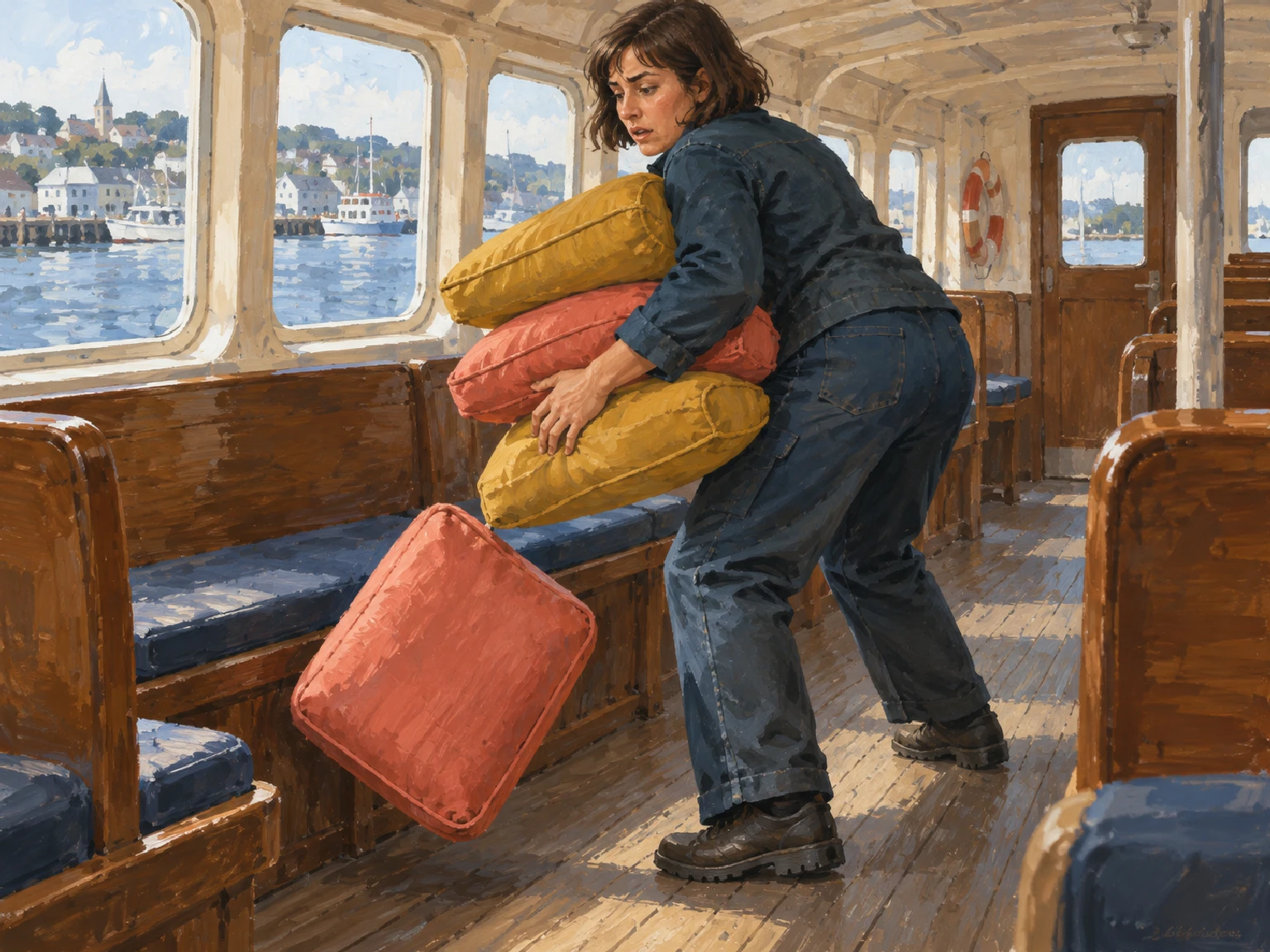
Cushions Toppling in the Ferry Cabin
A woman gathers slipping cushions in a ferry aisle, watching one escape. Overlapping volumes and opaque brushwork turn a small mishap into a lively gouache illustration.
Remix this referenceCushions Toppling in the Ferry Cabin
- Form language
- Simplify forms into weighty, slightly irregular masses; retain useful bends and bulges while letting small details merge.
- Contour
- Build contours from overlapping painted edges, alternating firm brush-cut sections with soft, broken passages.
- Mark-making
- Use loose opaque gouache strokes with broad bristle tracks and occasional dry skips; vary stroke size naturally.
- Surface rendering
- Layer matte paint over earlier passages, leaving underpaint peeking through; turn tones with adjacent scumbles rather than seamless blending.
Priority
Keep loose gouache's opaque, visibly revised brushwork evident throughout.
What to avoid & what to check
Exact prompt for this example
MODULE OWNERSHIP
subject: Subject count, type, stable proportions and landmarks, resting face geometry, hair shape, physical materials, garment construction and permanent marks. No emotion, movement, color assignment or rendering recipe.
expression: Facial soft-tissue displacement and pupil direction, muscle coordination, regional intensity, asymmetry and onset/peak/release. No head/body pose, stable appearance, skin color or rendering.
gesture: Head/neck/body/limb orientation, joint movement, support, contact and pose-caused occlusion using existing anatomy. No eye/pupil movement, emotion, identity, props inventory or camera.
props: Prop count, type, construction, physical material and scale relative to the subject. Holding/contact belongs to gesture, position to composition, color to palette.
scene: Environment elements, terrain, backdrop/floor presence and structural detail. No canvas positions, camera, lighting, assigned colors or render texture.
camera: Projection, focal-length impression, camera elevation/yaw/roll, viewing distance and crop. No actor pose, world placement, lighting or canvas aspect ratio.
composition: Normalized 0-100% canvas positions, scale in frame, depth/overlap, focal hierarchy and margins. No joint pose, camera projection, rendering, subject/prop inventory or emotion.
palette: Color anchors, hue/saturation/value ranges, colors assigned to parts and approximate color coverage. No illumination direction, shading algorithm, physical material or layout.
lighting: Light-source direction/softness/intensity, ambient illumination, physical shadow direction/length and highlight position. Absence of directional illumination is allowed. No shading technique, palette or material changes.
style: Reusable form abstraction, contour weight/taper/edge quality, medium and mark scale/density/direction, surface rendering and tonal transition technique. No fixed subject proportions, anatomy, identity, expression, pose, palette, light-source direction, camera or layout.
output: Image count, aspect ratio, size, file/alpha requirements and global lettering/logo/watermark restrictions. No background scenery, crop, style, identity or pose.

SUBJECT
inventory: A is one adult woman wearing practical ferry work clothes.
geometry: She has a sturdy everyday build, broad hands and recognizable adult proportions.
resting-face: A rounded cheek, short straight nose and broad chin define her resting facial structure.
appearance: A blunt bob, cotton canvas chore jacket, loose trousers and rubber-soled shoes; incidental folds may vary.

PRIORITY


AVOID


CHECK


EXPRESSION — ACTOR A
brows: The visible brow draws inward with a small lift at its inner end.
lids: The visible upper lid lifts slightly; the lower lid stays lightly taut.
cheeks: The visible cheek remains mostly relaxed, without a smile lift.
nose: The visible nostril stays relaxed, without flaring or wrinkling.
mouth: The lips part narrowly, with the visible corner held slightly tense.
jaw: The jaw releases just enough for the narrow lip opening.
gaze: The visible pupil tracks the cushion slipping free.
coordination: Keep brow concern stronger than mouth tension; unseen facial regions remain unprescribed.
timing: Catch the onset of concern as she notices the escaping cushion.

PRIORITY


AVOID


CHECK


GESTURE
head: A turns her head toward the slipping cushion, revealing a partial profile past her shoulder.
torso: She bends forward and twists through the waist to gather the slipping pile.
limbs: Her knees soften in a staggered stance; one arm scoops low while the other folds across the pile.
contact: Two cushions compress against her torso, a third tips over her forearm, and the fourth slips free.

PRIORITY


AVOID


CHECK


PROPS
inventory: Four generously stuffed seat cushions, each roughly as wide as A's torso.
construction: Soft linen covers have rounded corners and simple piped edges around yielding stuffing.

PRIORITY


AVOID


CHECK


SCENE
inventory: A small ferry cabin has timber benches, rounded rectangular windows and a narrow plank-floor aisle.
structure: A low curved ceiling joins sturdy window ribs; harbor water is visible through the windows.

PRIORITY


AVOID


CHECK


CAMERA
projection: Use natural perspective with a moderately wide lens impression.
viewpoint: Look along the aisle from standing eye level in a rear three-quarter view, without camera roll.
crop: Show the whole figure and falling cushion, with nearby bench ends cropped by the frame.

PRIORITY


AVOID


CHECK


COMPOSITION
placement: Set A right of center, with the cushion cascade extending diagonally toward the lower left.
depth: Cushions overlap A and the bench; a cropped foreground seat adds another depth layer.
spacing: Read the cushion tangle first and A second; leave breathing room around the loose cushion.

PRIORITY


AVOID


CHECK


PALETTE
colors: Use mustard, faded coral, deep petrol blue and warm ivory, supported by muted brown.
assignment: Alternate mustard and coral cushions; use petrol clothes, ivory window surrounds, brown timber and warm beige skin.
balance: Quiet brown and ivory occupy most of the image; richer cushions and dark clothing provide accents.

PRIORITY


AVOID


CHECK


LIGHTING
sources: Broad, soft daylight enters through the left windows, supported by gentle cabin ambience.
shadows: Soft shadows fall rightward across the floor; cushion contact shadows are deeper.
highlights: Broad highlights touch window-facing cushion bulges, jacket shoulders and bench edges.

PRIORITY


AVOID


CHECK


STYLE GUIDE
form-language: Simplify forms into weighty, slightly irregular masses; retain useful bends and bulges while letting small details merge.
contour: Build contours from overlapping painted edges, alternating firm brush-cut sections with soft, broken passages.
mark-making: Use loose opaque gouache strokes with broad bristle tracks and occasional dry skips; vary stroke size naturally.
surface-rendering: Layer matte paint over earlier passages, leaving underpaint peeking through; turn tones with adjacent scumbles rather than seamless blending.

PRIORITY
Keep loose gouache's opaque, visibly revised brushwork evident throughout.

AVOID


CHECK


OUTPUT
format: One finished illustration, 4:3 landscape, 1536 × 1152 pixels, opaque PNG.
restrictions: No lettering, logos or watermarks.

PRIORITY


AVOID


CHECK


FINAL INTEGRATION
composition + style: Let painterly edge variation enrich the overlaps while preserving readable silhouettes.
Model information comes from image provenance. The same prompt may produce a different result.