Text to imageProductStyle guide
Blue Glass Paperweight · Focused Caustic
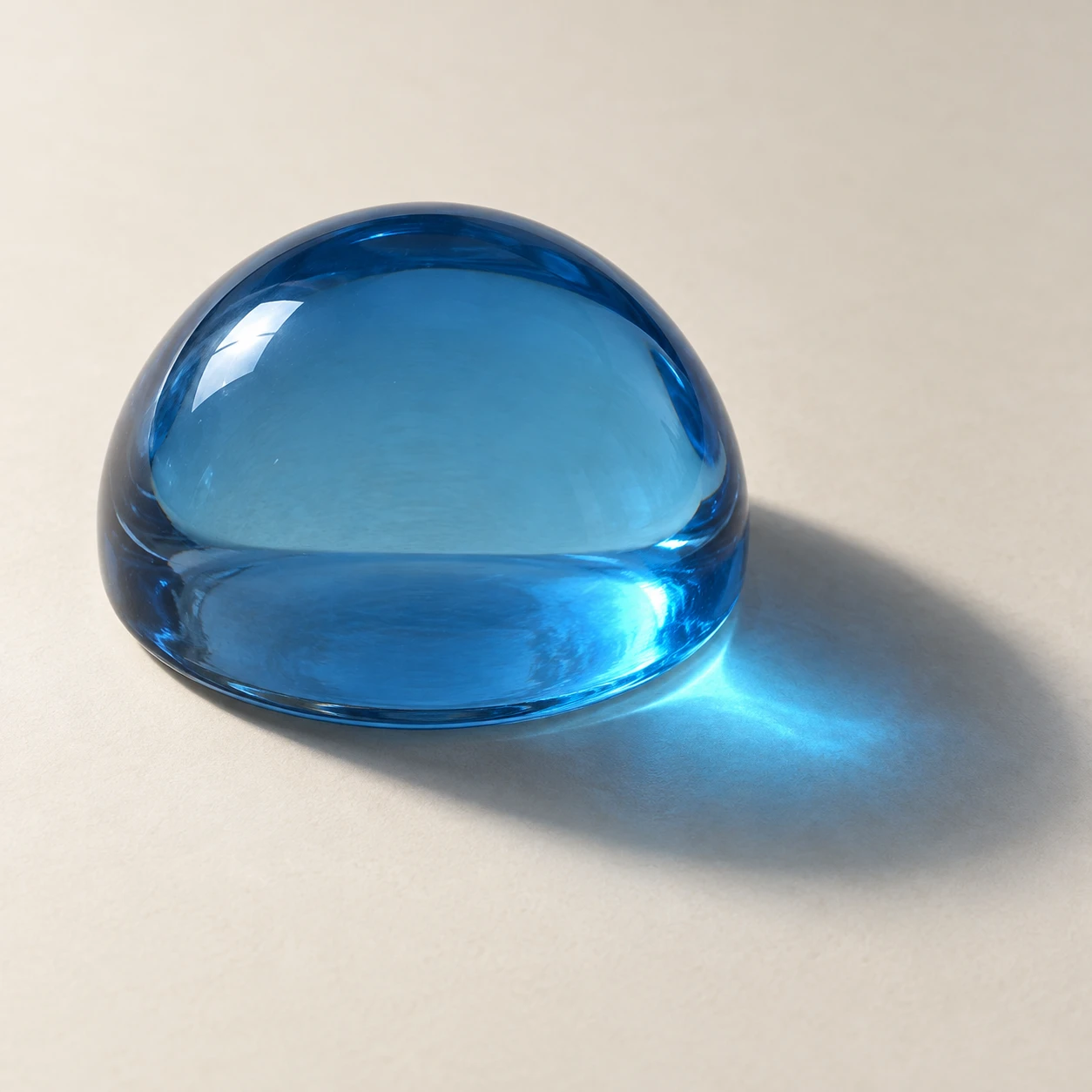
A product image showing the bright cyan caustic formed on a tabletop by light passing through a hemispherical glass paperweight.
Blue Glass Paperweight · Focused Caustic
- Shape & line
- Build the paperweight as a broad, continuous dome with a gently elliptical base in perspective; keep its silhouette smooth and show the flat underside meeting the tabletop without a gap.
- Color & light
- Direct a compact key light from image-upper-left toward image-lower-right; let the glass cast a subdued blue-gray shadow to the lower-right, with a distinctly brighter cyan crescent of transmitted light gathering within and along the shadow's outer portion.
- Texture & material
- Render polished transparent glass with one crisp white reflection on the upper-left dome and visible ivory tabletop through its center; give the caustic a bright curved core and a softer blue fringe, while keeping the matte table free of mirror reflections.
- Composition
- Frame the entire dome and its lower-right caustic together with generous ivory margins; keep the base contact and the bright light patch sharply readable, and use a quiet background so the curved patch remains visibly connected to the glass.
Priority
Prioritize the concentrated tabletop caustic and its visible relationship to the transparent dome.
What to avoid & what to check
Avoid an opaque blue body, a uniform luminous halo, or a light patch detached from the shadow.
Check that upper-left illumination produces a brighter cyan caustic within the lower-right shadow region.
Exact prompt for this example
SUBJECT
One transparent blue glass paperweight with a smooth hemispherical body and flat base, resting directly on a matte ivory tabletop. Light passing through the glass produces a concentrated cyan patch on the tabletop beside its lower-right edge.

COMPOSITION
Use an elevated three-quarter view that reveals the domed top, the base touching the table, and the projected light patch. Place the paperweight slightly left of center, leaving readable tabletop space on image-right.

STYLE GUIDE
1. Shape & line
Build the paperweight as a broad, continuous dome with a gently elliptical base in perspective; keep its silhouette smooth and show the flat underside meeting the tabletop without a gap.

2. Color & light
Direct a compact key light from image-upper-left toward image-lower-right; let the glass cast a subdued blue-gray shadow to the lower-right, with a distinctly brighter cyan crescent of transmitted light gathering within and along the shadow's outer portion.

3. Texture & material
Render polished transparent glass with one crisp white reflection on the upper-left dome and visible ivory tabletop through its center; give the caustic a bright curved core and a softer blue fringe, while keeping the matte table free of mirror reflections.

4. Composition
Frame the entire dome and its lower-right caustic together with generous ivory margins; keep the base contact and the bright light patch sharply readable, and use a quiet background so the curved patch remains visibly connected to the glass.

PRIORITY
Preserve the requested identity, count, action, composition and output settings. Apply the style rules within those constraints; a style reference must not replace the subject or layout. Within the style: Prioritize the concentrated tabletop caustic and its visible relationship to the transparent dome.

AVOID
Avoid an opaque blue body, a uniform luminous halo, or a light patch detached from the shadow.

OUTPUT
Create one square product photograph with no text, labels, logos, or watermark.

SELF-CHECK
Check that upper-left illumination produces a brighter cyan caustic within the lower-right shadow region.
Model information comes from image provenance. The same prompt may produce a different result.