Text to imageArt stylesStyle guide
A Waterslide Through a Ship Hull
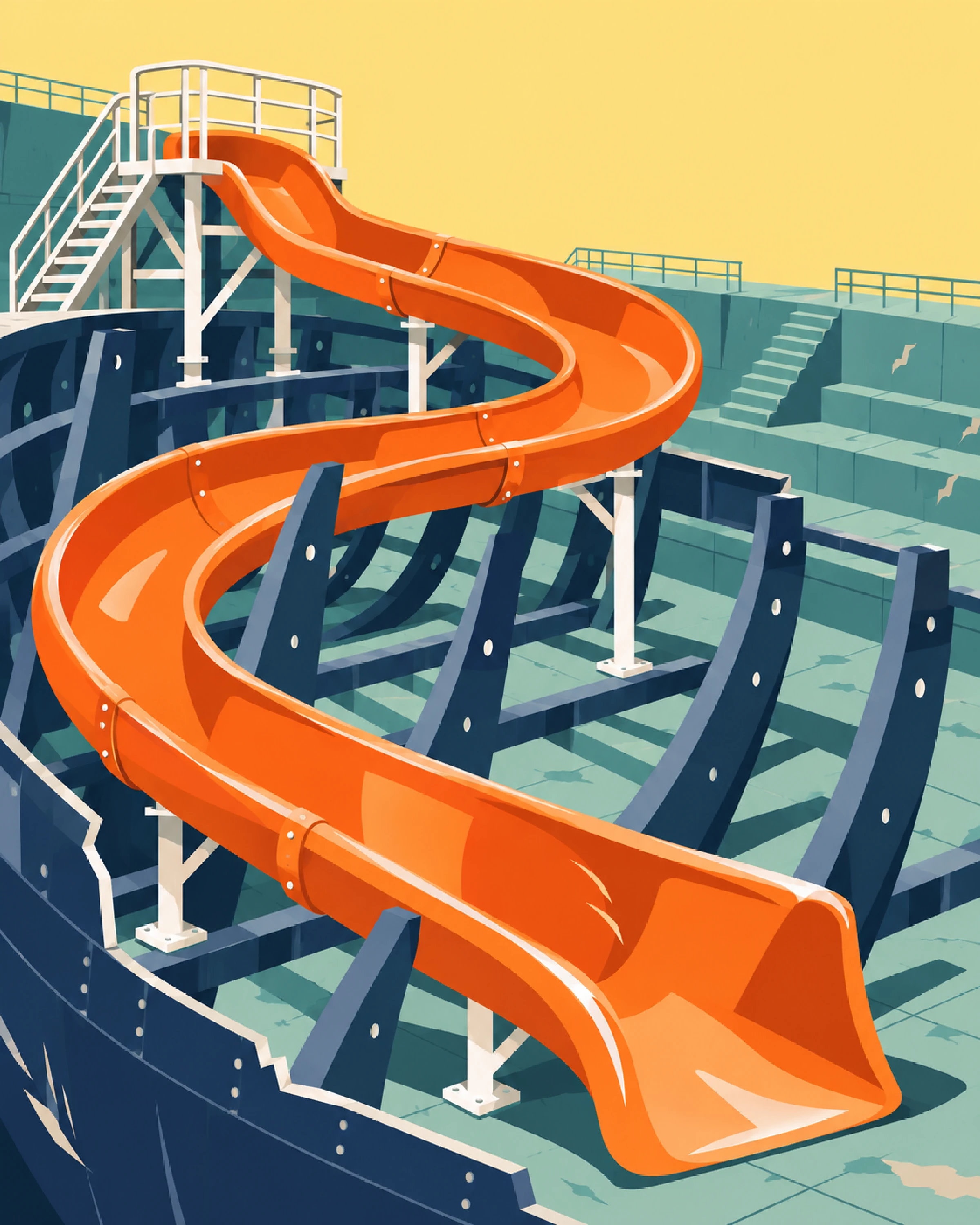
A waterslide curves through exposed ship ribs. Crisp vector shapes, playful asymmetry, and an expansive opening of sky turn a shipyard into an unexpected playground.
Remix this referenceA Waterslide Through a Ship Hull
- Form language
- Reduce forms to confident arcs and blunt wedges; vary local widths and junctions for playful asymmetry.
- Contour
- Use crisp vector edges, mostly without outlines; add occasional tapered strokes where adjacent shapes need separation.
- Mark-making
- Use sparse, decisive vector slashes and short broken curves; let their lengths vary instead of repeating a pattern.
- Surface rendering
- Build tone from a few interlocking hard-edged patches, with selective inset shapes suggesting surface changes.
Priority
Keep crisp vector construction and playful asymmetry visibly consistent.
What to avoid & what to check
Exact prompt for this example
MODULE OWNERSHIP
subject: Subject count, type, stable proportions and landmarks, resting face geometry, hair shape, physical materials, garment construction and permanent marks. No emotion, movement, color assignment or rendering recipe.
expression: Facial soft-tissue displacement and pupil direction, muscle coordination, regional intensity, asymmetry and onset/peak/release. No head/body pose, stable appearance, skin color or rendering.
gesture: Head/neck/body/limb orientation, joint movement, support, contact and pose-caused occlusion using existing anatomy. No eye/pupil movement, emotion, identity, props inventory or camera.
props: Prop count, type, construction, physical material and scale relative to the subject. Holding/contact belongs to gesture, position to composition, color to palette.
scene: Environment elements, terrain, backdrop/floor presence and structural detail. No canvas positions, camera, lighting, assigned colors or render texture.
camera: Projection, focal-length impression, camera elevation/yaw/roll, viewing distance and crop. No actor pose, world placement, lighting or canvas aspect ratio.
composition: Normalized 0-100% canvas positions, scale in frame, depth/overlap, focal hierarchy and margins. No joint pose, camera projection, rendering, subject/prop inventory or emotion.
palette: Color anchors, hue/saturation/value ranges, colors assigned to parts and approximate color coverage. No illumination direction, shading algorithm, physical material or layout.
lighting: Light-source direction/softness/intensity, ambient illumination, physical shadow direction/length and highlight position. Absence of directional illumination is allowed. No shading technique, palette or material changes.
style: Reusable form abstraction, contour weight/taper/edge quality, medium and mark scale/density/direction, surface rendering and tonal transition technique. No fixed subject proportions, anatomy, identity, expression, pose, palette, light-source direction, camera or layout.
output: Image count, aspect ratio, size, file/alpha requirements and global lettering/logo/watermark restrictions. No background scenery, crop, style, identity or pose.

SUBJECT
inventory: One large waterslide with an integral access platform; no people or animals.
geometry: An open trough makes a broad hairpin bend, with raised rounded lips and a flared exit mouth.
resting-face: No facial features apply.
appearance: Molded fiberglass sections and tubular steel platform rails; minor joints and wear may vary naturally.

PRIORITY


AVOID


CHECK


PROPS
inventory: No separate props.
construction: No prop construction applies.

PRIORITY


AVOID


CHECK


SCENE
inventory: An open ship hull in an empty dry dock, with exposed ribs, a concrete basin floor, and open sky.
structure: A missing section of hull exposes the skeletal interior; the dock has stepped retaining walls.

PRIORITY


AVOID


CHECK


CAMERA
projection: Restrained perspective with a mild wide-angle impression.
viewpoint: An elevated three-quarter view looks down into the dock, with no camera roll.
crop: A broad environmental view includes the complete slide bend while cropping the ship at both ends.

PRIORITY


AVOID


CHECK


COMPOSITION
placement: The slide sweeps from the upper left through the middle toward the lower right; the hull anchors the lower field.
depth: The slide is the first read; alternating ribs overlap its route and reveal the dock beyond.
spacing: Leave a generous uninterrupted sky opening at upper right and uneven breathing spaces between structural masses.

PRIORITY


AVOID


CHECK


PALETTE
colors: Tangerine, deep ink blue, pale butter yellow, muted teal, and a small chalk-white accent.
assignment: Give the slide tangerine, the hull ink blue, the sky butter yellow, and the dock muted teal.
balance: Let broad quiet colors support the concentrated orange accent; reserve chalk white for small structural details.

PRIORITY


AVOID


CHECK


LIGHTING
sources: Broad daylight arrives from upper left with moderate ambient fill.
shadows: Short cast shadows extend rightward beneath the slide and structural ribs.
highlights: Highlights favor upper-left-facing lips and rail surfaces.

PRIORITY


AVOID


CHECK


STYLE GUIDE
form-language: Reduce forms to confident arcs and blunt wedges; vary local widths and junctions for playful asymmetry.
contour: Use crisp vector edges, mostly without outlines; add occasional tapered strokes where adjacent shapes need separation.
mark-making: Use sparse, decisive vector slashes and short broken curves; let their lengths vary instead of repeating a pattern.
surface-rendering: Build tone from a few interlocking hard-edged patches, with selective inset shapes suggesting surface changes.

PRIORITY
Keep crisp vector construction and playful asymmetry visibly consistent.

AVOID


CHECK


OUTPUT
format: One finished image, portrait 4:5, 2400 × 3000 pixels, opaque PNG.
restrictions: No lettering, logos, signatures, or watermarks.

PRIORITY


AVOID


CHECK


FINAL INTEGRATION
scene + composition + style: Keep the setting recognizable while allowing structural simplification to strengthen the graphic rhythm.
Model information comes from image provenance. The same prompt may produce a different result.