Text to imageProductStyle guide
Bicycle Pannier Beside the Lock
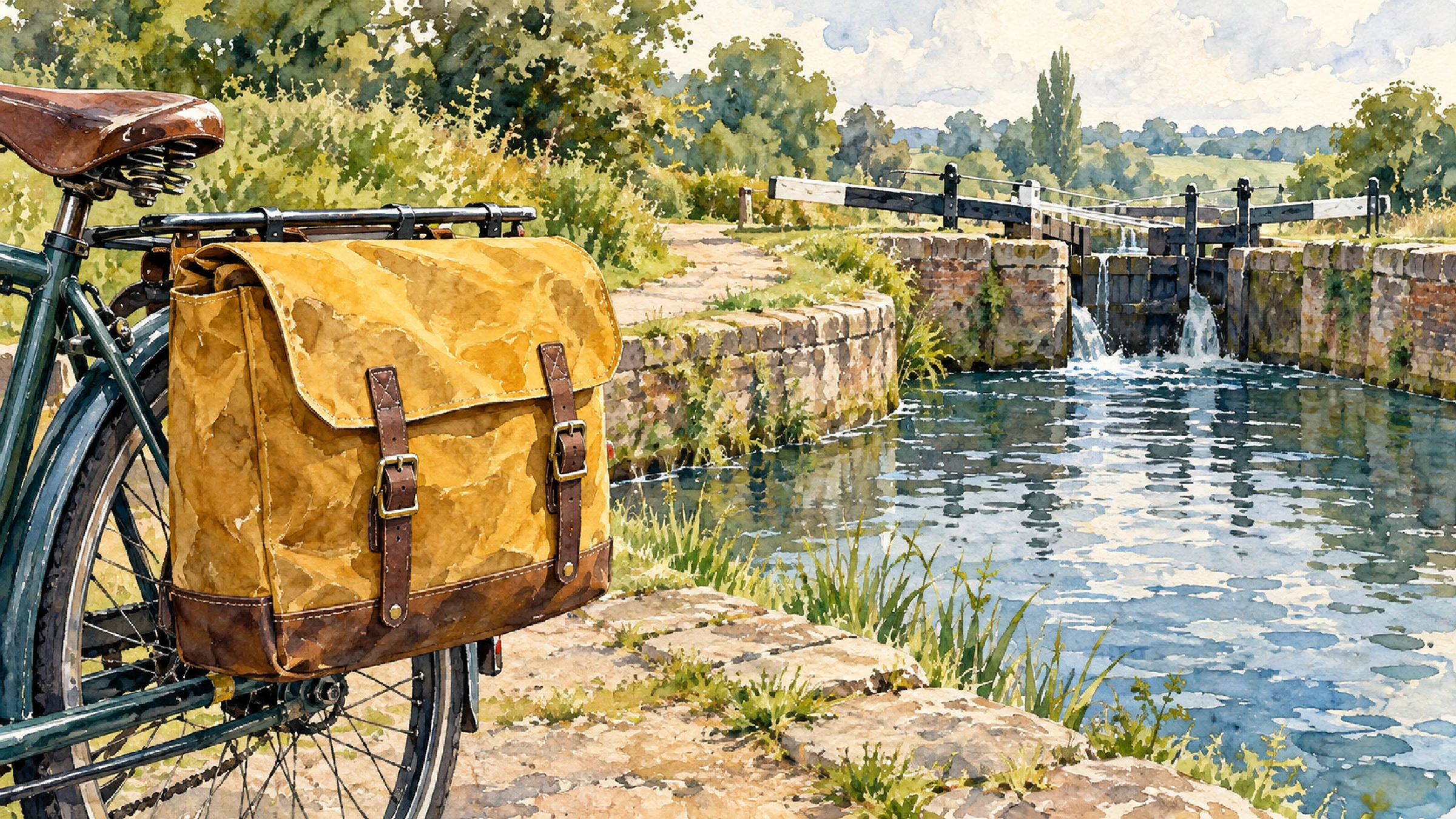
An expressive watercolor product image leading from a foreground canvas pannier along a curving towpath toward a distant canal lock.
Remix this referenceBicycle Pannier Beside the Lock
- Form language
- Reduce forms to generous interlocking masses with readable functional silhouettes; incidental shapes may vary naturally.
- Contour
- Alternate crisp brush turns, broken dry edges and contours lost into neighboring watercolor washes.
- Mark-making
- Use broad, water-loaded strokes with sparse dragged-brush interruptions and loose directional accents.
- Surface rendering
- Layer transparent washes with pigment pooling, expressive blooms and reserved paper; wet diffusion softens tonal transitions.
Priority
Expressive watercolor blooms and broken edges must remain visibly characteristic.
What to avoid & what to check
Exact prompt for this example
MODULE OWNERSHIP
subject: Subject count, type, stable proportions and landmarks, resting face geometry, hair shape, physical materials, garment construction and permanent marks. No emotion, movement, color assignment or rendering recipe.
expression: Facial soft-tissue displacement and pupil direction, muscle coordination, regional intensity, asymmetry and onset/peak/release. No head/body pose, stable appearance, skin color or rendering.
gesture: Head/neck/body/limb orientation, joint movement, support, contact and pose-caused occlusion using existing anatomy. No eye/pupil movement, emotion, identity, props inventory or camera.
props: Prop count, type, construction, physical material and scale relative to the subject. Holding/contact belongs to gesture, position to composition, color to palette.
scene: Environment elements, terrain, backdrop/floor presence and structural detail. No canvas positions, camera, lighting, assigned colors or render texture.
camera: Projection, focal-length impression, camera elevation/yaw/roll, viewing distance and crop. No actor pose, world placement, lighting or canvas aspect ratio.
composition: Normalized 0-100% canvas positions, scale in frame, depth/overlap, focal hierarchy and margins. No joint pose, camera projection, rendering, subject/prop inventory or emotion.
palette: Color anchors, hue/saturation/value ranges, colors assigned to parts and approximate color coverage. No illumination direction, shading algorithm, physical material or layout.
lighting: Light-source direction/softness/intensity, ambient illumination, physical shadow direction/length and highlight position. Absence of directional illumination is allowed. No shading technique, palette or material changes.
style: Reusable form abstraction, contour weight/taper/edge quality, medium and mark scale/density/direction, surface rendering and tonal transition technique. No fixed subject proportions, anatomy, identity, expression, pose, palette, light-source direction, camera or layout.
output: Image count, aspect ratio, size, file/alpha requirements and global lettering/logo/watermark restrictions. No background scenery, crop, style, identity or pose.

SUBJECT
inventory: One original canvas bicycle pannier; no people or animals.
geometry: A broad flap caps a softly tapered rectangular body with deep side gussets and a rigid, flat back.
resting-face: No facial structure applies.
appearance: Waxed canvas, a leather-reinforced base, paired buckle straps and rear mounting hooks define its construction.

PRIORITY


AVOID


CHECK


PROPS
inventory: One ordinary utility bicycle with a rear luggage rack.
construction: A metal diamond frame, full mudguards and conventional wheels; the pannier is sized for the rear rack.

PRIORITY


AVOID


CHECK


SCENE
inventory: A canal towpath, lock basin, timber lock gates, low brick retaining walls and bankside grasses.
structure: The towpath bends around the basin toward the lock, with worn coping stones and grass between masonry joints.

PRIORITY


AVOID


CHECK


CAMERA
projection: Perspective with a moderate wide-angle impression and gentle near-to-far expansion.
viewpoint: Look slightly downward from the pannier side in three-quarter view, with a level horizon.
crop: Show the complete pannier within a broad environmental view; parts of the bicycle may leave the frame.

PRIORITY


AVOID


CHECK


COMPOSITION
placement: Anchor the pannier in the lower-left third; the canal bend leads toward the distant right-hand lock.
depth: The pannier overlaps the rack in the foreground; walls and water recede through successive open intervals.
spacing: Keep the pannier dominant, with breathing room above its flap and generous water around the quieter lock.

PRIORITY


AVOID


CHECK


PALETTE
colors: Mustard ochre, petrol blue, muted reed green, warm ivory and restrained iron brown.
assignment: Mustard canvas, brown fittings, petrol-blue water, green banks and ivory sky.
balance: Cool, subdued colors occupy most of the image; the warmer bag supplies the strongest saturation.

PRIORITY


AVOID


CHECK


LIGHTING
sources: Broad, soft daylight enters from the upper left with ample ambient illumination.
shadows: Soft shadows fall briefly to the lower right; deeper shade gathers beneath the flap and rack.
highlights: Subdued highlights touch the upper flap fold, buckle tops and occasional water ripples.

PRIORITY


AVOID


CHECK


STYLE GUIDE
form-language: Reduce forms to generous interlocking masses with readable functional silhouettes; incidental shapes may vary naturally.
contour: Alternate crisp brush turns, broken dry edges and contours lost into neighboring watercolor washes.
mark-making: Use broad, water-loaded strokes with sparse dragged-brush interruptions and loose directional accents.
surface-rendering: Layer transparent washes with pigment pooling, expressive blooms and reserved paper; wet diffusion softens tonal transitions.

PRIORITY
Expressive watercolor blooms and broken edges must remain visibly characteristic.

AVOID


CHECK


OUTPUT
format: One finished image, 16:9 landscape, 2400 × 1350 pixels, opaque PNG.
restrictions: No lettering, logos, signatures or watermarks.

PRIORITY


AVOID


CHECK


FINAL INTEGRATION
subject + composition + style: Let construction, visual journey and painterly freedom reinforce one another without competing.
Model information comes from image provenance. The same prompt may produce a different result.