Text to imageIllustrationStyle guide
Cranes Carrying a Road
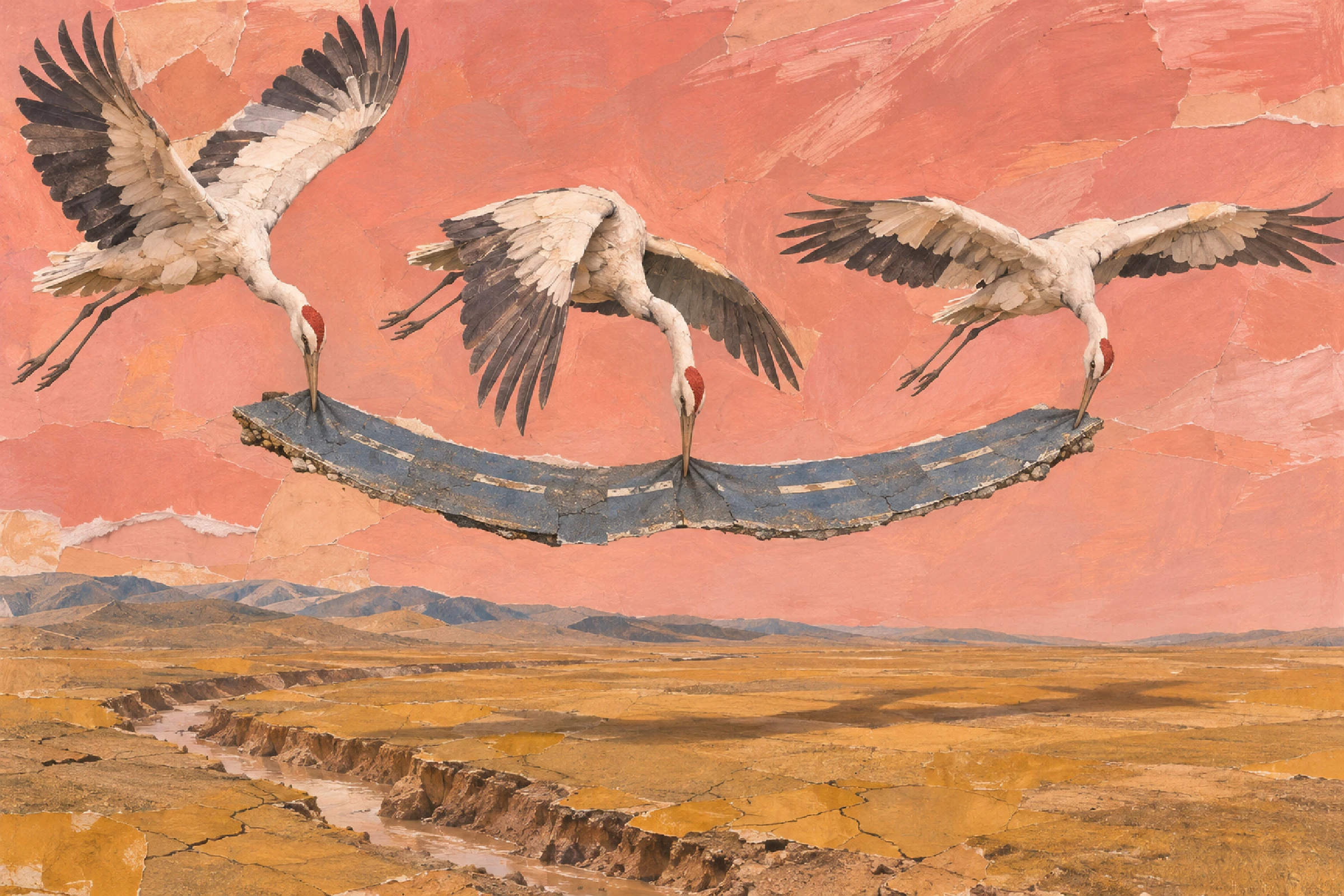
Three enormous cranes carry a strip of road above an open plain. Photographic fragments, torn paper and rough gouache meet around the sagging roadway, with a generous opening of empty sky beneath it.
Remix this referenceCranes Carrying a Road
- Form language
- Build recognizable forms from photographic fragments and broad paper-cut masses, with selective detail interrupted by simplified shapes.
- Contour
- Alternate sharp scissor edges with fibrous tears; add occasional broken graphite reinforcement instead of continuous outlines.
- Mark-making
- Use broad uneven gouache strokes and occasional dragged dry-brush marks; let their irregularities vary naturally within the collage language.
- Surface rendering
- Retain photographic detail in selected fragments, interrupt it with opaque paint, and let tones jump across exposed paper joins.
Priority
Make the collision of photographic fragments, torn paper and brushed gouache visibly essential.
What to avoid & what to check
Exact prompt for this example
MODULE OWNERSHIP
subject: Subject count, type, stable proportions and landmarks, resting face geometry, hair shape, physical materials, garment construction and permanent marks. No emotion, movement, color assignment or rendering recipe.
expression: Facial soft-tissue displacement and pupil direction, muscle coordination, regional intensity, asymmetry and onset/peak/release. No head/body pose, stable appearance, skin color or rendering.
gesture: Head/neck/body/limb orientation, joint movement, support, contact and pose-caused occlusion using existing anatomy. No eye/pupil movement, emotion, identity, props inventory or camera.
props: Prop count, type, construction, physical material and scale relative to the subject. Holding/contact belongs to gesture, position to composition, color to palette.
scene: Environment elements, terrain, backdrop/floor presence and structural detail. No canvas positions, camera, lighting, assigned colors or render texture.
camera: Projection, focal-length impression, camera elevation/yaw/roll, viewing distance and crop. No actor pose, world placement, lighting or canvas aspect ratio.
composition: Normalized 0-100% canvas positions, scale in frame, depth/overlap, focal hierarchy and margins. No joint pose, camera projection, rendering, subject/prop inventory or emotion.
palette: Color anchors, hue/saturation/value ranges, colors assigned to parts and approximate color coverage. No illumination direction, shading algorithm, physical material or layout.
lighting: Light-source direction/softness/intensity, ambient illumination, physical shadow direction/length and highlight position. Absence of directional illumination is allowed. No shading technique, palette or material changes.
style: Reusable form abstraction, contour weight/taper/edge quality, medium and mark scale/density/direction, surface rendering and tonal transition technique. No fixed subject proportions, anatomy, identity, expression, pose, palette, light-source direction, camera or layout.
output: Image count, aspect ratio, size, file/alpha requirements and global lettering/logo/watermark restrictions. No background scenery, crop, style, identity or pose.

SUBJECT
inventory: Three enormous cranes, identified as A, B and C; no people or other animals.
geometry: Recognizable cranes with long necks, compact bodies, broad feathered wings and slender legs.
resting-face: Small round eyes, straight tapered beaks and feathered orbital contours without mobile human eyebrows.
appearance: Layered plumage with distinct flight feathers, bare lower legs and smooth horn beaks; no accessories.

PRIORITY


AVOID


CHECK


EXPRESSION — ACTOR A
brows: No independent brow action is prescribed.
lids: Lids stay naturally open, without widening or pinching.
cheeks: No separate cheek displacement is prescribed.
nose: No independent nasal movement is prescribed.
mouth: Beak corners remain still, without a stretched mouth line.
jaw: The lower mandible stays raised in a quiet closed hold.
gaze: The visible pupil points downward toward A's carrying contact.
coordination: Downward gaze accompanies relaxed lids and an unstrained beak line.
timing: Hold the settled apex of a neutral facial state.

PRIORITY


AVOID


CHECK


EXPRESSION — ACTOR B
brows: No independent brow action is prescribed.
lids: Lids stay naturally open, without widening or pinching.
cheeks: No separate cheek displacement is prescribed.
nose: No independent nasal movement is prescribed.
mouth: Beak corners remain still, without a stretched mouth line.
jaw: The lower mandible stays raised in a quiet closed hold.
gaze: The visible pupil points downward toward B's carrying contact.
coordination: Downward gaze accompanies relaxed lids and an unstrained beak line.
timing: Hold the settled apex of a neutral facial state.

PRIORITY


AVOID


CHECK


EXPRESSION — ACTOR C
brows: No independent brow action is prescribed.
lids: Lids stay naturally open, without widening or pinching.
cheeks: No separate cheek displacement is prescribed.
nose: No independent nasal movement is prescribed.
mouth: Beak corners remain still, without a stretched mouth line.
jaw: The lower mandible stays raised in a quiet closed hold.
gaze: The visible pupil points downward toward C's carrying contact.
coordination: Downward gaze accompanies relaxed lids and an unstrained beak line.
timing: Hold the settled apex of a neutral facial state.

PRIORITY


AVOID


CHECK


GESTURE
head: Each crane bends its neck downward toward its carrying contact.
torso: All three bodies lean into forward flight; B banks slightly while A and C remain more level.
limbs: A spreads its wings high, B sweeps them downward, and C holds them outward; legs trail loosely.
contact: Each beak grips a separate section of the same road edge; the unsupported ribbon sags between grips.

PRIORITY


AVOID


CHECK


PROPS
inventory: One detached strip of two-lane road, its full width smaller than a crane's wingspan; no vehicles.
construction: Flexible asphalt with exposed aggregate edges, worn lane dashes and irregularly broken ends.

PRIORITY


AVOID


CHECK


SCENE
inventory: An open alluvial plain, a shallow winding trench, a distant low ridge and an uninterrupted sky.
structure: Freshly exposed trench banks and sparse ground fissures suggest a landscape stripped of its road.

PRIORITY


AVOID


CHECK


CAMERA
projection: Restrained perspective with a long-lens impression and little near-to-far exaggeration.
viewpoint: A distant, slightly elevated oblique view reveals the road surface and the plain beneath it; no roll.
crop: A wide environmental view includes all three cranes and both broken road ends.

PRIORITY


AVOID


CHECK


COMPOSITION
placement: Place A, B and C at uneven heights across the upper half, with the road forming a low arc beneath them.
depth: The road reads first, crane silhouettes second and the distant trench third; the road overlaps the plain.
spacing: Leave a broad opening beneath the road and generous space to the right; the plain occupies a shallow lower band.

PRIORITY


AVOID


CHECK


PALETTE
colors: Dusty salmon, mustard ochre, bone white, graphite and restrained faded blue.
assignment: Salmon sky, ochre plain, bone-white cranes with graphite flight feathers, and faded-blue asphalt.
balance: Muted warm colors dominate, with smaller pale and dark accents; reserve blue for the road.

PRIORITY


AVOID


CHECK


LIGHTING
sources: Broad soft daylight comes from the upper left, with generous ambient illumination.
shadows: Soft shadows gather beneath wings and road folds; faint ground shadows extend toward the lower right.
highlights: Subtle highlights touch upper-left feather edges and raised asphalt ridges.

PRIORITY


AVOID


CHECK


STYLE GUIDE
form-language: Build recognizable forms from photographic fragments and broad paper-cut masses, with selective detail interrupted by simplified shapes.
contour: Alternate sharp scissor edges with fibrous tears; add occasional broken graphite reinforcement instead of continuous outlines.
mark-making: Use broad uneven gouache strokes and occasional dragged dry-brush marks; let their irregularities vary naturally within the collage language.
surface-rendering: Retain photographic detail in selected fragments, interrupt it with opaque paint, and let tones jump across exposed paper joins.

PRIORITY
Make the collision of photographic fragments, torn paper and brushed gouache visibly essential.

AVOID


CHECK


OUTPUT
format: One finished illustration, landscape 3:2, 2400 × 1600 pixels, opaque PNG.
restrictions: No lettering, logos, signatures or watermarks.

PRIORITY


AVOID


CHECK


FINAL INTEGRATION
subject + props + style: Recognizable construction supports the impossible scale relationship while the mixed media makes that contradiction tangible.
expression + gesture + composition: Quiet facial acting supports the shared carrying action, and open spacing lets the separate contributions read together.
Model information comes from image provenance. The same prompt may produce a different result.