Text to imageCharacterStyle guide
Button in His Beard
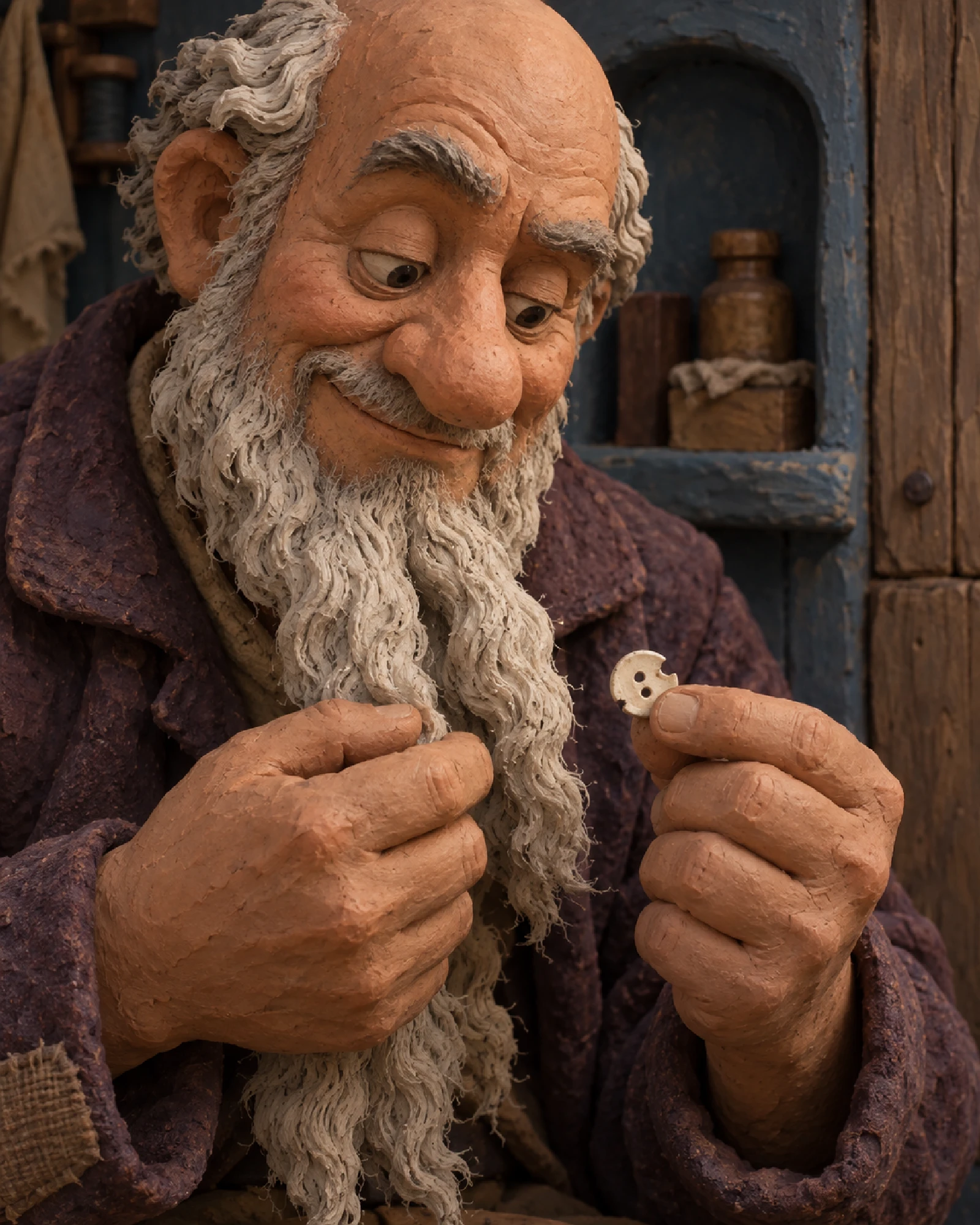
A shaggy mender discovers a button caught in his beard and begins to smile. Pressed surfaces and asymmetric masses give this handmade clay miniature an intimate, quietly comic presence.
Remix this referenceButton in His Beard
- Form language
- Build a hand-sculpted clay miniature from rounded wedges and swollen lobes, with compressed joins and purposeful irregularity.
- Contour
- Use softly uneven silhouettes and occasional pinched edges; shallow incisions replace drawn outlines.
- Mark-making
- Let thumb sweeps and short tool drags follow the modeled masses; vary their spacing naturally and leave quieter passages.
- Surface rendering
- Keep the clay matte, with softly rubbed tonal transitions and occasional crumbly edges; retain small handmade variations coherently.
Priority
The image must read as a tangible handbuilt clay miniature, with modeled volume and visible making.
What to avoid & what to check
Exact prompt for this example
MODULE OWNERSHIP
subject: Subject count, type, stable proportions and landmarks, resting face geometry, hair shape, physical materials, garment construction and permanent marks. No emotion, movement, color assignment or rendering recipe.
expression: Facial soft-tissue displacement and pupil direction, muscle coordination, regional intensity, asymmetry and onset/peak/release. No head/body pose, stable appearance, skin color or rendering.
gesture: Head/neck/body/limb orientation, joint movement, support, contact and pose-caused occlusion using existing anatomy. No eye/pupil movement, emotion, identity, props inventory or camera.
props: Prop count, type, construction, physical material and scale relative to the subject. Holding/contact belongs to gesture, position to composition, color to palette.
scene: Environment elements, terrain, backdrop/floor presence and structural detail. No canvas positions, camera, lighting, assigned colors or render texture.
camera: Projection, focal-length impression, camera elevation/yaw/roll, viewing distance and crop. No actor pose, world placement, lighting or canvas aspect ratio.
composition: Normalized 0-100% canvas positions, scale in frame, depth/overlap, focal hierarchy and margins. No joint pose, camera projection, rendering, subject/prop inventory or emotion.
palette: Color anchors, hue/saturation/value ranges, colors assigned to parts and approximate color coverage. No illumination direction, shading algorithm, physical material or layout.
lighting: Light-source direction/softness/intensity, ambient illumination, physical shadow direction/length and highlight position. Absence of directional illumination is allowed. No shading technique, palette or material changes.
style: Reusable form abstraction, contour weight/taper/edge quality, medium and mark scale/density/direction, surface rendering and tonal transition technique. No fixed subject proportions, anatomy, identity, expression, pose, palette, light-source direction, camera or layout.
output: Image count, aspect ratio, size, file/alpha requirements and global lettering/logo/watermark restrictions. No background scenery, crop, style, identity or pose.

SUBJECT
inventory: One original older male mender, actor A, with human anatomy.
geometry: A pear-shaped head, broad nose and thick fingers; a forked beard divides into two substantial locks.
resting-face: Deep-set eyes beneath heavy brow ridges, a long upper lip and a small rounded chin.
appearance: Wiry hair forms a broken horseshoe around a bald crown; a wool jacket has a broad collar and one cloth elbow patch.

PRIORITY


AVOID


CHECK


EXPRESSION — ACTOR A
brows: One brow lifts slightly while the other stays relaxed.
lids: Lower lids tighten subtly; upper lids remain comfortably open.
cheeks: The cheek beside the rising mouth corner gathers gently upward.
nose: Nostrils remain relaxed without a nose wrinkle.
mouth: Closed lips form a small crooked smile, stronger on one side.
jaw: The jaw stays loose with no visible opening.
gaze: Both pupils look down toward the button.
coordination: The restrained brow lift and uneven smile register the same small discovery.
timing: Catch the onset of amusement, before the smile fully spreads.

PRIORITY


AVOID


CHECK


GESTURE
head: A lowers his chin and inclines his neck slightly toward his working hand.
torso: His upper body bends forward gently, with one shoulder drawn ahead of the other.
limbs: One hand pinches and draws the button out of the beard; the other gathers a beard lock aside, elbows comfortably bent.
contact: Fingertips grip the button rim while the opposite fingers support the beard; neither hand covers the mouth.

PRIORITY


AVOID


CHECK


PROPS
inventory: One loose button, approximately as wide as A's thumb.
construction: A shallow bone disc with two threading holes and a slightly chipped rim.

PRIORITY


AVOID


CHECK


SCENE
inventory: A cramped repair booth with a shallow wall recess and a wooden partition; the floor is unseen.
structure: The recess has a thick rounded lip; the partition consists of broad joined boards.

PRIORITY


AVOID


CHECK


CAMERA
projection: Perspective with a short-telephoto impression and gentle depth compression.
viewpoint: An intimate viewing distance, slightly above eye level and offset toward A's working-hand side.
crop: A tight upper-chest portrait clips the crown and portions of both forearms while retaining both hands.

PRIORITY


AVOID


CHECK


COMPOSITION
placement: The face fills the left half; the button sits below and to its right, with the hands extending across the lower frame.
depth: Hands overlap the beard in the foreground; the booth forms a shallow enclosing layer behind A.
spacing: Lead from the face to the small button; preserve a quiet upper-right pocket and clear gaps around the fingertips.

PRIORITY


AVOID


CHECK


PALETTE
colors: Warm terracotta, dusty aubergine, chalk ivory and muted petrol blue form a restrained, mostly middle-value palette.
assignment: Terracotta skin, ivory hair and button, aubergine jacket, and petrol-blue booth surfaces.
balance: Aubergine and blue occupy broad areas; the pale beard is the largest light mass, with the button a small pale accent.

PRIORITY


AVOID


CHECK


LIGHTING
sources: A broad soft source enters from upper right, supported by weak ambient fill.
shadows: Soft shadows fall toward lower left, deepening gently beneath the beard and between overlapping fingers.
highlights: Broad subdued highlights touch the upper-right planes of the nose, knuckles and button rim.

PRIORITY


AVOID


CHECK


STYLE GUIDE
form-language: Build a hand-sculpted clay miniature from rounded wedges and swollen lobes, with compressed joins and purposeful irregularity.
contour: Use softly uneven silhouettes and occasional pinched edges; shallow incisions replace drawn outlines.
mark-making: Let thumb sweeps and short tool drags follow the modeled masses; vary their spacing naturally and leave quieter passages.
surface-rendering: Keep the clay matte, with softly rubbed tonal transitions and occasional crumbly edges; retain small handmade variations coherently.

PRIORITY
The image must read as a tangible handbuilt clay miniature, with modeled volume and visible making.

AVOID


CHECK


OUTPUT
format: One finished image, 4:5 portrait, 1600 × 2000 pixels, opaque PNG.
restrictions: No lettering, logos or watermarks.

PRIORITY


AVOID


CHECK


FINAL INTEGRATION
expression + gesture + composition: Keep the facial response and hand action readable together, allowing each to explain the other.
style + lighting: Let the illumination reveal the modeled surface while preserving the natural softness of the handmade marks.
Model information comes from image provenance. The same prompt may produce a different result.