Text to imageArt stylesStyle guide
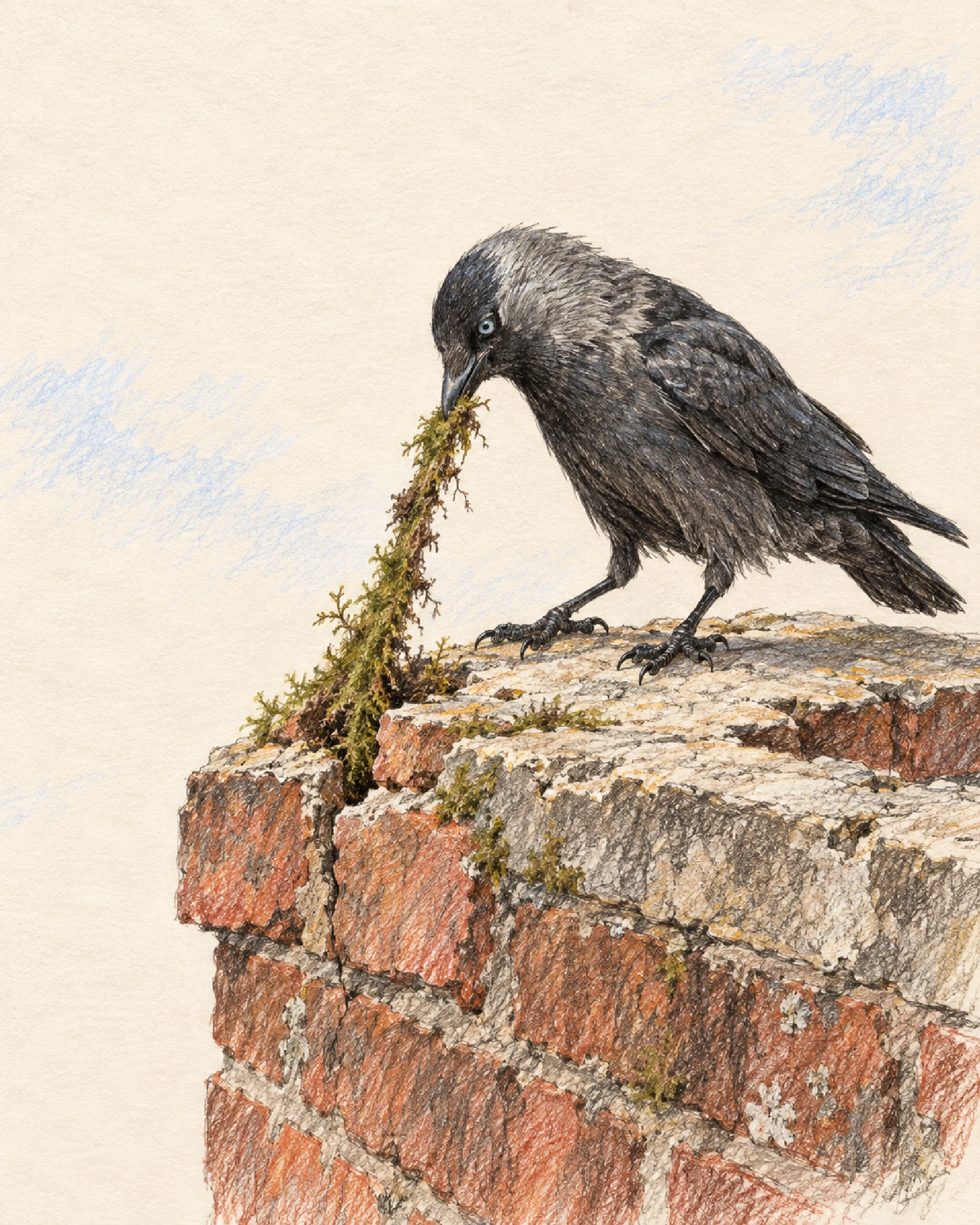
Jackdaw Tugging a Moss Strip
A jackdaw tugs moss from a cracked chimney, drawn with rough graphite and loosely layered colored pencil. Spacious sky sets off the concentrated marks around this small act.
Remix this referenceJackdaw Tugging a Moss Strip
- Form language
- Compress complex forms into blunt masses and selective angular facets; let small irregularities remain unresolved.
- Contour
- Use searching graphite contours with broken pressure, occasional doubled lines and tapered, unfinished endings.
- Mark-making
- Combine quick pencil hatching with blunt colored-pencil scumbles; vary stroke length and let marks stray across edges.
- Surface rendering
- Build tone through loose translucent pencil layers and exposed paper tooth, using rubbed passages beside crisp scratches.
Priority
Keep the finished image visibly rooted in rough graphite and colored-pencil sketchbook drawing.
What to avoid & what to check
Exact prompt for this example
MODULE OWNERSHIP
subject: Subject count, type, stable proportions and landmarks, resting face geometry, hair shape, physical materials, garment construction and permanent marks. No emotion, movement, color assignment or rendering recipe.
expression: Facial soft-tissue displacement and pupil direction, muscle coordination, regional intensity, asymmetry and onset/peak/release. No head/body pose, stable appearance, skin color or rendering.
gesture: Head/neck/body/limb orientation, joint movement, support, contact and pose-caused occlusion using existing anatomy. No eye/pupil movement, emotion, identity, props inventory or camera.
props: Prop count, type, construction, physical material and scale relative to the subject. Holding/contact belongs to gesture, position to composition, color to palette.
scene: Environment elements, terrain, backdrop/floor presence and structural detail. No canvas positions, camera, lighting, assigned colors or render texture.
camera: Projection, focal-length impression, camera elevation/yaw/roll, viewing distance and crop. No actor pose, world placement, lighting or canvas aspect ratio.
composition: Normalized 0-100% canvas positions, scale in frame, depth/overlap, focal hierarchy and margins. No joint pose, camera projection, rendering, subject/prop inventory or emotion.
palette: Color anchors, hue/saturation/value ranges, colors assigned to parts and approximate color coverage. No illumination direction, shading algorithm, physical material or layout.
lighting: Light-source direction/softness/intensity, ambient illumination, physical shadow direction/length and highlight position. Absence of directional illumination is allowed. No shading technique, palette or material changes.
style: Reusable form abstraction, contour weight/taper/edge quality, medium and mark scale/density/direction, surface rendering and tonal transition technique. No fixed subject proportions, anatomy, identity, expression, pose, palette, light-source direction, camera or layout.
output: Image count, aspect ratio, size, file/alpha requirements and global lettering/logo/watermark restrictions. No background scenery, crop, style, identity or pose.

SUBJECT
inventory: A is one adult jackdaw with feathered plumage, a keratin bill and scaled feet.
geometry: A compact crow with a broad crown, short pointed bill, sturdy chest and short wedge-shaped tail.
resting-face: Round eyes sit above a straight bill seam; preserve avian facial structure.
appearance: Small breast feathers overlap beneath longer flight feathers; minor feather irregularities may vary naturally.

PRIORITY


AVOID


CHECK


EXPRESSION — ACTOR A
brows: Brow regions stay at rest without exaggerated lifting or inward compression.
lids: The visible eye stays open, with a slight tightening of the lower lid.
cheeks: Cheek regions remain unpuffed, without a smile-like lift.
nose: The tissue around the nares stays still, without wrinkling or flaring.
mouth: No separate mouth soft-tissue displacement is prescribed.
jaw: No separate jaw soft-tissue displacement is prescribed.
gaze: The visible pupil turns downward toward the moss attachment in the crack.
coordination: Pair the steady pupil direction with restrained lower-lid tension.
timing: Hold the apex of concentration, with pupil direction and lid tension not yet relaxing.

PRIORITY


AVOID


CHECK


GESTURE
head: A draws its head upward and backward, extending its neck as it tugs.
torso: A braces its body forward, with its tail extended behind as a counterbalance.
limbs: Both feet spread their toes around the uneven rim; the wings remain folded against the body.
contact: The bill grips the raised moss end with a narrow gap and firm upward lower-bill pressure. Hold the grip at the tug's peak; the other end catches in the masonry crack.

PRIORITY


AVOID


CHECK


PROPS
inventory: One loose strip of moss, roughly as long as A's bill-to-breast distance.
construction: Branching shoots form a flexible mat with a thin root underside and a ragged torn edge.

PRIORITY


AVOID


CHECK


SCENE
inventory: A weathered brick chimney crown beneath open sky; no additional buildings are needed.
structure: An incomplete mortar cap exposes uneven brick edges and one open crack.

PRIORITY


AVOID


CHECK


CAMERA
projection: Natural perspective with a mild telephoto impression and little near-to-far exaggeration.
viewpoint: View near the chimney crown's height from a shallow three-quarter angle, with a level horizon.
crop: Include the complete bird and moss strip while cropping through the chimney shaft.

PRIORITY


AVOID


CHECK


COMPOSITION
placement: Cluster A and the chimney within the right 40% of the canvas; the head and moss lead the focal hierarchy.
depth: The moss crosses the chimney silhouette; a clear gap separates the neck from the masonry.
spacing: Leave the upper-left field broadly open, with generous breathing room beyond the bill.

PRIORITY


AVOID


CHECK


PALETTE
colors: Use paper cream, graphite charcoal, muted brick red, moss olive and a small pale blue accent.
assignment: Give A charcoal plumage and pale blue irises, the masonry brick red, the moss olive and the sky paper cream.
balance: Cream dominates; dark plumage supplies the strongest value contrast, with restrained red and olive accents.

PRIORITY


AVOID


CHECK


LIGHTING
sources: Broad, soft daylight arrives from the upper left with generous ambient fill.
shadows: Short, soft shadows fall down and right beneath the feet, moss and broken rim.
highlights: Subtle highlights touch the upper bill, crown and exposed upper edges of the masonry.

PRIORITY


AVOID


CHECK


STYLE GUIDE
form-language: Compress complex forms into blunt masses and selective angular facets; let small irregularities remain unresolved.
contour: Use searching graphite contours with broken pressure, occasional doubled lines and tapered, unfinished endings.
mark-making: Combine quick pencil hatching with blunt colored-pencil scumbles; vary stroke length and let marks stray across edges.
surface-rendering: Build tone through loose translucent pencil layers and exposed paper tooth, using rubbed passages beside crisp scratches.

PRIORITY
Keep the finished image visibly rooted in rough graphite and colored-pencil sketchbook drawing.

AVOID


CHECK


OUTPUT
format: Produce one opaque PNG image, 1600 × 2000 pixels, in a 4:5 aspect ratio.
restrictions: No lettering, logos, signatures or watermarks.

PRIORITY


AVOID


CHECK


FINAL INTEGRATION
gesture + props + scene: Coordinate the tug with the strip's flexibility and the masonry's attachment point so the action reads immediately.
composition + style: Let the concentration of pencil marks reinforce the focal hierarchy while spacious areas retain the drawing's openness.
Model information comes from image provenance. The same prompt may produce a different result.