Text to imageCharacterStyle guide
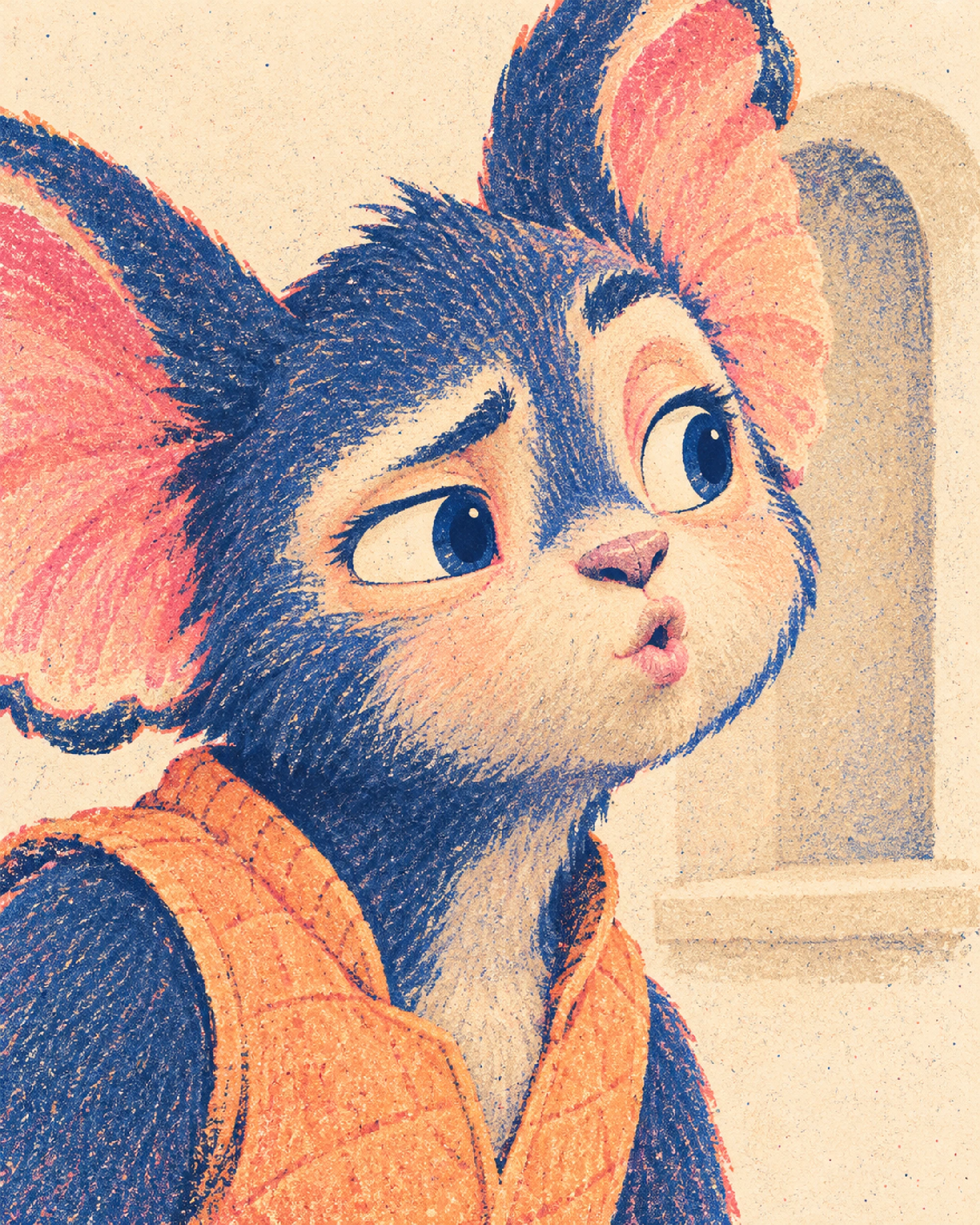
Fan-Eared Creature Practicing a Whistle
A fan-eared creature purses its little muzzle and waits for its first whistle. An intimate crop cuts through its expansive ears, while grainy riso impressions and playful registration offsets give the character a lively printed presence.
Remix this referenceFan-Eared Creature Practicing a Whistle
- Form language
- Reduce volumes to buoyant cut-paper-like shapes with a few blunt internal divisions; permit small irregularities.
- Contour
- Use mostly unoutlined edges with occasional chunky keyline fragments and deliberately imperfect plate alignment.
- Mark-making
- Build printed areas from uneven stipple and rubbed crayon marks, letting density drift naturally across each impression.
- Surface rendering
- Layer translucent riso impressions into visible overprints; use grainy tonal steps and occasional unprinted pinholes.
Priority
Preserve the tactile riso character through visibly separate impressions and playful registration offsets.
What to avoid & what to check
Exact prompt for this example
MODULE OWNERSHIP
subject: Subject count, type, stable proportions and landmarks, resting face geometry, hair shape, physical materials, garment construction and permanent marks. No emotion, movement, color assignment or rendering recipe.
expression: Facial soft-tissue displacement and pupil direction, muscle coordination, regional intensity, asymmetry and onset/peak/release. No head/body pose, stable appearance, skin color or rendering.
gesture: Head/neck/body/limb orientation, joint movement, support, contact and pose-caused occlusion using existing anatomy. No eye/pupil movement, emotion, identity, props inventory or camera.
props: Prop count, type, construction, physical material and scale relative to the subject. Holding/contact belongs to gesture, position to composition, color to palette.
scene: Environment elements, terrain, backdrop/floor presence and structural detail. No canvas positions, camera, lighting, assigned colors or render texture.
camera: Projection, focal-length impression, camera elevation/yaw/roll, viewing distance and crop. No actor pose, world placement, lighting or canvas aspect ratio.
composition: Normalized 0-100% canvas positions, scale in frame, depth/overlap, focal hierarchy and margins. No joint pose, camera projection, rendering, subject/prop inventory or emotion.
palette: Color anchors, hue/saturation/value ranges, colors assigned to parts and approximate color coverage. No illumination direction, shading algorithm, physical material or layout.
lighting: Light-source direction/softness/intensity, ambient illumination, physical shadow direction/length and highlight position. Absence of directional illumination is allowed. No shading technique, palette or material changes.
style: Reusable form abstraction, contour weight/taper/edge quality, medium and mark scale/density/direction, surface rendering and tonal transition technique. No fixed subject proportions, anatomy, identity, expression, pose, palette, light-source direction, camera or layout.
output: Image count, aspect ratio, size, file/alpha requirements and global lettering/logo/watermark restrictions. No background scenery, crop, style, identity or pose.

SUBJECT
inventory: One original small, furred creature with a humanoid upper body.
geometry: A broad head narrows into a short conical muzzle; large scalloped fan ears contrast with a compact neck and shoulders.
resting-face: Wide-set oval eyes, thick brow pads, a small triangular nose, and a projecting lower lip define the resting face.
appearance: Short felt-like fur, flexible cartilage ears with folded tips, and a sleeveless quilted cloth vest.

PRIORITY


AVOID


CHECK


EXPRESSION — ACTOR A
brows: One brow lifts while the other presses slightly inward.
lids: One eye narrows a little; the other remains openly attentive.
cheeks: Both cheeks inflate gently, with slightly more fullness on one side.
nose: Keep the nose unwrinkled and the nostrils relaxed.
mouth: Push the lips into a small, slightly off-center round opening.
jaw: Lower the jaw only enough to support the pursed opening.
gaze: Both pupils look toward the empty air just beyond the muzzle.
coordination: The uncertain upper face contrasts with the firmly organized whistle shape below.
timing: Capture the onset, just as the lips gather before any successful whistle.

PRIORITY


AVOID


CHECK


GESTURE
head: Tilt the head toward one shoulder while extending the muzzle slightly forward.
torso: Raise that shoulder slightly and let the upper torso follow the forward inclination.
limbs: No limb action is prescribed.
contact: No external contact.

PRIORITY


AVOID


CHECK


PROPS
inventory: No separate props.
construction: No prop construction applies.

PRIORITY


AVOID


CHECK


SCENE
inventory: A plaster interior wall with one shallow arched niche; no floor is visible.
structure: The niche has a rounded recessed edge and a simple continuous sill.

PRIORITY


AVOID


CHECK


CAMERA
projection: Use a gently compressed portrait perspective with no wide-angle enlargement.
viewpoint: View at eye level from a shallow three-quarter angle, with a level camera.
crop: An intimate head-and-shoulders crop cuts through the outer ears and ends within the vest.

PRIORITY


AVOID


CHECK


COMPOSITION
placement: The face fills the left two-thirds, leaving a smaller open interval ahead of the muzzle; the mouth leads the reading.
depth: The nearer ear overlaps the far ear; the niche remains a subordinate layer behind the silhouette.
spacing: Let one ear cross the top edge and the other cross the left edge, while keeping the muzzle clear of the right margin.

PRIORITY


AVOID


CHECK


PALETTE
colors: Deep indigo, lively pink, pale apricot, and warm cream form a limited print palette.
assignment: Indigo belongs to fur and facial accents, pink to inner ears, apricot to the vest, and cream to the wall and paper.
balance: Indigo carries the largest colored mass; pink stays vivid, apricot quiet, and cream leaves the image airy.

PRIORITY


AVOID


CHECK


LIGHTING
sources: A large diffuse source from the upper right provides gentle illumination with ample ambient fill.
shadows: Short soft shadows sit beneath the muzzle and ear folds, leaning slightly left.
highlights: Broad restrained highlights touch the upper-right brow, muzzle, and ear rims.

PRIORITY


AVOID


CHECK


STYLE GUIDE
form-language: Reduce volumes to buoyant cut-paper-like shapes with a few blunt internal divisions; permit small irregularities.
contour: Use mostly unoutlined edges with occasional chunky keyline fragments and deliberately imperfect plate alignment.
mark-making: Build printed areas from uneven stipple and rubbed crayon marks, letting density drift naturally across each impression.
surface-rendering: Layer translucent riso impressions into visible overprints; use grainy tonal steps and occasional unprinted pinholes.

PRIORITY
Preserve the tactile riso character through visibly separate impressions and playful registration offsets.

AVOID


CHECK


OUTPUT
format: One finished image, portrait 4:5, 2000 × 2500 pixels, opaque PNG.
restrictions: No lettering, logos, signatures, or watermarks.

PRIORITY


AVOID


CHECK


FINAL INTEGRATION
expression + style: Keep the small facial displacements legible through the print irregularities.
Model information comes from image provenance. The same prompt may produce a different result.