Text to imageArt stylesStyle guide
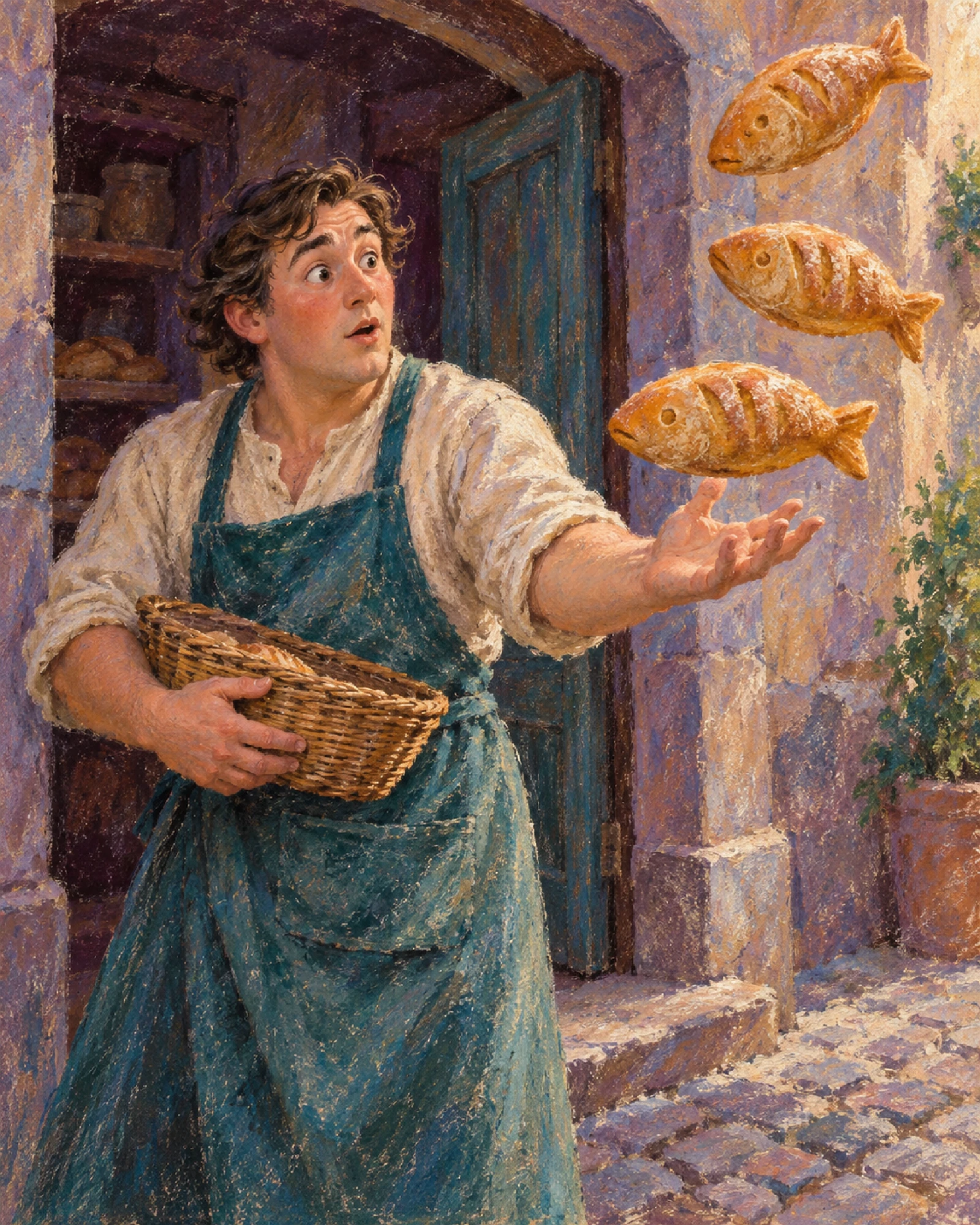
Baker and Floating Fish Loaves
At a bakery threshold, a baker reaches to catch fish-shaped loaves floating out of a basket. Rubbed oil-pastel masses and scratches exposing underlying layers give the overlapping forms a dreamlike liveliness.
Remix this referenceBaker and Floating Fish Loaves
- Form language
- Simplify forms into swelling, slightly uneven masses and broad interlocking planes; let small details dissolve into suggestive fragments.
- Contour
- Use broken, blunt pastel edges with occasional narrow scratched accents; alternate firm boundaries with rubbed, partially lost edges.
- Mark-making
- Lay oil pastel in broad side strokes, rub selected passages, then scratch loose hooks and short sweeps through the wax; vary pressure naturally.
- Surface rendering
- Build waxy opaque layers over earlier passages; rubbing creates cloudy tonal bridges, while scratches reveal irregular slivers underneath.
Priority
Keep the rubbed wax and exposed underlayers visibly integral to the dreamlike oil-pastel treatment.
What to avoid & what to check
Exact prompt for this example
MODULE OWNERSHIP
subject: Subject count, type, stable proportions and landmarks, resting face geometry, hair shape, physical materials, garment construction and permanent marks. No emotion, movement, color assignment or rendering recipe.
expression: Facial soft-tissue displacement and pupil direction, muscle coordination, regional intensity, asymmetry and onset/peak/release. No head/body pose, stable appearance, skin color or rendering.
gesture: Head/neck/body/limb orientation, joint movement, support, contact and pose-caused occlusion using existing anatomy. No eye/pupil movement, emotion, identity, props inventory or camera.
props: Prop count, type, construction, physical material and scale relative to the subject. Holding/contact belongs to gesture, position to composition, color to palette.
scene: Environment elements, terrain, backdrop/floor presence and structural detail. No canvas positions, camera, lighting, assigned colors or render texture.
camera: Projection, focal-length impression, camera elevation/yaw/roll, viewing distance and crop. No actor pose, world placement, lighting or canvas aspect ratio.
composition: Normalized 0-100% canvas positions, scale in frame, depth/overlap, focal hierarchy and margins. No joint pose, camera projection, rendering, subject/prop inventory or emotion.
palette: Color anchors, hue/saturation/value ranges, colors assigned to parts and approximate color coverage. No illumination direction, shading algorithm, physical material or layout.
lighting: Light-source direction/softness/intensity, ambient illumination, physical shadow direction/length and highlight position. Absence of directional illumination is allowed. No shading technique, palette or material changes.
style: Reusable form abstraction, contour weight/taper/edge quality, medium and mark scale/density/direction, surface rendering and tonal transition technique. No fixed subject proportions, anatomy, identity, expression, pose, palette, light-source direction, camera or layout.
output: Image count, aspect ratio, size, file/alpha requirements and global lettering/logo/watermark restrictions. No background scenery, crop, style, identity or pose.

SUBJECT
inventory: One original adult baker, actor A; no other figures.
geometry: Recognizable adult proportions, broad shoulders and substantial hands; short wavy hair curves behind the ears.
resting-face: An oval face with broad cheeks, a short straight nose and a small mouth at rest.
appearance: A cotton collarless shirt and canvas bib apron with a broad patch pocket; minor garment details may vary.

PRIORITY


AVOID


CHECK


EXPRESSION — ACTOR A
brows: Both brows lift, with the brow nearest the loaves slightly higher.
lids: Upper lids lift clearly; lower lids retain a gentle, unstrained curve.
cheeks: Cheeks remain mostly relaxed, with a slight lift beside the mouth.
nose: Nostrils remain relaxed, without a wrinkle across the nose.
mouth: Lips part into a small rounded opening, with one corner barely raised.
jaw: The jaw releases slightly, leaving only a modest mouth opening.
gaze: Both pupils track the nearest loaf.
coordination: Brow and lid opening lead the response; the smaller mouth change follows.
timing: Show surprise at onset, before the face reaches its widest opening.

PRIORITY


AVOID


CHECK


GESTURE
head: The head turns toward the reaching hand, with the neck extending slightly forward.
torso: The torso pivots out through the doorway, with a small forward lean over the supporting hip.
limbs: One forearm cradles the basket at the hip; the other reaches outward with an open, upward-facing palm.
contact: The basket rests against the apron and supporting forearm; the reaching hand has not touched the loaf.

PRIORITY


AVOID


CHECK


PROPS
inventory: One oval bread basket and three fish-shaped loaves, each roughly the length of the baker's hand.
construction: The basket is woven willow; the baked loaves have plump bodies, pinched tails and shallow scored gills.

PRIORITY


AVOID


CHECK


SCENE
inventory: A small bakery entrance with an open timber door, stone threshold, cobbled pavement and an interior shelf.
structure: A shallow arched recess encloses the entrance; the interior recedes into a simple room with broad wall surfaces.

PRIORITY


AVOID


CHECK


CAMERA
projection: Use natural perspective with a normal-lens impression and restrained depth convergence.
viewpoint: View from adult chest height, slightly oblique to the doorway, with a level camera.
crop: A medium view crops the baker below the knees and includes the complete basket and all three loaves.

PRIORITY


AVOID


CHECK


COMPOSITION
placement: The baker fills the left half; the basket anchors the lower middle, and the loaves rise across the right half.
depth: Apron, basket and doorway overlap in layers; the nearest loaf is the lowest and floats just above the reaching palm, with a visible gap defining the primary focal pair.
spacing: Leave an airy gap around the highest loaf and uneven intervals between loaves; the baker occupies most frame height.

PRIORITY


AVOID


CHECK


PALETTE
colors: Anchor the palette in dusky plum, muted teal, saffron and pale peach, with restrained saturation overall.
assignment: Use teal for the apron, peach for skin and shirt, saffron for bread and basket, and plum for the room and stonework.
balance: Plum and teal occupy the broadest areas; smaller warm passages punctuate them, with bread the most saturated accent.

PRIORITY


AVOID


CHECK


LIGHTING
sources: Broad, soft daylight enters from the upper right; subdued ambient illumination keeps the bakery interior visible.
shadows: Soft shadows fall down and left, with gentle contact shadows beneath the basket and along the threshold.
highlights: Broad highlights touch the upper-right sides of the loaves, the reaching hand and the baker's cheek.

PRIORITY


AVOID


CHECK


STYLE GUIDE
form-language: Simplify forms into swelling, slightly uneven masses and broad interlocking planes; let small details dissolve into suggestive fragments.
contour: Use broken, blunt pastel edges with occasional narrow scratched accents; alternate firm boundaries with rubbed, partially lost edges.
mark-making: Lay oil pastel in broad side strokes, rub selected passages, then scratch loose hooks and short sweeps through the wax; vary pressure naturally.
surface-rendering: Build waxy opaque layers over earlier passages; rubbing creates cloudy tonal bridges, while scratches reveal irregular slivers underneath.

PRIORITY
Keep the rubbed wax and exposed underlayers visibly integral to the dreamlike oil-pastel treatment.

AVOID


CHECK


OUTPUT
format: One finished portrait image, 4:5 aspect ratio, 1600 × 2000 pixels, opaque PNG.
restrictions: No lettering, logos, signatures or watermarks.

PRIORITY


AVOID


CHECK


FINAL INTEGRATION
gesture + composition + expression: Coordinate the reach, focal gap and pupil direction so the interrupted catch reads immediately.
style + lighting: Let the medium soften tonal transitions while preserving the broad illumination cues.
Model information comes from image provenance. The same prompt may produce a different result.