Text to imagePortraitStyle guide
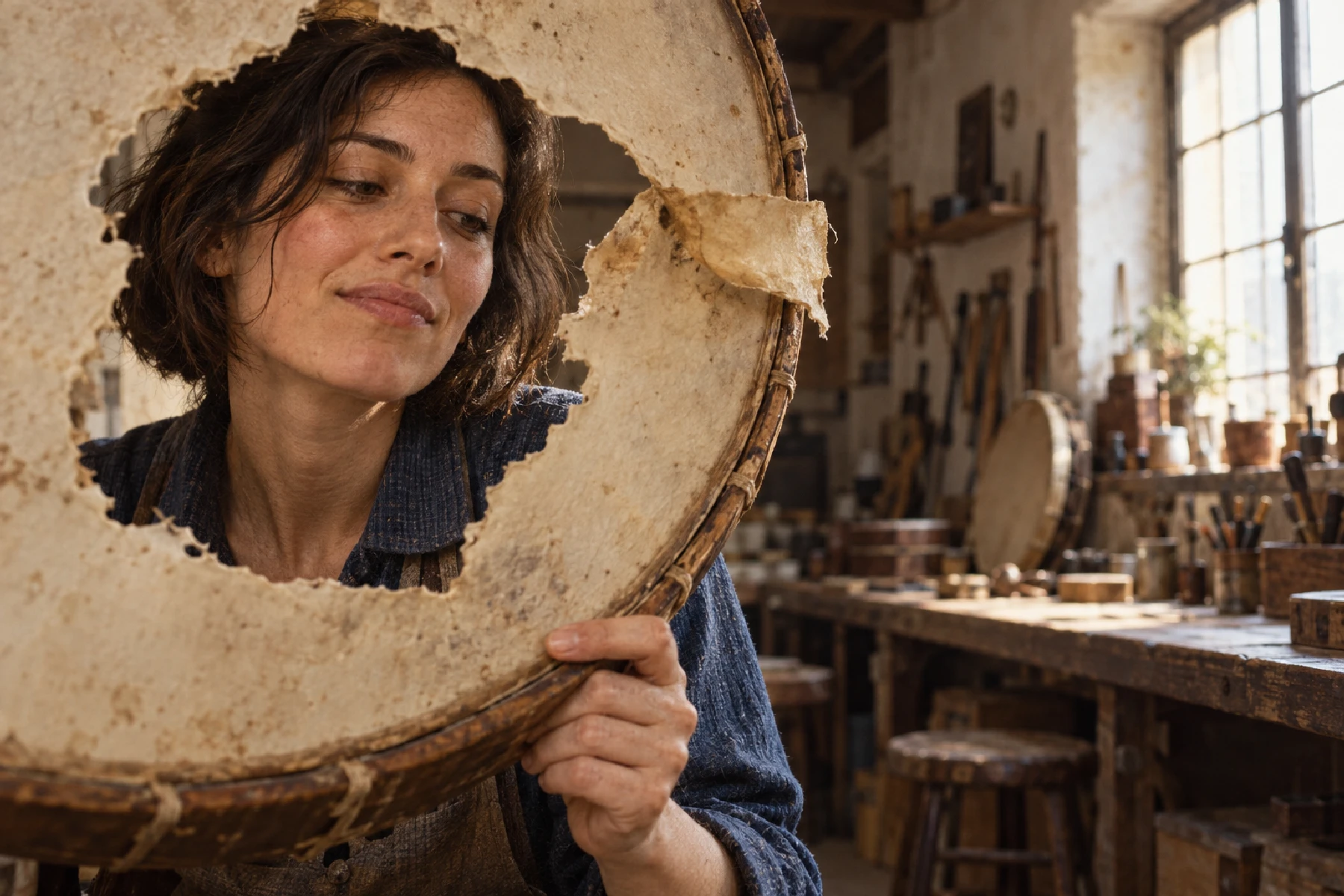
Repairer Behind a Torn Drum
A drum repairer lets a small smile subside behind a torn drumhead. An off-center portrait and a receding workshop gain expressive depth through an analog photographic treatment.
Remix this referenceRepairer Behind a Torn Drum
- Form language
- Use observational photographic forms; let secondary detail simplify naturally through optical depth rather than graphic reduction.
- Contour
- Keep edges optically continuous, with crisp local transitions and gently dissolving peripheral boundaries; add no drawn outline.
- Mark-making
- Fine irregular emulsion grain and faint print mottling vary naturally, remaining subordinate to recognizable detail.
- Surface rendering
- Color-negative print tonality uses rounded highlight shoulders, open shadow detail and slight dye bleed at bright transitions.
Priority
Make analog photographic depth and print character visibly integral to the finished portrait.
What to avoid & what to check
Exact prompt for this example
MODULE OWNERSHIP
subject: Subject count, type, stable proportions and landmarks, resting face geometry, hair shape, physical materials, garment construction and permanent marks. No emotion, movement, color assignment or rendering recipe.
expression: Facial soft-tissue displacement and pupil direction, muscle coordination, regional intensity, asymmetry and onset/peak/release. No head/body pose, stable appearance, skin color or rendering.
gesture: Head/neck/body/limb orientation, joint movement, support, contact and pose-caused occlusion using existing anatomy. No eye/pupil movement, emotion, identity, props inventory or camera.
props: Prop count, type, construction, physical material and scale relative to the subject. Holding/contact belongs to gesture, position to composition, color to palette.
scene: Environment elements, terrain, backdrop/floor presence and structural detail. No canvas positions, camera, lighting, assigned colors or render texture.
camera: Projection, focal-length impression, camera elevation/yaw/roll, viewing distance and crop. No actor pose, world placement, lighting or canvas aspect ratio.
composition: Normalized 0-100% canvas positions, scale in frame, depth/overlap, focal hierarchy and margins. No joint pose, camera projection, rendering, subject/prop inventory or emotion.
palette: Color anchors, hue/saturation/value ranges, colors assigned to parts and approximate color coverage. No illumination direction, shading algorithm, physical material or layout.
lighting: Light-source direction/softness/intensity, ambient illumination, physical shadow direction/length and highlight position. Absence of directional illumination is allowed. No shading technique, palette or material changes.
style: Reusable form abstraction, contour weight/taper/edge quality, medium and mark scale/density/direction, surface rendering and tonal transition technique. No fixed subject proportions, anatomy, identity, expression, pose, palette, light-source direction, camera or layout.
output: Image count, aspect ratio, size, file/alpha requirements and global lettering/logo/watermark restrictions. No background scenery, crop, style, identity or pose.

SUBJECT
inventory: One adult human woman, actor A, a drum repairer.
geometry: An ordinary adult build, broad cheekbones, a narrowing chin and a long neck.
resting-face: Wide-set almond eyes, a straight nose, a defined upper lip and a gently squared jaw.
appearance: A wiry chin-length bob and a woven work shirt with a folded collar and broad cuffs.

PRIORITY


AVOID


CHECK


EXPRESSION — ACTOR A
brows: Brows settle, with one outer end still slightly lifted.
lids: Lower lids retain a gentle upward squeeze.
cheeks: One cheek remains lifted as the other relaxes.
nose: The nose bridge stays smooth; nostrils remain unflared.
mouth: Lips close loosely, retaining a small lift at one corner.
jaw: The jaw settles without clenching.
gaze: Pupils turn toward the nearby torn edge.
coordination: The lifted mouth corner and cheek stay on the same side.
timing: Catch the release just after a private chuckle.

PRIORITY


AVOID


CHECK


GESTURE
head: Her neck extends slightly and her head inclines toward the opening in the drumhead.
torso: Her upper body leans forward with one shoulder leading.
limbs: One visible forearm rises beneath the drum; its fingers curl around the outer rim.
contact: Her hand supports the rim while her face approaches the tear without touching the hide.

PRIORITY


AVOID


CHECK


PROPS
inventory: One large frame drum, broad enough for its torn opening to reveal her face.
construction: A shallow timber hoop carries taut animal hide with one broad, irregular tear and a loose curled flap.

PRIORITY


AVOID


CHECK


SCENE
inventory: A modest instrument workshop with a long workbench, a tall window and a recessed plaster wall.
structure: The workshop has a floor; the workbench follows the wall into an open rear bay.

PRIORITY


AVOID


CHECK


CAMERA
projection: Perspective projection with a short-telephoto portrait-lens impression.
viewpoint: Near eye height, slightly oblique, at conversational distance; focus rests on the face.
crop: Chest-up framing includes the supporting hand and clips the drum's lower outer rim.

PRIORITY


AVOID


CHECK


COMPOSITION
placement: The face occupies the upper-left third; the open right half gives the workshop room to recede, with only a narrow floor strip visible.
depth: The drum surrounds the face and overlaps the shirt; the bench supplies a long secondary depth.
spacing: Keep clear space inside the tear around the eyes and mouth; face first, torn edge second, room last.

PRIORITY


AVOID


CHECK


PALETTE
colors: Tobacco brown, parchment cream, muted indigo and warm rose form a restrained color family.
assignment: Cream belongs to hide and plaster, brown to timber and hair, indigo to the shirt, warm rose to skin.
balance: Broad quiet neutrals carry the image, with the shirt as a restrained dark accent.

PRIORITY


AVOID


CHECK


LIGHTING
sources: Broad soft window light enters from the upper right, supported by weak room bounce.
shadows: Gentle shadows fall leftward; the drum flap casts a small soft shadow onto the hide.
highlights: Restrained highlights follow the right cheek, the nose ridge and the exposed hoop edge.

PRIORITY


AVOID


CHECK


STYLE GUIDE
form-language: Use observational photographic forms; let secondary detail simplify naturally through optical depth rather than graphic reduction.
contour: Keep edges optically continuous, with crisp local transitions and gently dissolving peripheral boundaries; add no drawn outline.
mark-making: Fine irregular emulsion grain and faint print mottling vary naturally, remaining subordinate to recognizable detail.
surface-rendering: Color-negative print tonality uses rounded highlight shoulders, open shadow detail and slight dye bleed at bright transitions.

PRIORITY
Make analog photographic depth and print character visibly integral to the finished portrait.

AVOID


CHECK


OUTPUT
format: One finished image, landscape 3:2, 1800 × 1200 pixels, opaque PNG.
restrictions: No lettering, logos or watermarks.

PRIORITY


AVOID


CHECK


FINAL INTEGRATION
expression + camera + style: Let photographic softness support depth while preserving the small facial changes that carry the moment.
Model information comes from image provenance. The same prompt may produce a different result.