Text to imageArt stylesStyle guide
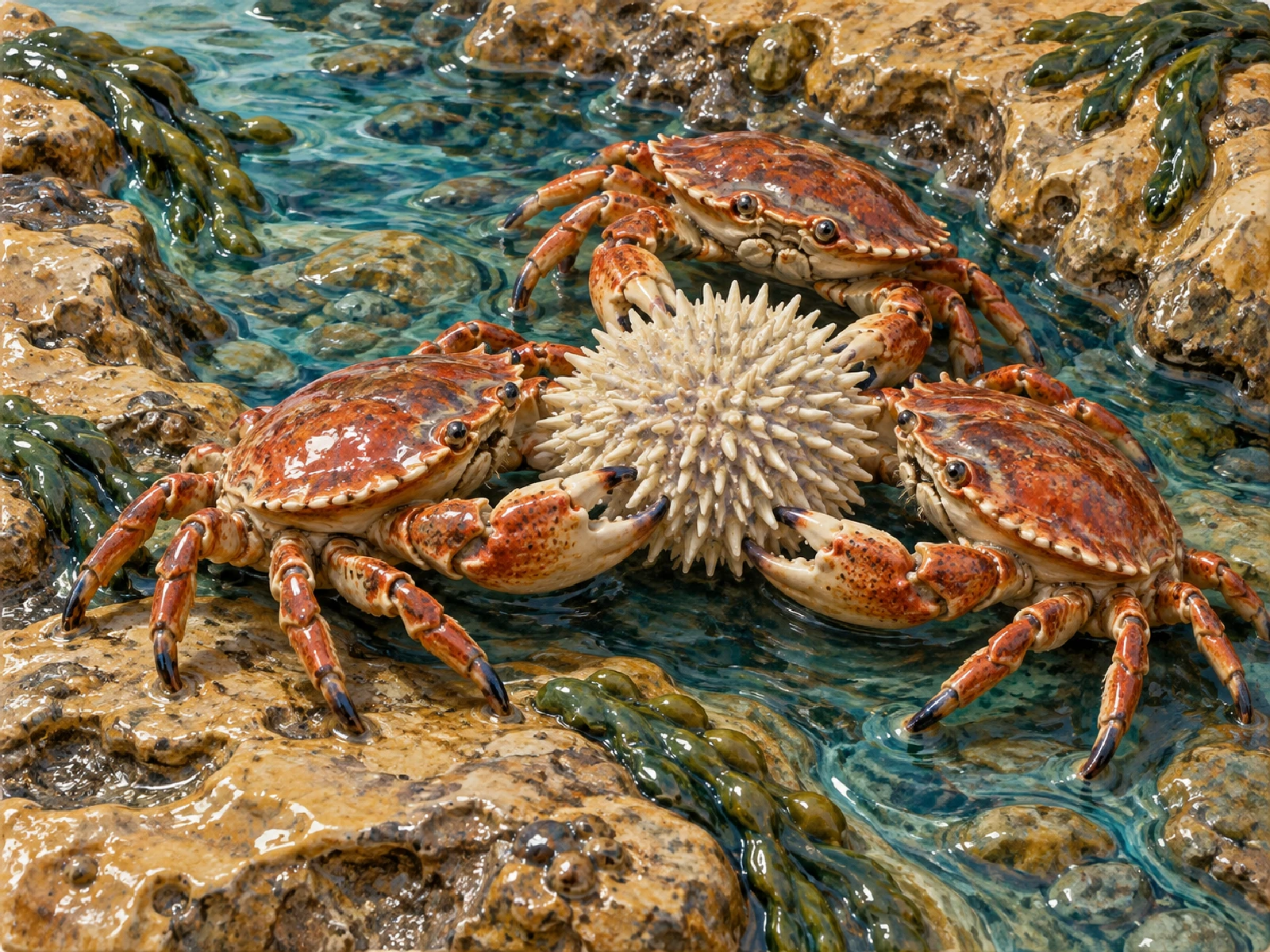
Crabs Carrying an Urchin
Three crabs carry an urchin across a tidal runnel. Rounded relief and glaze gathered in recesses give their small cooperative effort a weighty, playful presence.
Remix this referenceCrabs Carrying an Urchin
- Form language
- Build a continuous ceramic relief from softly modeled raised masses, with recessed channels separating overlapping forms.
- Contour
- Use rounded, slightly wavering relief edges; narrow impressed grooves replace uniform drawn outlines.
- Mark-making
- Leave occasional thumb-smoothed swells and short incised strokes following local surfaces; let spacing vary naturally.
- Surface rendering
- Model glazed surfaces with translucent tonal pooling in recesses, thinner glaze on crests and softly uneven glossy transitions.
Priority
Make modeled relief and pooled glaze integral to one finished ceramic illustration.
What to avoid & what to check
Exact prompt for this example
MODULE OWNERSHIP
subject: Subject count, type, stable proportions and landmarks, resting face geometry, hair shape, physical materials, garment construction and permanent marks. No emotion, movement, color assignment or rendering recipe.
expression: Facial soft-tissue displacement and pupil direction, muscle coordination, regional intensity, asymmetry and onset/peak/release. No head/body pose, stable appearance, skin color or rendering.
gesture: Head/neck/body/limb orientation, joint movement, support, contact and pose-caused occlusion using existing anatomy. No eye/pupil movement, emotion, identity, props inventory or camera.
props: Prop count, type, construction, physical material and scale relative to the subject. Holding/contact belongs to gesture, position to composition, color to palette.
scene: Environment elements, terrain, backdrop/floor presence and structural detail. No canvas positions, camera, lighting, assigned colors or render texture.
camera: Projection, focal-length impression, camera elevation/yaw/roll, viewing distance and crop. No actor pose, world placement, lighting or canvas aspect ratio.
composition: Normalized 0-100% canvas positions, scale in frame, depth/overlap, focal hierarchy and margins. No joint pose, camera projection, rendering, subject/prop inventory or emotion.
palette: Color anchors, hue/saturation/value ranges, colors assigned to parts and approximate color coverage. No illumination direction, shading algorithm, physical material or layout.
lighting: Light-source direction/softness/intensity, ambient illumination, physical shadow direction/length and highlight position. Absence of directional illumination is allowed. No shading technique, palette or material changes.
style: Reusable form abstraction, contour weight/taper/edge quality, medium and mark scale/density/direction, surface rendering and tonal transition technique. No fixed subject proportions, anatomy, identity, expression, pose, palette, light-source direction, camera or layout.
output: Image count, aspect ratio, size, file/alpha requirements and global lettering/logo/watermark restrictions. No background scenery, crop, style, identity or pose.

SUBJECT
inventory: Three shore crabs, actors A, B and C, and one sea urchin; no other creatures.
geometry: Crabs have broad shallow carapaces and slender jointed legs; the urchin has a rounded test with short radial spines.
resting-face: Crabs have small stalked compound eyes and tucked mouthparts, without eyebrows, eyelids, soft cheeks, noses or readable pupils; the urchin has no readable face.
appearance: Retain hard shell plates and subtle natural shell irregularities; no garments.

PRIORITY


AVOID


CHECK


EXPRESSION — ACTOR A
brows: No brow action applies.
lids: No lid action applies.
cheeks: No cheek displacement applies.
nose: No nasal action applies.
mouth: Keep mouthparts still, without spreading or clenching.
jaw: No separately readable jaw movement.
gaze: Leave pupil direction unprescribed.
coordination: Maintain neutral rest without humanlike soft-tissue acting.
timing: Hold neutral rest throughout the captured moment.

PRIORITY


AVOID


CHECK


EXPRESSION — ACTOR B
brows: No brow action applies.
lids: No lid action applies.
cheeks: No cheek displacement applies.
nose: No nasal action applies.
mouth: Keep mouthparts still, without spreading or clenching.
jaw: No separately readable jaw movement.
gaze: Leave pupil direction unprescribed.
coordination: Maintain neutral rest without humanlike soft-tissue acting.
timing: Hold neutral rest throughout the captured moment.

PRIORITY


AVOID


CHECK


EXPRESSION — ACTOR C
brows: No brow action applies.
lids: No lid action applies.
cheeks: No cheek displacement applies.
nose: No nasal action applies.
mouth: Keep mouthparts still, without spreading or clenching.
jaw: No separately readable jaw movement.
gaze: Leave pupil direction unprescribed.
coordination: Maintain neutral rest without humanlike soft-tissue acting.
timing: Hold neutral rest throughout the captured moment.

PRIORITY


AVOID


CHECK


GESTURE
head: No separate head or neck articulation is emphasized.
torso: A braces on the near bank while B and C cant their shells into the crossing.
limbs: Their walking legs spread at uneven strides; raised claws converge beneath the urchin.
contact: Broad claw surfaces jointly cradle the urchin's underside; planted feet visibly meet rock.

PRIORITY


AVOID


CHECK


PROPS
inventory: No separate props or accessories.
construction: No prop construction applies.

PRIORITY


AVOID


CHECK


SCENE
inventory: A shallow tidal runnel cuts between low rock shelves, with a few attached seaweed fronds.
structure: Worn ledges step into the water; small hollows and submerged stone continue the coastal terrain.

PRIORITY


AVOID


CHECK


CAMERA
projection: Near-orthographic projection with little size diminution.
viewpoint: An elevated oblique view reveals shell tops, supporting claws and the runnel bed.
crop: A close environmental view includes all three crabs while cutting through the outer rock shelves.

PRIORITY


AVOID


CHECK


COMPOSITION
placement: The carrying knot gathers just right of center and below mid-height; the runnel opens toward the upper left.
depth: The crabs gather around the urchin, which overlaps converging claws with staggered shells behind; its compact silhouette leads the hierarchy.
spacing: Keep open water above the dense cluster and small gaps between leg groups so the crossing stays legible.

PRIORITY


AVOID


CHECK


PALETTE
colors: Use petrol teal, burnt coral, warm ivory and muted ochre, with restrained saturation.
assignment: Teal belongs to water and seaweed, coral to crabs, ivory to the urchin and ochre to rock.
balance: Teal and ochre form the broad color fields; coral provides concentrated accents, with ivory used sparingly.

PRIORITY


AVOID


CHECK


LIGHTING
sources: Broad soft light arrives from the upper left, supported by gentle ambient illumination.
shadows: Short shadows fall toward the lower right, deepening beneath the lifted urchin and overlapping claws.
highlights: Broad highlights rest on upper-left-facing shell ridges and spine tips.

PRIORITY


AVOID


CHECK


STYLE GUIDE
form-language: Build a continuous ceramic relief from softly modeled raised masses, with recessed channels separating overlapping forms.
contour: Use rounded, slightly wavering relief edges; narrow impressed grooves replace uniform drawn outlines.
mark-making: Leave occasional thumb-smoothed swells and short incised strokes following local surfaces; let spacing vary naturally.
surface-rendering: Model glazed surfaces with translucent tonal pooling in recesses, thinner glaze on crests and softly uneven glossy transitions.

PRIORITY
Make modeled relief and pooled glaze integral to one finished ceramic illustration.

AVOID


CHECK


OUTPUT
format: One opaque PNG image, 1600 × 1200 pixels, with a 4:3 aspect ratio.
restrictions: No lettering, logos or watermarks.

PRIORITY


AVOID


CHECK


FINAL INTEGRATION
gesture + composition: The overlapping arrangement keeps the shared support readable.
style + lighting: Illumination reveals the relief while the surface treatment carries the ceramic character.
expression + gesture: Neutral facial rest continues through the captured apex of the shared carrying action.
Model information comes from image provenance. The same prompt may produce a different result.