Text to imageComicsStyle guide
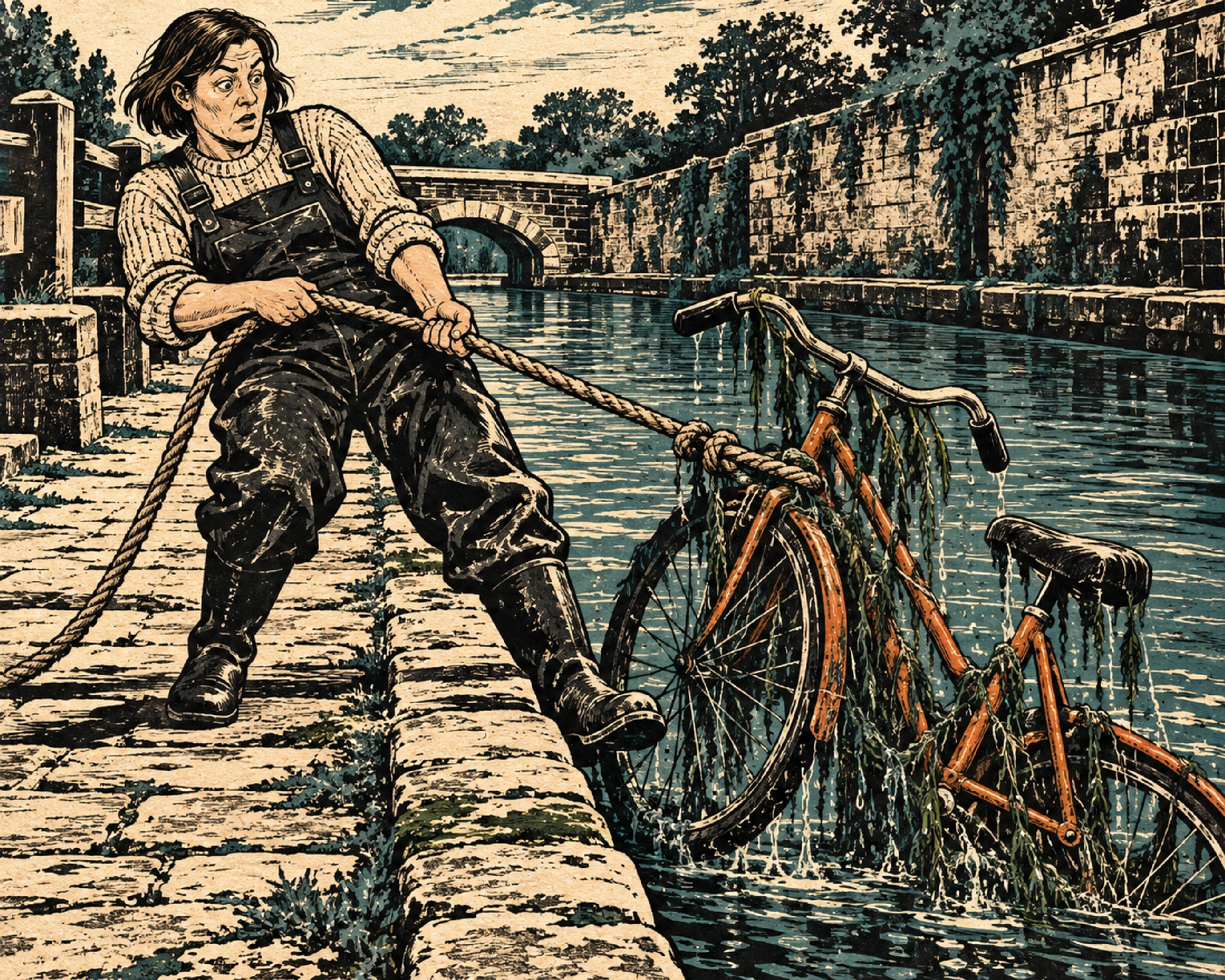
Hauling a Bicycle from the Canal
A canal keeper pulls a rope, revealing a bicycle tangled in riverweed. Rough woodcut gouges and weighty ink masses turn the unexpected discovery into one expressive comic illustration.
Remix this referenceHauling a Bicycle from the Canal
- Form language
- Translate volumes into interlocking cut planes and blunt wedges; preserve irregular, hand-shaped simplification.
- Contour
- Use weighty, slightly chipped contours that swell into solid masses and break into short knife-cut gaps.
- Mark-making
- Carve long curved gouges against clustered short cuts; vary their rhythm naturally instead of applying uniform hatching.
- Surface rendering
- Build tone through retained ink masses and exposed paper cuts, with uneven ink bite and occasional soft-edged overprinting.
Priority
Rendering medium: woodcut graphic-novel illustration with hand-carved relief-print character.
What to avoid & what to check
Exact prompt for this example
MODULE OWNERSHIP
subject: Subject count, type, stable proportions and landmarks, resting face geometry, hair shape, physical materials, garment construction and permanent marks. No emotion, movement, color assignment or rendering recipe.
expression: Facial soft-tissue displacement and pupil direction, muscle coordination, regional intensity, asymmetry and onset/peak/release. No head/body pose, stable appearance, skin color or rendering.
gesture: Head/neck/body/limb orientation, joint movement, support, contact and pose-caused occlusion using existing anatomy. No eye/pupil movement, emotion, identity, props inventory or camera.
props: Prop count, type, construction, physical material and scale relative to the subject. Holding/contact belongs to gesture, position to composition, color to palette.
scene: Environment elements, terrain, backdrop/floor presence and structural detail. No canvas positions, camera, lighting, assigned colors or render texture.
camera: Projection, focal-length impression, camera elevation/yaw/roll, viewing distance and crop. No actor pose, world placement, lighting or canvas aspect ratio.
composition: Normalized 0-100% canvas positions, scale in frame, depth/overlap, focal hierarchy and margins. No joint pose, camera projection, rendering, subject/prop inventory or emotion.
palette: Color anchors, hue/saturation/value ranges, colors assigned to parts and approximate color coverage. No illumination direction, shading algorithm, physical material or layout.
lighting: Light-source direction/softness/intensity, ambient illumination, physical shadow direction/length and highlight position. Absence of directional illumination is allowed. No shading technique, palette or material changes.
style: Reusable form abstraction, contour weight/taper/edge quality, medium and mark scale/density/direction, surface rendering and tonal transition technique. No fixed subject proportions, anatomy, identity, expression, pose, palette, light-source direction, camera or layout.
output: Image count, aspect ratio, size, file/alpha requirements and global lettering/logo/watermark restrictions. No background scenery, crop, style, identity or pose.

SUBJECT
inventory: A is one adult woman working as a canal keeper; no other people appear.
geometry: A has a sturdy, compact build, broad hands and a square jaw; keep the proportions recognizably adult.
resting-face: Her resting features have straight brows, deep-set eyes, a wedge-shaped nose and a broad, thin-lipped mouth.
appearance: Ear-length blunt hair, waterproof bib overalls over a knitted pullover, and rubber work boots define her appearance.

PRIORITY


AVOID


CHECK


EXPRESSION — ACTOR A
brows: Both brows rise, with the nearer brow slightly higher.
lids: Upper lids lift distinctly while lower lids remain lightly taut.
cheeks: Cheeks tighten subtly without lifting into a smile.
nose: The nose stays relaxed, without wrinkling or pronounced nostril flare.
mouth: Lips part into a small uneven opening, one corner held slightly tighter.
jaw: The jaw releases slightly, keeping the mouth opening modest.
gaze: Both pupils point down toward the emerging bicycle handlebar.
coordination: Raised brows and open lids carry the surprise; the restrained mouth preserves a moment of disbelief.
timing: Capture the apex of recognition, just as the unexpected object becomes identifiable.

PRIORITY


AVOID


CHECK


GESTURE
head: A turns her head toward the bicycle and lowers her chin slightly, leaving her face unobstructed.
torso: Her torso leans back from the canal, shoulders drawn rearward against the pull.
limbs: One boot braces on the low coping, the other plants behind; bent arms draw the rope toward her waist.
contact: Both hands grip the taut rope, which loops around the bicycle frame and supports its emerging weight.

PRIORITY


AVOID


CHECK


PROPS
inventory: One adult-size step-through bicycle and one continuous hauling rope are the only separate props.
construction: The bicycle has a steel frame, spoked wheels and curved handlebars; the thick rope is twisted plant fiber.

PRIORITY


AVOID


CHECK


SCENE
inventory: A narrow working canal has a stone towpath, low coping, rippling water and long strands of riverweed.
structure: Old masonry walls enclose the channel; riverweed drapes the bicycle and water streams back into the canal.

PRIORITY


AVOID


CHECK


CAMERA
projection: Use natural perspective with a normal-lens impression and no conspicuous wide-angle stretching.
viewpoint: Look obliquely along the canal from slightly above standing eye level, with a level horizon.
crop: A medium-wide view includes the keeper's whole figure and most of the bicycle; the nearest wheel may cross the edge.

PRIORITY


AVOID


CHECK


COMPOSITION
placement: Place A's face near 30% width and 30% height; the bicycle cuts diagonally through the lower-right area.
depth: Overlap wheel, weed, water and canal edge in successive layers, while keeping the face and gripping hands distinct.
spacing: The face leads to the hands and revealed frame; leave spacious water beyond the bicycle to release the dense overlaps.

PRIORITY


AVOID
No speech balloons or panel borders.

CHECK


PALETTE
colors: Use soot black, warm paper cream, muted canal teal and a restrained rusty orange.
assignment: Black anchors hair and overalls; cream carries skin and masonry; teal belongs to water and weed, orange to the bicycle.
balance: Cream and black dominate, teal forms a broad secondary field, and orange stays a small assertive accent.

PRIORITY


AVOID


CHECK


LIGHTING
sources: Broad daylight enters from upper left, supported by soft open-sky ambient light.
shadows: Moderately soft shadows fall toward lower right, with deeper shade beneath the coping and overhanging frame.
highlights: Light catches the upper-left edges of wet tubing, knuckles and the disturbed water.

PRIORITY


AVOID


CHECK


STYLE GUIDE
form-language: Translate volumes into interlocking cut planes and blunt wedges; preserve irregular, hand-shaped simplification.
contour: Use weighty, slightly chipped contours that swell into solid masses and break into short knife-cut gaps.
mark-making: Carve long curved gouges against clustered short cuts; vary their rhythm naturally instead of applying uniform hatching.
surface-rendering: Build tone through retained ink masses and exposed paper cuts, with uneven ink bite and occasional soft-edged overprinting.

PRIORITY
Rendering medium: woodcut graphic-novel illustration with hand-carved relief-print character.

AVOID


CHECK


OUTPUT
format: One finished image, landscape 5:4 aspect ratio, 2500 × 2000 pixels, opaque PNG.
restrictions: No lettering, logos or watermarks.

PRIORITY


AVOID


CHECK
Model information comes from image provenance. The same prompt may produce a different result.