Text to imageSpace & architectureStyle guide
Opening the Courtyard Kitchen Roof
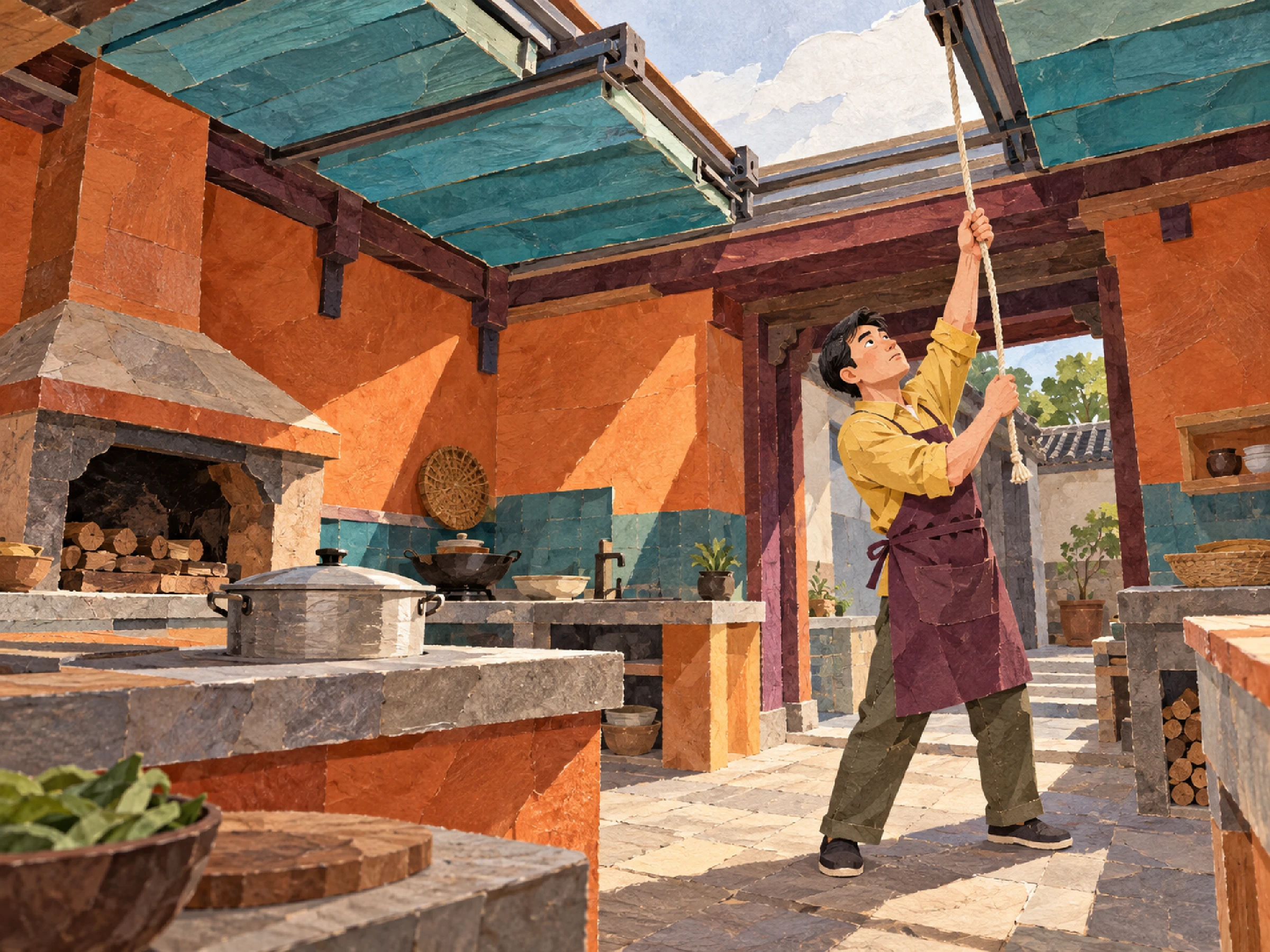
A communal courtyard kitchen as a cook pulls its roof open. Overlapping roof panels, counters and a reaching figure turn tactile paper collage into a lively moment of spatial transformation.
Remix this referenceOpening the Courtyard Kitchen Roof
- Form language
- Translate forms into interlocking cut-paper planes with slightly skewed corners; allow small variations within the same handmade logic.
- Contour
- Use exposed cut edges instead of drawn outlines, mixing clean scissor turns with occasional softly torn stretches.
- Mark-making
- Leave sparse rubbed-pencil strokes and uneven brush swipes on the paper pieces; vary direction and density naturally.
- Surface rendering
- Build tactile layers with visible paper thickness and slight edge lift; use rubbed tonal patches rather than smoothly modeled volumes.
Priority
Make layered cut-paper collage and tactile overlaps unmistakable.
What to avoid & what to check
Exact prompt for this example
MODULE OWNERSHIP
subject: Subject count, type, stable proportions and landmarks, resting face geometry, hair shape, physical materials, garment construction and permanent marks. No emotion, movement, color assignment or rendering recipe.
expression: Facial soft-tissue displacement and pupil direction, muscle coordination, regional intensity, asymmetry and onset/peak/release. No head/body pose, stable appearance, skin color or rendering.
gesture: Head/neck/body/limb orientation, joint movement, support, contact and pose-caused occlusion using existing anatomy. No eye/pupil movement, emotion, identity, props inventory or camera.
props: Prop count, type, construction, physical material and scale relative to the subject. Holding/contact belongs to gesture, position to composition, color to palette.
scene: Environment elements, terrain, backdrop/floor presence and structural detail. No canvas positions, camera, lighting, assigned colors or render texture.
camera: Projection, focal-length impression, camera elevation/yaw/roll, viewing distance and crop. No actor pose, world placement, lighting or canvas aspect ratio.
composition: Normalized 0-100% canvas positions, scale in frame, depth/overlap, focal hierarchy and margins. No joint pose, camera projection, rendering, subject/prop inventory or emotion.
palette: Color anchors, hue/saturation/value ranges, colors assigned to parts and approximate color coverage. No illumination direction, shading algorithm, physical material or layout.
lighting: Light-source direction/softness/intensity, ambient illumination, physical shadow direction/length and highlight position. Absence of directional illumination is allowed. No shading technique, palette or material changes.
style: Reusable form abstraction, contour weight/taper/edge quality, medium and mark scale/density/direction, surface rendering and tonal transition technique. No fixed subject proportions, anatomy, identity, expression, pose, palette, light-source direction, camera or layout.
output: Image count, aspect ratio, size, file/alpha requirements and global lettering/logo/watermark restrictions. No background scenery, crop, style, identity or pose.

SUBJECT
inventory: A is one adult cook; no other people or animals.
geometry: A has an ordinary adult build, a compact head silhouette and short, softly irregular hair.
resting-face: A has an oval face, straight brows, a short straight nose and a softly squared jaw.
appearance: A wears a cotton overshirt, a plain waist apron, straight trousers and low slip-on shoes.

PRIORITY


AVOID


CHECK


EXPRESSION — ACTOR A
brows: Inner brow ends draw slightly inward and down.
lids: Upper lids narrow slightly without squeezing shut.
cheeks: Cheeks remain relaxed, without a smile lift.
nose: Nostrils remain relaxed, with no nose wrinkle.
mouth: Closed lips press lightly together, with level corners.
jaw: The jaw firms gently without clenching.
gaze: Direct the pupils upward toward the roof panel.
coordination: Brow tension leads; restrained mouth tension supports the same focused effort.
timing: Hold the apex of concentration.

PRIORITY


AVOID


CHECK


GESTURE
head: A raises the chin toward the roof opening, keeping the face turned three-quarter toward the viewer.
torso: A lengthens one side of the torso and leans slightly back over a stable standing base.
limbs: One arm reaches high and the other bends near the chest; staggered feet support the pull.
contact: Both hands grip successive sections of the pull cord; both soles remain supported by the floor.

PRIORITY


AVOID


CHECK


PROPS
inventory: One roof pull cord and one lidded stockpot are the only separate props.
construction: The braided cord has a knotted grip; the metal stockpot is torso-wide with a shallow domed lid.

PRIORITY


AVOID


CHECK


SCENE
inventory: A communal courtyard kitchen contains built-in cooking counters, a masonry hearth and a retractable roof.
structure: Stepped counter bays surround a tiled court; partly retracted roof panels slide open and overlap on exposed rails above a deep doorway.

PRIORITY


AVOID


CHECK


CAMERA
projection: Use broad architectural perspective with a wide lens impression and restrained convergence.
viewpoint: View diagonally across the kitchen from a slightly raised three-quarter side viewpoint, without roll.
crop: Include A's full figure and the roof opening; let the nearest counter continue beyond the frame.

PRIORITY


AVOID


CHECK


COMPOSITION
placement: Place A in the right third beneath the opening; counter bands sweep across the lower third.
depth: Roof panels overlap above the doorway; the cord crosses the opening and a counter lip partly hides the pot.
spacing: Lead with the roof panels, then A; leave clear gaps around the face and hand amid denser overlaps.

PRIORITY


AVOID


CHECK


PALETTE
colors: Use burnt orange, dusty turquoise, butter yellow and deep plum with a small pale gray interval.
assignment: Use orange masonry, turquoise roof panels, a yellow overshirt, plum apron, warm ochre skin and a pale gray opening.
balance: Warm architectural colors dominate, balanced by cooler roof colors and a concentrated yellow clothing accent.

PRIORITY


AVOID


CHECK


LIGHTING
sources: Soft daylight enters through the roof opening from the upper right, supported by diffuse courtyard bounce.
shadows: Roof panels cast broad shadows down and left; counter recesses retain gentle ambient darkness.
highlights: Upper-right rail edges and the pot lid receive modest highlights without dramatic glare.

PRIORITY


AVOID


CHECK


STYLE GUIDE
form-language: Translate forms into interlocking cut-paper planes with slightly skewed corners; allow small variations within the same handmade logic.
contour: Use exposed cut edges instead of drawn outlines, mixing clean scissor turns with occasional softly torn stretches.
mark-making: Leave sparse rubbed-pencil strokes and uneven brush swipes on the paper pieces; vary direction and density naturally.
surface-rendering: Build tactile layers with visible paper thickness and slight edge lift; use rubbed tonal patches rather than smoothly modeled volumes.

PRIORITY
Make layered cut-paper collage and tactile overlaps unmistakable.

AVOID


CHECK


OUTPUT
format: One finished landscape image, 4:3 aspect ratio, 2400 × 1800 pixels, opaque PNG.
restrictions: No lettering, logos or watermarks.

PRIORITY


AVOID


CHECK


FINAL INTEGRATION
gesture + composition: Keep the pulling action legible within the architectural sequence so it explains the changing space.
expression + camera: Keep the facial performance readable within the environmental view.
lighting + style: Keep depicted illumination coherent across the assembled paper layers.
expression + gesture + scene: Synchronize the facial apex with A's sustained cord pull and the roof panels sliding open.
Model information comes from image provenance. The same prompt may produce a different result.