Text to imageProductStyle guide
Pomegranate Door Knocker
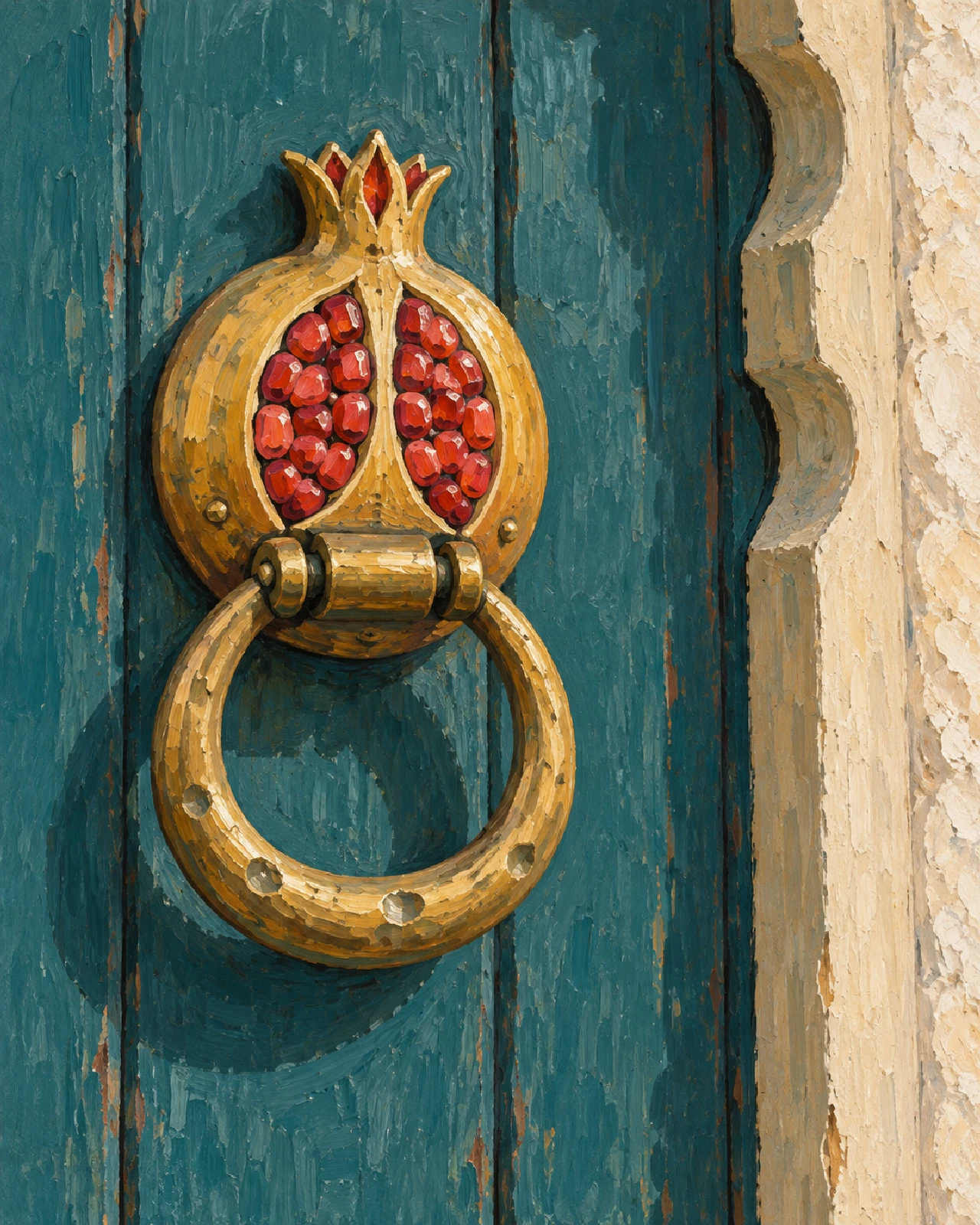
An intimate folk-painted product portrait of a brass door knocker shaped like an open pomegranate. Uneven ornament and loaded brushwork enliven the small entrance.
Remix this referencePomegranate Door Knocker
- Form language
- Simplify volumes into rounded emblems and nested shapes; let decorative repetition vary by hand.
- Contour
- Draw wavering brush contours with rounded joins; let occasional edges overrun or stop short of neighboring shapes.
- Mark-making
- Lay opaque paint in short loaded strokes; use irregular dabs and looping accents instead of mechanical ornament.
- Surface rendering
- Model with broad stepped patches softened by brush drag; let underpaint and bristle ridges interrupt the surface.
Priority
Naive folk painting with lively decorative simplification and visible hand variation.
What to avoid & what to check
Exact prompt for this example
MODULE OWNERSHIP
subject: Subject count, type, stable proportions and landmarks, resting face geometry, hair shape, physical materials, garment construction and permanent marks. No emotion, movement, color assignment or rendering recipe.
expression: Facial soft-tissue displacement and pupil direction, muscle coordination, regional intensity, asymmetry and onset/peak/release. No head/body pose, stable appearance, skin color or rendering.
gesture: Head/neck/body/limb orientation, joint movement, support, contact and pose-caused occlusion using existing anatomy. No eye/pupil movement, emotion, identity, props inventory or camera.
props: Prop count, type, construction, physical material and scale relative to the subject. Holding/contact belongs to gesture, position to composition, color to palette.
scene: Environment elements, terrain, backdrop/floor presence and structural detail. No canvas positions, camera, lighting, assigned colors or render texture.
camera: Projection, focal-length impression, camera elevation/yaw/roll, viewing distance and crop. No actor pose, world placement, lighting or canvas aspect ratio.
composition: Normalized 0-100% canvas positions, scale in frame, depth/overlap, focal hierarchy and margins. No joint pose, camera projection, rendering, subject/prop inventory or emotion.
palette: Color anchors, hue/saturation/value ranges, colors assigned to parts and approximate color coverage. No illumination direction, shading algorithm, physical material or layout.
lighting: Light-source direction/softness/intensity, ambient illumination, physical shadow direction/length and highlight position. Absence of directional illumination is allowed. No shading technique, palette or material changes.
style: Reusable form abstraction, contour weight/taper/edge quality, medium and mark scale/density/direction, surface rendering and tonal transition technique. No fixed subject proportions, anatomy, identity, expression, pose, palette, light-source direction, camera or layout.
output: Image count, aspect ratio, size, file/alpha requirements and global lettering/logo/watermark restrictions. No background scenery, crop, style, identity or pose.

SUBJECT
inventory: One original pomegranate-shaped door knocker.
geometry: A palm-sized fruit backplate has rounded shoulders, a small crown and open seed chambers above a broad oval striking ring.
resting-face: No face or facial landmarks.
appearance: Cast brass with enamel-filled seed recesses; a visible hinge joins the ring to the backplate, with shallow dents along its lower arc.

PRIORITY


AVOID


CHECK


PROPS
inventory: No separate props.
construction: No prop construction applies.

PRIORITY


AVOID


CHECK


SCENE
inventory: A cottage entrance comprising a plank door, a scalloped wooden jamb and a small area of plaster wall; no floor is visible.
structure: The knocker is mounted on vertical door boards; a shallow wall niche surrounds the jamb.

PRIORITY


AVOID


CHECK


CAMERA
projection: Gently flattened perspective with a short telephoto impression.
viewpoint: View at knocker height with slight yaw from the right and no roll.
crop: Close product detail containing the complete knocker and cropped portions of the entrance.

PRIORITY


AVOID


CHECK


COMPOSITION
placement: Set the knocker near 40% of the canvas width, large enough for the seed chambers to lead attention.
depth: The ring overlaps the fruit backplate; the door forms a shallow middle plane and the jamb establishes a second depth.
spacing: Leave more room below the ring than above the crown; crop the jamb boldly at the right edge.

PRIORITY


AVOID


CHECK


PALETTE
colors: Mustard gold, coral red, deep teal and warm chalk, with modest saturation outside the coral.
assignment: Gold belongs to the knocker, coral to its enamel seeds, teal to the door and warm chalk to the jamb and wall.
balance: Teal occupies the broad field; gold carries the product, coral provides small accents and chalk gives relief.

PRIORITY


AVOID


CHECK


LIGHTING
sources: Soft daylight arrives from the upper right, with ample diffuse ambient illumination.
shadows: Short, soft shadows fall down and left beneath the ring, crown and projecting jamb.
highlights: Broad highlights rest on the upper-right shoulders and ring rim; seed recesses remain subdued.

PRIORITY


AVOID


CHECK


STYLE GUIDE
form-language: Simplify volumes into rounded emblems and nested shapes; let decorative repetition vary by hand.
contour: Draw wavering brush contours with rounded joins; let occasional edges overrun or stop short of neighboring shapes.
mark-making: Lay opaque paint in short loaded strokes; use irregular dabs and looping accents instead of mechanical ornament.
surface-rendering: Model with broad stepped patches softened by brush drag; let underpaint and bristle ridges interrupt the surface.

PRIORITY
Naive folk painting with lively decorative simplification and visible hand variation.

AVOID


CHECK


OUTPUT
format: One image, portrait 4:5, 1280 × 1600 pixels, opaque PNG.
restrictions: No lettering, logos or watermarks.

PRIORITY


AVOID


CHECK


FINAL INTEGRATION
subject + style + lighting: Keep the hardware construction understandable while translating its volume through the folk-painted treatment.
Model information comes from image provenance. The same prompt may produce a different result.