Text to imageIllustrationStyle guide
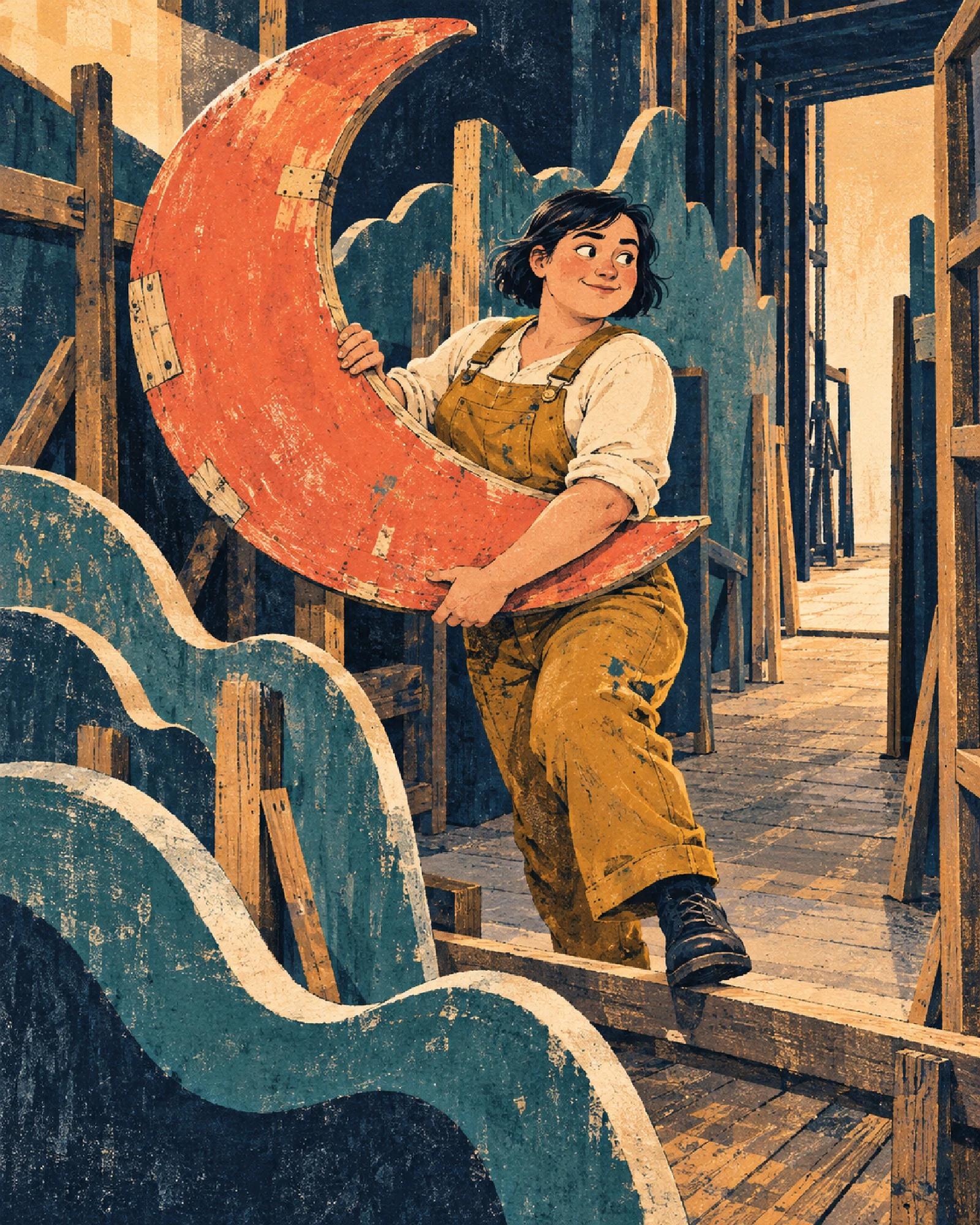
Stagehand Carrying the Moon Through Painted Waves
A stagehand squeezes between wave scenery flats with a crescent moon under her arm. Rough brushwork and slipped print layers turn backstage bustle into an experimental poster illustration.
Remix this referenceStagehand Carrying the Moon Through Painted Waves
- Form language
- Reduce forms to bold, slightly lopsided cut shapes; alternate broad masses with narrow notches and permit incidental shapes to vary.
- Contour
- Use blunt, pressure-changing ink contours that break at dry edges and occasionally merge into solid silhouettes.
- Mark-making
- Combine fast bristle sweeps with rough roller drag; let occasional scratched reversals interrupt the broader printed marks.
- Surface rendering
- Build tone through translucent overprinting and coarse broken halftones, with small registration slips and irregular ink pickup.
Priority
Make the meeting of gestural ink and imperfect print visibly define the illustration.
What to avoid & what to check
Exact prompt for this example
MODULE OWNERSHIP
subject: Subject count, type, stable proportions and landmarks, resting face geometry, hair shape, physical materials, garment construction and permanent marks. No emotion, movement, color assignment or rendering recipe.
expression: Facial soft-tissue displacement and pupil direction, muscle coordination, regional intensity, asymmetry and onset/peak/release. No head/body pose, stable appearance, skin color or rendering.
gesture: Head/neck/body/limb orientation, joint movement, support, contact and pose-caused occlusion using existing anatomy. No eye/pupil movement, emotion, identity, props inventory or camera.
props: Prop count, type, construction, physical material and scale relative to the subject. Holding/contact belongs to gesture, position to composition, color to palette.
scene: Environment elements, terrain, backdrop/floor presence and structural detail. No canvas positions, camera, lighting, assigned colors or render texture.
camera: Projection, focal-length impression, camera elevation/yaw/roll, viewing distance and crop. No actor pose, world placement, lighting or canvas aspect ratio.
composition: Normalized 0-100% canvas positions, scale in frame, depth/overlap, focal hierarchy and margins. No joint pose, camera projection, rendering, subject/prop inventory or emotion.
palette: Color anchors, hue/saturation/value ranges, colors assigned to parts and approximate color coverage. No illumination direction, shading algorithm, physical material or layout.
lighting: Light-source direction/softness/intensity, ambient illumination, physical shadow direction/length and highlight position. Absence of directional illumination is allowed. No shading technique, palette or material changes.
style: Reusable form abstraction, contour weight/taper/edge quality, medium and mark scale/density/direction, surface rendering and tonal transition technique. No fixed subject proportions, anatomy, identity, expression, pose, palette, light-source direction, camera or layout.
output: Image count, aspect ratio, size, file/alpha requirements and global lettering/logo/watermark restrictions. No background scenery, crop, style, identity or pose.

SUBJECT
inventory: One adult woman stagehand, actor A.
geometry: Compact, sturdy build with broad shoulders, substantial hands and a rounded chin.
resting-face: Wide-set eyes, level brows, a short triangular nose and a broad mouth with a level resting line.
appearance: Short blunt hair tucked behind the ears; cotton bib overalls over a collarless shirt, with plain work shoes.

PRIORITY


AVOID


CHECK


EXPRESSION — ACTOR A
brows: One brow rises slightly while the other stays nearly level.
lids: Lower lids lift gently; upper lids remain comfortably open.
cheeks: A small cheek lift is stronger on the smiling side.
nose: Nostrils and nose bridge remain relaxed.
mouth: One closed lip corner curls upward into an emerging crooked smile.
jaw: Jaw stays loose with the lips together.
gaze: Pupils look toward the clear passage beyond the crescent.
coordination: The uneven smile and mild lid lift work together without a nose wrinkle.
timing: Catch the first instant of the smile, before the mouth opens.

PRIORITY


AVOID


CHECK


GESTURE
head: Her neck extends slightly and her head inclines toward the passage, leaving the face visible.
torso: Her torso twists sideways with a slight forward lean.
limbs: Bent elbows cradle the crescent; she stands on one supporting foot while the other lifts over a scenery edge.
contact: One forearm supports the crescent's lower curve; the other hand grips its inner rim against her ribs.

PRIORITY


AVOID


CHECK


PROPS
inventory: One theatrical crescent moon, roughly as tall as the stagehand's torso.
construction: A broad plywood crescent with blunt tips, a shallow edge and a few old repairs.

PRIORITY


AVOID


CHECK


SCENE
inventory: A backstage passage with wave-shaped scenery flats, exposed floorboards and an open wing entrance.
structure: Freestanding timber flats have scalloped crests and visible bracing, with a narrow gap and a low scenery edge; the wing entrance has a plain rectangular frame.

PRIORITY


AVOID


CHECK


CAMERA
projection: Moderately wide perspective with a natural lens impression and restrained convergence.
viewpoint: Look into the passage from a three-quarter angle, slightly above the stagehand's eye level, with no roll.
crop: Use a full-figure view that includes both shoes and the complete crescent.

PRIORITY


AVOID


CHECK


COMPOSITION
placement: A is placed around 60% across the canvas; the crescent reaches into the upper-left area and waves sweep across the base.
depth: Foreground wave crests overlap the lower figure; staggered flats lead back to the opening.
spacing: The crescent leads, the face answers in a clear gap, and generous upper-right space balances the crowded lower half.

PRIORITY


AVOID


CHECK


PALETTE
colors: Soot navy, burnt coral, muted teal and warm ochre against pale cream; keep saturation earthy.
assignment: Coral crescent, teal waves, ochre overalls, cream shirt and skin; navy hair, recesses and structural accents.
balance: Cream and teal occupy broad areas; coral is the strongest chromatic accent, with navy used sparingly.

PRIORITY


AVOID


CHECK


LIGHTING
sources: Broad, soft work light enters from the upper left with enough ambient fill to reveal the passage.
shadows: Short, soft-edged shadows fall toward the rear right, with deeper shade between the flats.
highlights: Keep subdued highlights on the crescent's upper-left rim and the upper planes of the hands.

PRIORITY


AVOID


CHECK


STYLE GUIDE
form-language: Reduce forms to bold, slightly lopsided cut shapes; alternate broad masses with narrow notches and permit incidental shapes to vary.
contour: Use blunt, pressure-changing ink contours that break at dry edges and occasionally merge into solid silhouettes.
mark-making: Combine fast bristle sweeps with rough roller drag; let occasional scratched reversals interrupt the broader printed marks.
surface-rendering: Build tone through translucent overprinting and coarse broken halftones, with small registration slips and irregular ink pickup.

PRIORITY
Make the meeting of gestural ink and imperfect print visibly define the illustration.

AVOID


CHECK


OUTPUT
format: One finished illustration, portrait 4:5, 1600 × 2000 pixels, opaque PNG.
restrictions: No lettering, logos, signatures or watermarks.

PRIORITY


AVOID


CHECK
Model information comes from image provenance. The same prompt may produce a different result.