Text to imageIllustrationStyle guide
A Gardener Sweeping Snow from the Glasshouse
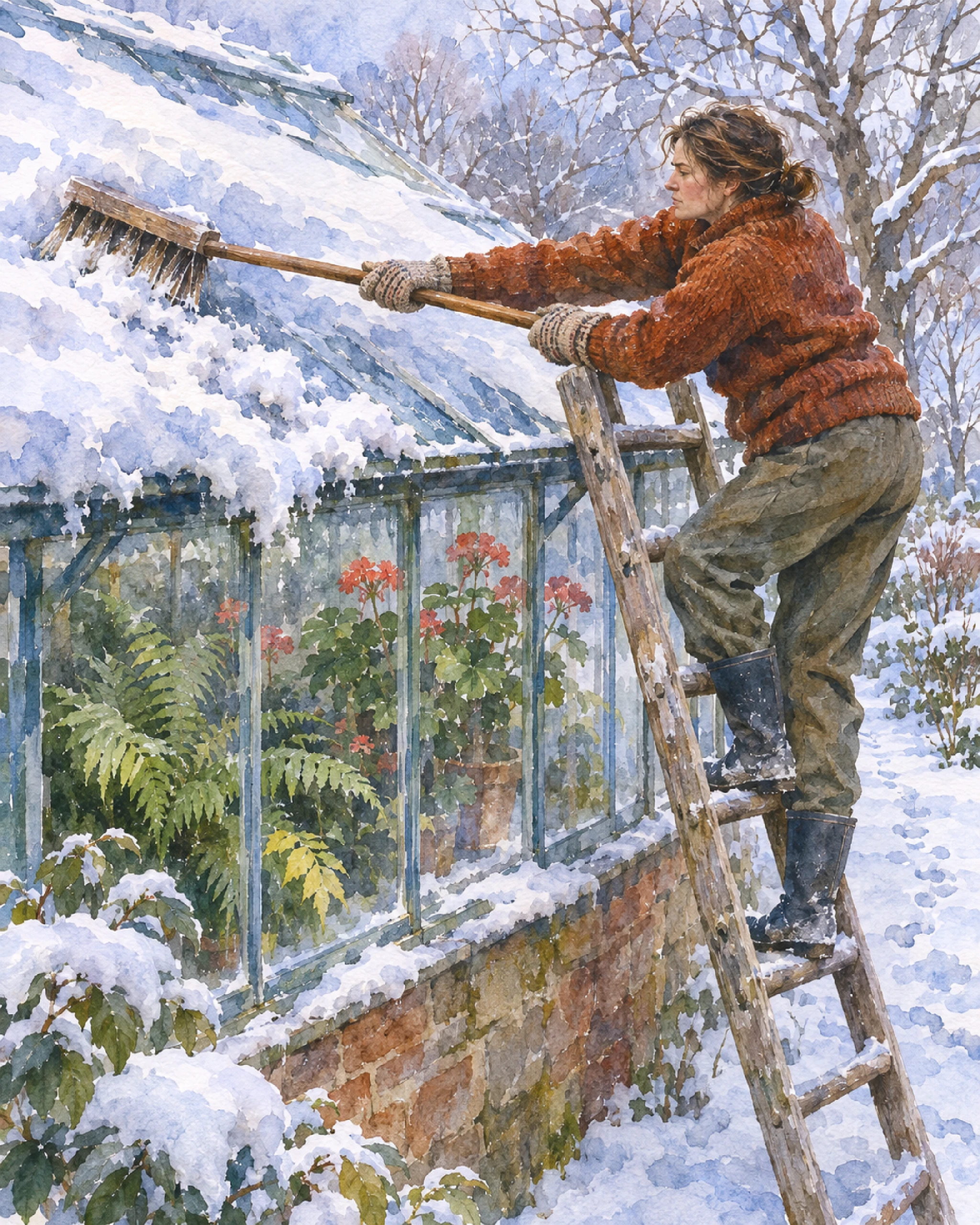
Braced on a ladder, a gardener pushes snow from a glasshouse roof. Broken snow edges overlap luxuriant plants behind glass in watercolor washes that bloom, dissolve, and catch.
Remix this referenceA Gardener Sweeping Snow from the Glasshouse
- Form language
- Gather secondary detail into broad interlocking masses, preserving irregular silhouettes and a few decisive structural breaks.
- Contour
- Let wet edges dissolve and return as wiry dry-brush fragments; vary sharpness without enclosing every shape.
- Mark-making
- Alternate generous loaded strokes with skipping scumbles and occasional lifted streaks; allow natural variation in mark size and density.
- Surface rendering
- Transparent watercolor pools into blooms and granular deposits; layered washes meet reserved paper through uneven, softly bleeding transitions.
Priority
Keep watercolor blooms and broken edges visibly active throughout the finished illustration.
What to avoid & what to check
Exact prompt for this example
MODULE OWNERSHIP
subject: Subject count, type, stable proportions and landmarks, resting face geometry, hair shape, physical materials, garment construction and permanent marks. No emotion, movement, color assignment or rendering recipe.
expression: Facial soft-tissue displacement and pupil direction, muscle coordination, regional intensity, asymmetry and onset/peak/release. No head/body pose, stable appearance, skin color or rendering.
gesture: Head/neck/body/limb orientation, joint movement, support, contact and pose-caused occlusion using existing anatomy. No eye/pupil movement, emotion, identity, props inventory or camera.
props: Prop count, type, construction, physical material and scale relative to the subject. Holding/contact belongs to gesture, position to composition, color to palette.
scene: Environment elements, terrain, backdrop/floor presence and structural detail. No canvas positions, camera, lighting, assigned colors or render texture.
camera: Projection, focal-length impression, camera elevation/yaw/roll, viewing distance and crop. No actor pose, world placement, lighting or canvas aspect ratio.
composition: Normalized 0-100% canvas positions, scale in frame, depth/overlap, focal hierarchy and margins. No joint pose, camera projection, rendering, subject/prop inventory or emotion.
palette: Color anchors, hue/saturation/value ranges, colors assigned to parts and approximate color coverage. No illumination direction, shading algorithm, physical material or layout.
lighting: Light-source direction/softness/intensity, ambient illumination, physical shadow direction/length and highlight position. Absence of directional illumination is allowed. No shading technique, palette or material changes.
style: Reusable form abstraction, contour weight/taper/edge quality, medium and mark scale/density/direction, surface rendering and tonal transition technique. No fixed subject proportions, anatomy, identity, expression, pose, palette, light-source direction, camera or layout.
output: Image count, aspect ratio, size, file/alpha requirements and global lettering/logo/watermark restrictions. No background scenery, crop, style, identity or pose.

SUBJECT
inventory: One adult human gardener, actor A.
geometry: A sturdy adult build with broad shoulders and ordinary human proportions.
resting-face: Broad cheek planes, a straight nose, and a softly squared jaw define the resting face.
appearance: Short hair gathered into a loose nape knot; a thick wool pullover, canvas trousers, knitted mittens, and rubber boots.

PRIORITY


AVOID


CHECK


EXPRESSION — ACTOR A
brows: The visible brow draws slightly inward and down.
lids: The visible lower lid firms beneath a gently narrowed upper lid.
cheeks: The visible cheek firms lightly without lifting into a smile.
nose: The visible nostril stays relaxed, with no wrinkle at the bridge.
mouth: Lips meet with light pressure; the visible corner remains level.
jaw: The jaw stays closed without a pronounced clench.
gaze: The visible pupil aims toward the brush edge against the snow.
coordination: Brow and lids carry the effort; mouth and cheek tension remain quieter.
timing: Hold a restrained apex; the far side of the face remains unprescribed.

PRIORITY


AVOID


CHECK


GESTURE
head: A turns the head sideways toward the brush, exposing the near eye, cheek, and mouth corner in profile.
torso: A leans across the eave with the waist bent and shoulders following a broad sideways push.
limbs: Both arms extend along the handle; bent knees and staggered feet brace the lower body.
contact: Both mittens grip the brush handle, boots rest on ladder rungs, and the brush head presses into roof snow.

PRIORITY


AVOID


CHECK


PROPS
inventory: Two separate props: a long-handled roof brush and a ladder taller than A.
construction: The brush has a wooden shaft and broad bristle block; the weathered timber ladder has round rungs.

PRIORITY


AVOID


CHECK


SCENE
inventory: A garden glasshouse, deep roof snow, loose snow clumps, dense interior plants, a snowy path, and bare trees.
structure: Sloping glazing meets a low masonry wall; ferns and tall geraniums crowd beneath a broken snow overhang.

PRIORITY


AVOID


CHECK


CAMERA
projection: Natural perspective with a moderately wide lens impression and restrained near-to-far enlargement.
viewpoint: An oblique side-rear view from just above eave height, looking gently downward with no camera roll.
crop: A medium-wide view includes A's whole figure and much of the glasshouse; the ladder continues below the crop.

PRIORITY


AVOID


CHECK


COMPOSITION
placement: A occupies the right third; the brush spans the upper middle, with generous snowy roof space to the left.
depth: The brush-and-snow junction leads attention, followed by A; plants overlap behind glazing and trees recede beyond.
spacing: An open interval around the arms preserves their silhouette; cropped plants at the bottom deepen the enclosure.

PRIORITY


AVOID


CHECK


PALETTE
colors: Paper white, Prussian blue, muted pine green, burnt sienna, and a little pale lemon.
assignment: White and blue belong to snow and glazing; green to plants; sienna to the pullover and masonry; lemon to a few leaves.
balance: Pale passages dominate around dense greens and a compact sienna accent; skin and other clothing stay subdued.

PRIORITY


AVOID


CHECK


LIGHTING
sources: Broad, soft overcast daylight enters from the upper left; weaker ambient light reaches the interior.
shadows: Short, diffuse shadows fall toward the lower right, with deeper shelter beneath the eave.
highlights: Gentle highlights gather on upper-left-facing snow ridges and glazing edges.

PRIORITY


AVOID


CHECK


STYLE GUIDE
form-language: Gather secondary detail into broad interlocking masses, preserving irregular silhouettes and a few decisive structural breaks.
contour: Let wet edges dissolve and return as wiry dry-brush fragments; vary sharpness without enclosing every shape.
mark-making: Alternate generous loaded strokes with skipping scumbles and occasional lifted streaks; allow natural variation in mark size and density.
surface-rendering: Transparent watercolor pools into blooms and granular deposits; layered washes meet reserved paper through uneven, softly bleeding transitions.

PRIORITY
Keep watercolor blooms and broken edges visibly active throughout the finished illustration.

AVOID


CHECK


OUTPUT
format: One finished illustration, portrait 4:5, 2048 × 2560 pixels, PNG with an opaque background.
restrictions: No lettering, logos, signatures, or watermarks.

PRIORITY


AVOID


CHECK


FINAL INTEGRATION
gesture + composition: Let spacing support the legibility of the sweeping action without flattening the surrounding layers.
scene + style + lighting: Let edge variation connect the environmental layers while preserving coherent light relationships.
Model information comes from image provenance. The same prompt may produce a different result.