Text to imageProductStyle guide
Camping Lantern with Reflector Wings
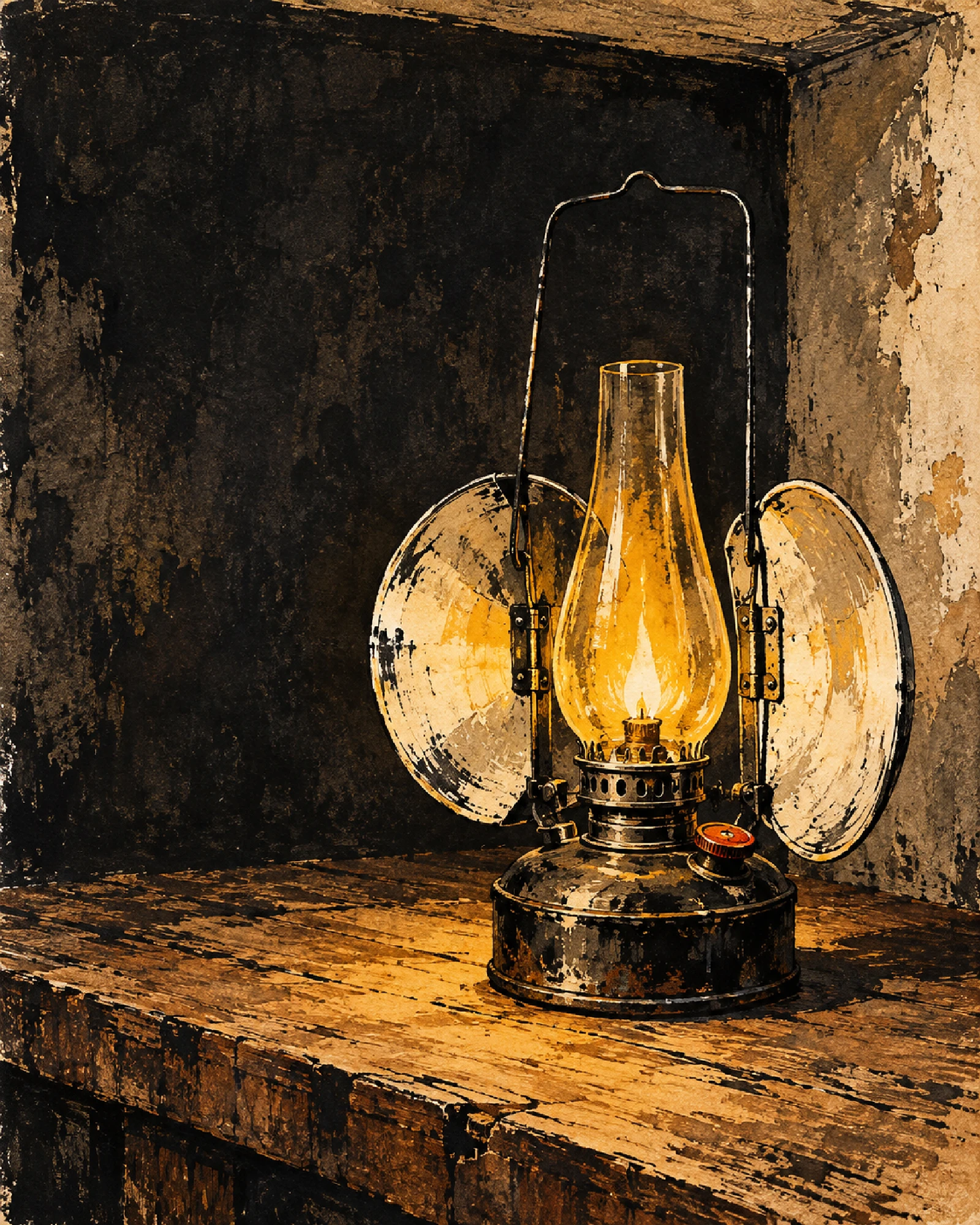
An oil lantern with folding reflector wings lights a dark workbench alcove. Rough ink contours and overlapping printed fields present its construction and glow as an experimental product poster.
Remix this referenceCamping Lantern with Reflector Wings
- Form language
- Reduce forms to bold cut masses interrupted by selective diagram-like openings, allowing small irregularities in their geometry.
- Contour
- Use forceful brush-ink edges that alternate between swollen strokes, dry breaks, and brief exposed-paper gaps.
- Mark-making
- Combine dragged ink streaks with broad relief-print impressions; keep pressure changes and slight registration drift visible.
- Surface rendering
- Build tone with translucent overprints and rubbed ink deposits, shifting abruptly between dense fields and exposed paper.
Priority
Preserve the visible tension between spontaneous brush ink and imperfect mechanical printing.
What to avoid & what to check
Exact prompt for this example
MODULE OWNERSHIP
subject: Subject count, type, stable proportions and landmarks, resting face geometry, hair shape, physical materials, garment construction and permanent marks. No emotion, movement, color assignment or rendering recipe.
expression: Facial soft-tissue displacement and pupil direction, muscle coordination, regional intensity, asymmetry and onset/peak/release. No head/body pose, stable appearance, skin color or rendering.
gesture: Head/neck/body/limb orientation, joint movement, support, contact and pose-caused occlusion using existing anatomy. No eye/pupil movement, emotion, identity, props inventory or camera.
props: Prop count, type, construction, physical material and scale relative to the subject. Holding/contact belongs to gesture, position to composition, color to palette.
scene: Environment elements, terrain, backdrop/floor presence and structural detail. No canvas positions, camera, lighting, assigned colors or render texture.
camera: Projection, focal-length impression, camera elevation/yaw/roll, viewing distance and crop. No actor pose, world placement, lighting or canvas aspect ratio.
composition: Normalized 0-100% canvas positions, scale in frame, depth/overlap, focal hierarchy and margins. No joint pose, camera projection, rendering, subject/prop inventory or emotion.
palette: Color anchors, hue/saturation/value ranges, colors assigned to parts and approximate color coverage. No illumination direction, shading algorithm, physical material or layout.
lighting: Light-source direction/softness/intensity, ambient illumination, physical shadow direction/length and highlight position. Absence of directional illumination is allowed. No shading technique, palette or material changes.
style: Reusable form abstraction, contour weight/taper/edge quality, medium and mark scale/density/direction, surface rendering and tonal transition technique. No fixed subject proportions, anatomy, identity, expression, pose, palette, light-source direction, camera or layout.
output: Image count, aspect ratio, size, file/alpha requirements and global lettering/logo/watermark restrictions. No background scenery, crop, style, identity or pose.

SUBJECT
inventory: One original folding-reflector oil lantern.
geometry: A squat reservoir supports a glass chimney, two hinged reflector leaves, and a tall wire carrying bail.
resting-face: No face or facial landmarks.
appearance: Pressed steel housing, polished aluminum reflectors, clear glass, and a cotton wick show modest signs of use.

PRIORITY


AVOID


CHECK


PROPS
inventory: No separate props.
construction: No prop construction applies.

PRIORITY


AVOID


CHECK


SCENE
inventory: A wooden workbench within a shallow plaster alcove.
structure: A thick tabletop meets a recessed wall with a simple return and a few worn plaster chips.

PRIORITY


AVOID


CHECK


CAMERA
projection: Near-normal perspective with a restrained product-photography focal-length impression.
viewpoint: Look slightly down from a front three-quarter viewpoint, with no camera roll.
crop: Include the complete lantern while cropping the surrounding workbench and alcove.

PRIORITY


AVOID


CHECK


COMPOSITION
placement: Set the lantern low and right of center, leaving a broad uninterrupted field above and to the left.
depth: The chimney is the first focal point, followed by the reflector pair; the wall stays secondary behind them.
spacing: Let the reflector silhouettes overlap unequally, preserve their outer gaps, and leave breathing room around the bail.

PRIORITY


AVOID


CHECK


PALETTE
colors: Use soot black, saffron yellow, chalk ivory, and a small vermilion accent.
assignment: Black anchors the alcove, saffron fills the chimney, ivory defines the reflectors, and vermilion marks the fuel cap.
balance: A large dark field surrounds a compact warm cluster; the vermilion remains a minor punctuation.

PRIORITY


AVOID


CHECK


LIGHTING
sources: The lantern supplies the main local light, supported by dim, broad ambient fill from the upper left.
shadows: The housing casts soft shadows outward across the tabletop; the contact shadow remains darkest beneath the reservoir.
highlights: Inner reflector edges and the center of the glass catch the strongest highlights.

PRIORITY


AVOID


CHECK


STYLE GUIDE
form-language: Reduce forms to bold cut masses interrupted by selective diagram-like openings, allowing small irregularities in their geometry.
contour: Use forceful brush-ink edges that alternate between swollen strokes, dry breaks, and brief exposed-paper gaps.
mark-making: Combine dragged ink streaks with broad relief-print impressions; keep pressure changes and slight registration drift visible.
surface-rendering: Build tone with translucent overprints and rubbed ink deposits, shifting abruptly between dense fields and exposed paper.

PRIORITY
Preserve the visible tension between spontaneous brush ink and imperfect mechanical printing.

AVOID


CHECK


OUTPUT
format: One finished portrait image, 4:5 aspect ratio, 1600 × 2000 pixels, opaque PNG.
restrictions: No lettering, logos, signatures, or watermarks.

PRIORITY


AVOID


CHECK


FINAL INTEGRATION
lighting + style: Translate the illumination into printed tonal relationships while retaining a coherent sense of emitted light.
Model information comes from image provenance. The same prompt may produce a different result.