Text to imageCafe & brandStyle guide
Weaving a Chair in the Courtyard
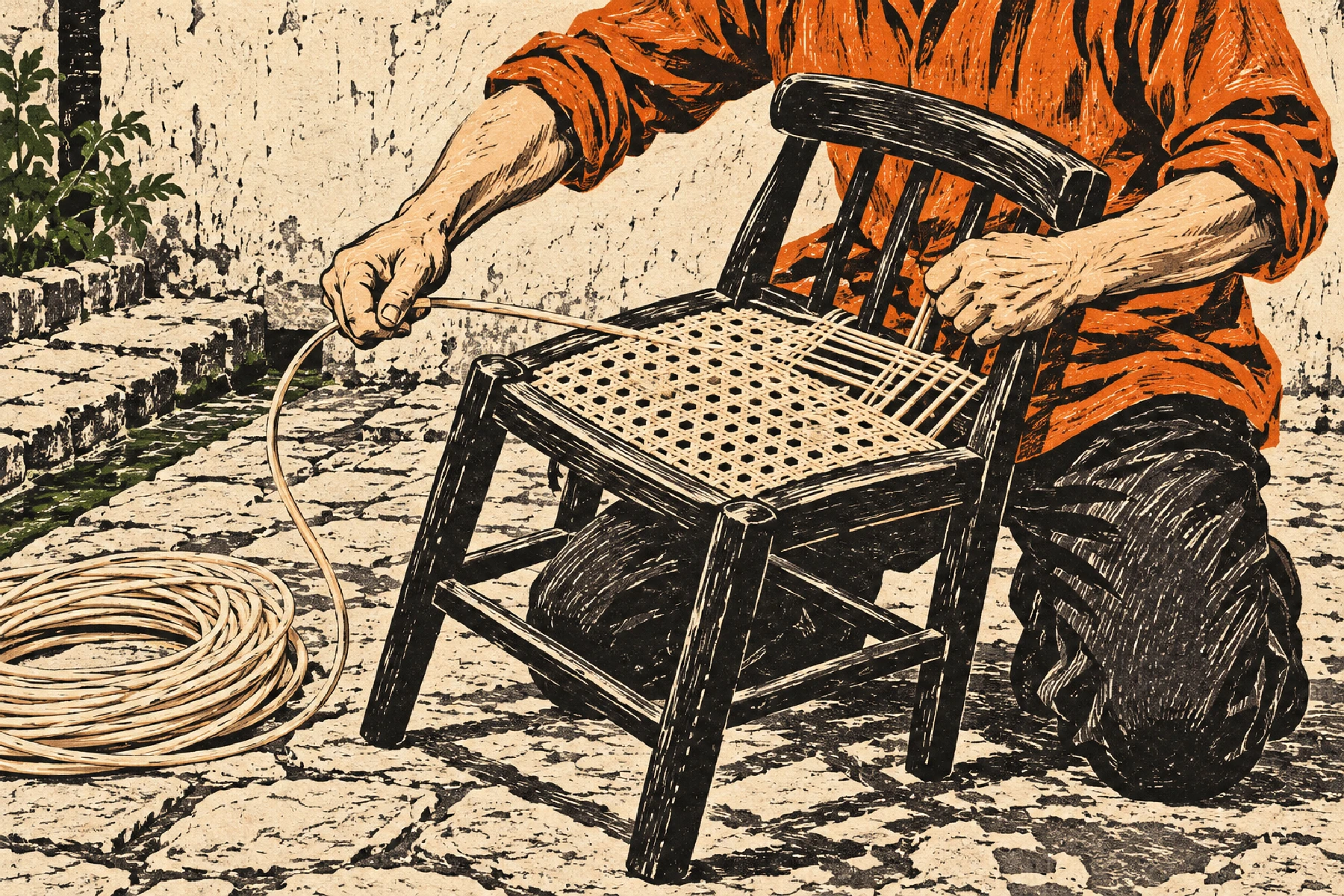
A maker braces a tilted chair while pulling cane through its seat. Overlapping forms and rhythmic linocut cuts give a furniture brand a vivid image of skilled handwork.
Remix this referenceWeaving a Chair in the Courtyard
- Form language
- Reduce forms to interlocking broad masses; small irregular notches keep the abstraction handmade.
- Contour
- Use blunt relief-print edges interrupted by chipped breaks and occasional tapered cuts.
- Mark-making
- Carve curved rhythmic strokes in changing lengths; let neighboring marks bunch and separate naturally.
- Surface rendering
- Build tone from inked masses and exposed paper cuts, allowing uneven ink pickup and lively block overlap.
Priority
Make the bold linocut visibly carved, with cuts carrying rhythm through large inked shapes.
What to avoid & what to check
Exact prompt for this example
MODULE OWNERSHIP
subject: Subject count, type, stable proportions and landmarks, resting face geometry, hair shape, physical materials, garment construction and permanent marks. No emotion, movement, color assignment or rendering recipe.
expression: Facial soft-tissue displacement and pupil direction, muscle coordination, regional intensity, asymmetry and onset/peak/release. No head/body pose, stable appearance, skin color or rendering.
gesture: Head/neck/body/limb orientation, joint movement, support, contact and pose-caused occlusion using existing anatomy. No eye/pupil movement, emotion, identity, props inventory or camera.
props: Prop count, type, construction, physical material and scale relative to the subject. Holding/contact belongs to gesture, position to composition, color to palette.
scene: Environment elements, terrain, backdrop/floor presence and structural detail. No canvas positions, camera, lighting, assigned colors or render texture.
camera: Projection, focal-length impression, camera elevation/yaw/roll, viewing distance and crop. No actor pose, world placement, lighting or canvas aspect ratio.
composition: Normalized 0-100% canvas positions, scale in frame, depth/overlap, focal hierarchy and margins. No joint pose, camera projection, rendering, subject/prop inventory or emotion.
palette: Color anchors, hue/saturation/value ranges, colors assigned to parts and approximate color coverage. No illumination direction, shading algorithm, physical material or layout.
lighting: Light-source direction/softness/intensity, ambient illumination, physical shadow direction/length and highlight position. Absence of directional illumination is allowed. No shading technique, palette or material changes.
style: Reusable form abstraction, contour weight/taper/edge quality, medium and mark scale/density/direction, surface rendering and tonal transition technique. No fixed subject proportions, anatomy, identity, expression, pose, palette, light-source direction, camera or layout.
output: Image count, aspect ratio, size, file/alpha requirements and global lettering/logo/watermark restrictions. No background scenery, crop, style, identity or pose.

SUBJECT
inventory: One adult furniture maker, actor A.
geometry: A sturdy adult build with broad hands and ordinary human proportions.
resting-face: Facial landmarks and hair geometry remain unspecified.
appearance: A loose linen work shirt with rolled cuffs and roomy cotton trousers; no permanent markings.

PRIORITY


AVOID


CHECK


EXPRESSION — ACTOR A
brows: Brow displacement remains unprescribed.
lids: Eyelid opening and tension remain unprescribed.
cheeks: Cheek lift and compression remain unprescribed.
nose: Nostril action remains unprescribed.
mouth: Lip shape and tension remain unprescribed.
jaw: Jaw opening and firmness remain unprescribed.
gaze: Pupil direction remains unprescribed.
coordination: Facial muscle coordination remains unprescribed.
timing: No facial onset, peak or release is prescribed.

PRIORITY


AVOID


CHECK


GESTURE
head: No head or neck action is prescribed.
torso: A twists slightly through the waist to counter the pull.
limbs: A kneels, bracing the backrest with one forearm while the opposite hand pulls the cane outward.
contact: A thigh supports the tilted seat frame; the bracing hand pins the strand at its threaded exit.

PRIORITY


AVOID


CHECK


PROPS
inventory: One adult-sized chair and one continuous cane strand with a loose coiled remainder.
construction: A timber chair with a curved back rail and a partly woven cane seat retains an open unfinished section.

PRIORITY


AVOID


CHECK


SCENE
inventory: A small working courtyard with a plaster wall and stone paving.
structure: A shallow drainage channel interrupts the paving; the wall is otherwise plain.

PRIORITY


AVOID


CHECK


CAMERA
projection: A moderate normal-lens perspective keeps structural depth easy to read.
viewpoint: View obliquely from seat height, without camera roll.
crop: A medium-wide crop excludes the maker's head and includes the knees and complete chair.

PRIORITY


AVOID


CHECK


COMPOSITION
placement: The chair spans the middle diagonally; the maker occupies the right half and the coil opens toward the left.
depth: Chair rails overlap the torso; the pulling hand separates clearly in front, and the threading point leads.
spacing: Leave broad breathing space above the coil and small open gaps between the chair rails.

PRIORITY


AVOID


CHECK


PALETTE
colors: Soot black, flax cream, persimmon orange and subdued moss green.
assignment: Black for chair and trousers, flax for cane and courtyard, orange for the shirt, moss for the drain.
balance: Flax and black dominate; orange is a generous accent and moss remains a quiet trace.

PRIORITY


AVOID


CHECK


LIGHTING
sources: Broad daylight enters from the upper left, supported by gentle courtyard ambient light.
shadows: A joined shadow from maker and chair falls softly toward the lower right.
highlights: Light catches the upper chair rail, knuckles and exposed cane edges.

PRIORITY


AVOID


CHECK


STYLE GUIDE
form-language: Reduce forms to interlocking broad masses; small irregular notches keep the abstraction handmade.
contour: Use blunt relief-print edges interrupted by chipped breaks and occasional tapered cuts.
mark-making: Carve curved rhythmic strokes in changing lengths; let neighboring marks bunch and separate naturally.
surface-rendering: Build tone from inked masses and exposed paper cuts, allowing uneven ink pickup and lively block overlap.

PRIORITY
Make the bold linocut visibly carved, with cuts carrying rhythm through large inked shapes.

AVOID


CHECK


OUTPUT
format: One finished image, landscape 3:2, 1800 × 1200 pixels, opaque PNG.
restrictions: One finished image, landscape 3:2, 1800 × 1200 pixels, opaque PNG; no lettering, logos or watermarks.

PRIORITY


AVOID


CHECK


FINAL INTEGRATION
gesture + props + composition: Let contact, unfinished construction and overlap cooperate to make the handwork immediately understandable.
Model information comes from image provenance. The same prompt may produce a different result.