Text to imageCafe & brandStyle guide
Jam on the Orchard Wall
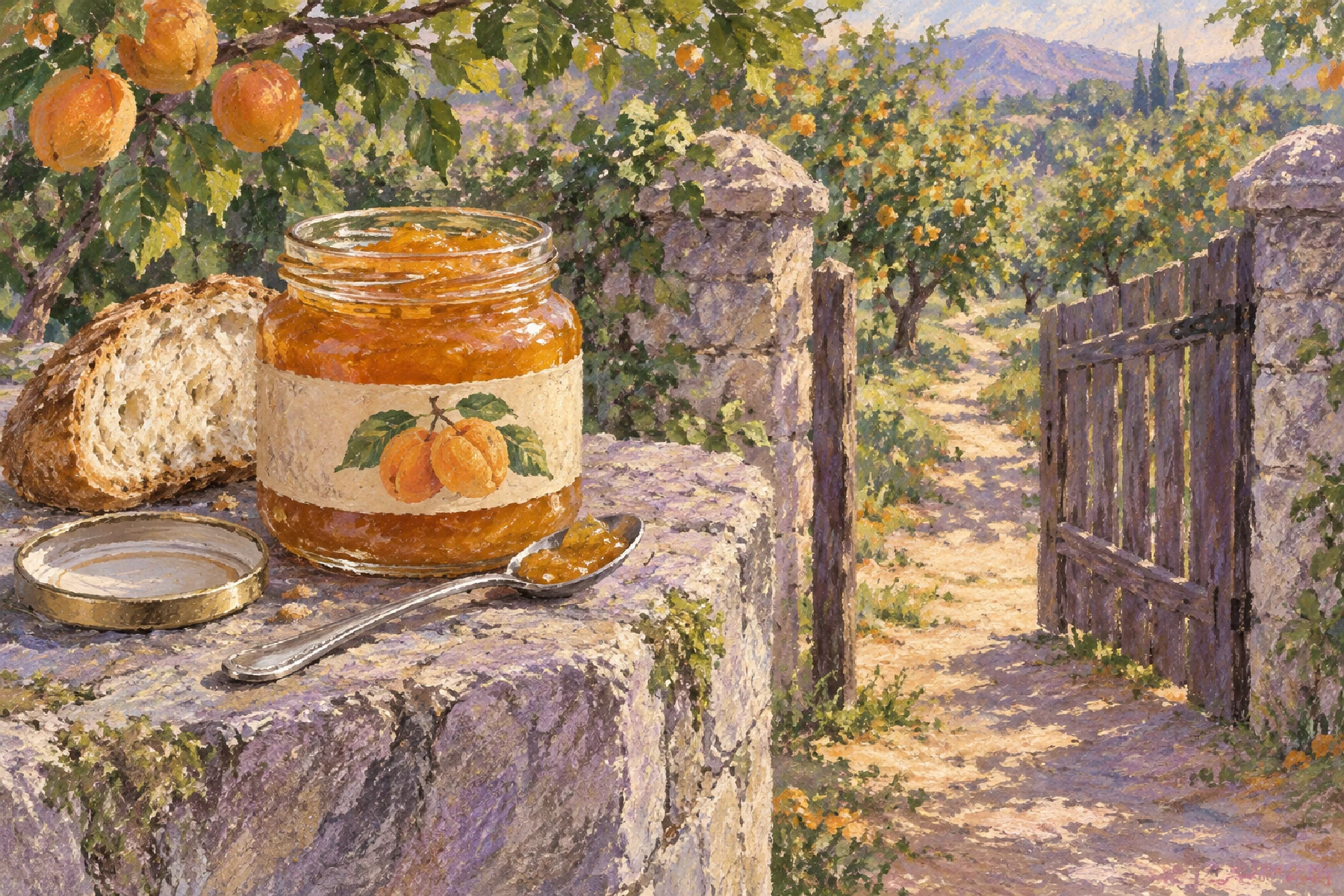
An apricot preserve brand illustration, with jam and bread beside an open garden gate in rubbed and scratched oil pastel.
Remix this referenceJam on the Orchard Wall
- Form language
- Reduce forms to rounded, slightly swollen masses, allowing small irregularities within a coherent dreamlike vocabulary.
- Contour
- Let broad pastel edges soften into rubbed passages, interrupted by a few sharp, hand-scratched boundaries.
- Mark-making
- Use sideways oil-pastel sweeps, thumb-rubbed smears, and loose scratches that reveal earlier layers.
- Surface rendering
- Build waxy broken layers with rubbed tonal transitions; retain paper flecks and uneven deposits instead of polishing every surface.
Priority
The rubbed and scratched oil pastel must remain visibly tactile and dreamlike.
What to avoid & what to check
Exact prompt for this example
MODULE OWNERSHIP
subject: Subject count, type, stable proportions and landmarks, resting face geometry, hair shape, physical materials, garment construction and permanent marks. No emotion, movement, color assignment or rendering recipe.
expression: Facial soft-tissue displacement and pupil direction, muscle coordination, regional intensity, asymmetry and onset/peak/release. No head/body pose, stable appearance, skin color or rendering.
gesture: Head/neck/body/limb orientation, joint movement, support, contact and pose-caused occlusion using existing anatomy. No eye/pupil movement, emotion, identity, props inventory or camera.
props: Prop count, type, construction, physical material and scale relative to the subject. Holding/contact belongs to gesture, position to composition, color to palette.
scene: Environment elements, terrain, backdrop/floor presence and structural detail. No canvas positions, camera, lighting, assigned colors or render texture.
camera: Projection, focal-length impression, camera elevation/yaw/roll, viewing distance and crop. No actor pose, world placement, lighting or canvas aspect ratio.
composition: Normalized 0-100% canvas positions, scale in frame, depth/overlap, focal hierarchy and margins. No joint pose, camera projection, rendering, subject/prop inventory or emotion.
palette: Color anchors, hue/saturation/value ranges, colors assigned to parts and approximate color coverage. No illumination direction, shading algorithm, physical material or layout.
lighting: Light-source direction/softness/intensity, ambient illumination, physical shadow direction/length and highlight position. Absence of directional illumination is allowed. No shading technique, palette or material changes.
style: Reusable form abstraction, contour weight/taper/edge quality, medium and mark scale/density/direction, surface rendering and tonal transition technique. No fixed subject proportions, anatomy, identity, expression, pose, palette, light-source direction, camera or layout.
output: Image count, aspect ratio, size, file/alpha requirements and global lettering/logo/watermark restrictions. No background scenery, crop, style, identity or pose.

SUBJECT
inventory: One open jar of apricot preserve is the featured product.
geometry: A squat jar with broad shoulders, a generous mouth, and a substantial glass base.
resting-face: No faces are present.
appearance: Transparent glass contains thick preserve with fruit pieces; a paper band wraps around the body.

PRIORITY


AVOID


CHECK


PROPS
inventory: Three separate props: the detached jar lid, a teaspoon, and a thick slice of bread.
construction: The lid is pressed metal; the slender steel spoon fits the jar mouth; the bread has an open crumb.

PRIORITY


AVOID


CHECK


SCENE
inventory: A stone garden wall, an open timber gate, a narrow earth path, and an apricot orchard.
structure: A broad gate pier provides a resting ledge; the path passes through the opening beneath branching trees.

PRIORITY


AVOID


CHECK


CAMERA
projection: Gentle perspective with a normal-lens impression.
viewpoint: Look slightly downward from just above the wall, with a modest oblique view through the gateway.
crop: A medium-wide view includes the complete jar and enough gateway to establish the orchard beyond.

PRIORITY


AVOID


CHECK


COMPOSITION
placement: The jar anchors the lower-left third; the open gateway answers it across a spacious right half.
depth: The spoon overlaps the jar base, bread rises behind it, and the gateway separates the ledge from distant trees.
spacing: Keep the product group compact and dominant, with broad quiet intervals along the wall and above the path.

PRIORITY


AVOID


CHECK


PALETTE
colors: Apricot orange, dusty lilac, moss green, warm cream, and restrained plum.
assignment: Orange belongs to preserve; cream to bread and label; lilac to stone; moss to trees; plum to gate recesses.
balance: Muted lilac and cream occupy broad areas; concentrated orange gives the product its strongest chromatic accent.

PRIORITY


AVOID


CHECK


LIGHTING
sources: Broad, soft morning light enters from the upper left with generous ambient illumination.
shadows: Short, soft shadows fall toward the lower right; the gateway interior remains gently shaded.
highlights: A broad highlight catches the left jar shoulder, with a small glint at the preserve surface.

PRIORITY


AVOID


CHECK


STYLE GUIDE
form-language: Reduce forms to rounded, slightly swollen masses, allowing small irregularities within a coherent dreamlike vocabulary.
contour: Let broad pastel edges soften into rubbed passages, interrupted by a few sharp, hand-scratched boundaries.
mark-making: Use sideways oil-pastel sweeps, thumb-rubbed smears, and loose scratches that reveal earlier layers.
surface-rendering: Build waxy broken layers with rubbed tonal transitions; retain paper flecks and uneven deposits instead of polishing every surface.

PRIORITY
The rubbed and scratched oil pastel must remain visibly tactile and dreamlike.

AVOID


CHECK


OUTPUT
format: One finished landscape image, 3:2 aspect ratio, 1800 × 1200 pixels, opaque PNG.
restrictions: No lettering, logos, or watermarks.

PRIORITY


AVOID


CHECK


FINAL INTEGRATION
subject + composition + style: Keep the product recognizable while allowing the surrounding forms to dissolve more freely.
palette + lighting: Let illumination reveal the assigned hues without washing out their muted relationships.
Model information comes from image provenance. The same prompt may produce a different result.