Text to imagePortraitStyle guide
Auburn-Fringed Adult · Plane-Based Color Blocking
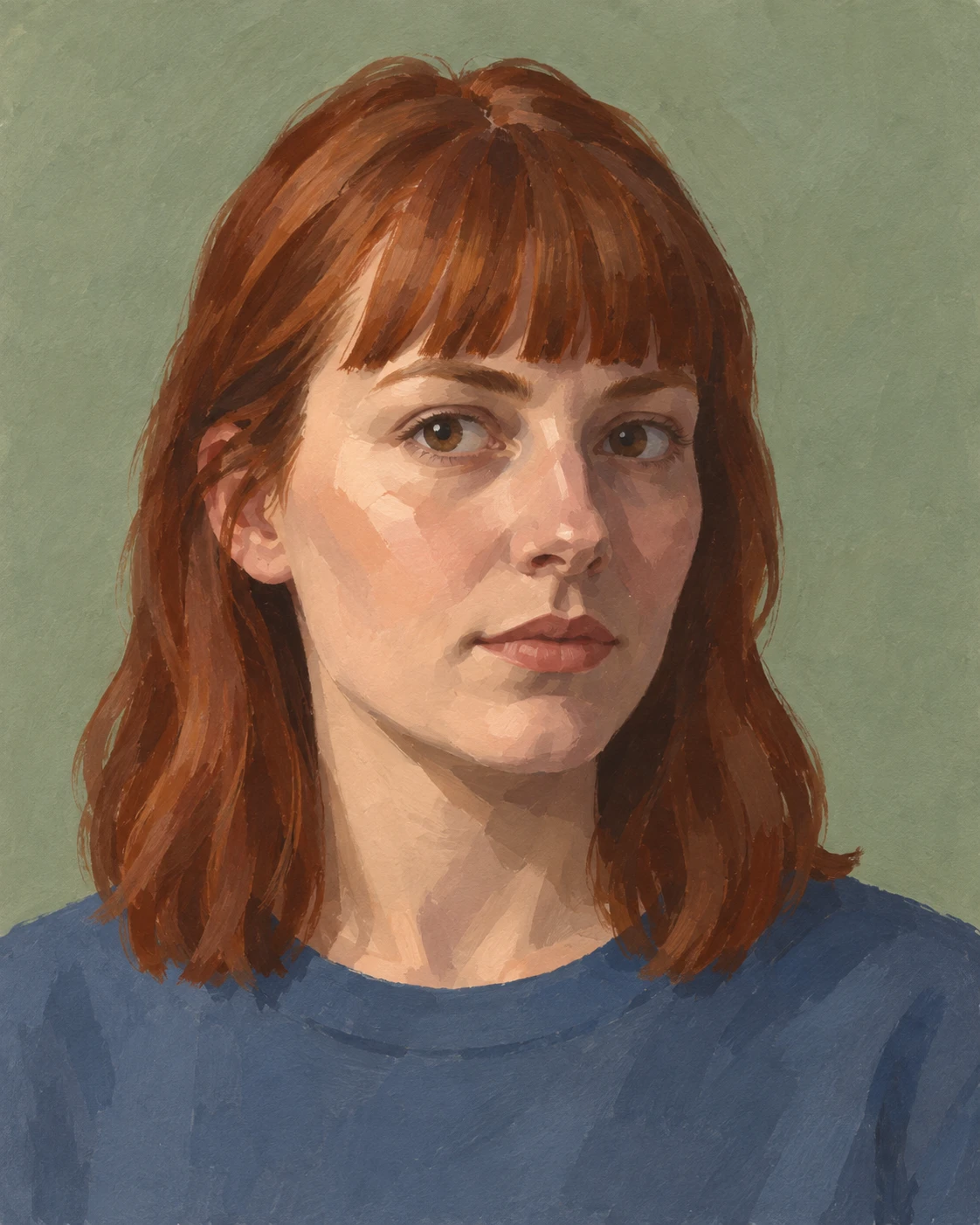
A gouache portrait that builds volume with broad opaque color shapes wherever facial planes change direction.
Auburn-Fringed Adult · Plane-Based Color Blocking
- Shape & line
- Build the forehead, cheekbones, nose, and jaw from broad interlocking shapes whose boundaries follow changes in surface direction. Use angled cheek and jaw edges alongside softer eyelid and lip curves, keeping the adult's features recognizable without outlining every shape.
- Color & light
- Place a broad light source above image-left so the image-left forehead and cheek receive pale warm peach, while the image-right cheek and underside of the jaw form cooler muted rose-brown masses. Separate neighboring planes through clear color and value steps, with only small transitions around the nose and mouth.
- Texture & material
- Apply matte, opaque gouache in broad brush passes, letting a little paper grain show at lightly dragged edges. Keep each facial color block mostly even, and describe the auburn hair with a few overlapping painted ribbons rather than individual strands.
- Composition
- Concentrate the smallest shapes and strongest local contrast around the eyes and nose. Simplify the crewneck into two large blue masses, keep the sage background flat, and leave clear background space beside both cheeks so the facial plane pattern remains the focal point.
Priority
Prioritize readable facial volume through deliberate color-block boundaries.
What to avoid & what to check
Avoid arbitrary polygon patterns and airbrushed gradients that obscure the facial planes.
Check that the color boundaries follow facial turns and the image-left light remains consistent.
Exact prompt for this example
SUBJECT
One adult with a straight auburn fringe, a neutral expression, and a plain slate-blue crewneck. Turn the face slightly toward image-right while keeping both eyes visible; the nose overlaps a small portion of the image-right cheek.

COMPOSITION
Use a vertical chest-up portrait at eye level, with the head slightly above center, comfortable space above the hair, and shoulders extending toward both lower corners. Place the figure against a plain muted sage background.

STYLE GUIDE
1. Shape & line
Build the forehead, cheekbones, nose, and jaw from broad interlocking shapes whose boundaries follow changes in surface direction. Use angled cheek and jaw edges alongside softer eyelid and lip curves, keeping the adult's features recognizable without outlining every shape.

2. Color & light
Place a broad light source above image-left so the image-left forehead and cheek receive pale warm peach, while the image-right cheek and underside of the jaw form cooler muted rose-brown masses. Separate neighboring planes through clear color and value steps, with only small transitions around the nose and mouth.

3. Texture & material
Apply matte, opaque gouache in broad brush passes, letting a little paper grain show at lightly dragged edges. Keep each facial color block mostly even, and describe the auburn hair with a few overlapping painted ribbons rather than individual strands.

4. Composition
Concentrate the smallest shapes and strongest local contrast around the eyes and nose. Simplify the crewneck into two large blue masses, keep the sage background flat, and leave clear background space beside both cheeks so the facial plane pattern remains the focal point.

PRIORITY
Preserve the requested identity, count, action, composition and output settings. Apply the style rules within those constraints; a style reference must not replace the subject or layout. Within the style: Prioritize readable facial volume through deliberate color-block boundaries.

AVOID
Avoid arbitrary polygon patterns and airbrushed gradients that obscure the facial planes.

OUTPUT
Create one finished gouache portrait in a 4:5 aspect ratio, without lettering, captions, signatures, or watermarks.

SELF-CHECK
Check that the color boundaries follow facial turns and the image-left light remains consistent.
Model information comes from image provenance. The same prompt may produce a different result.