Text to imageLandscapeStyle guide
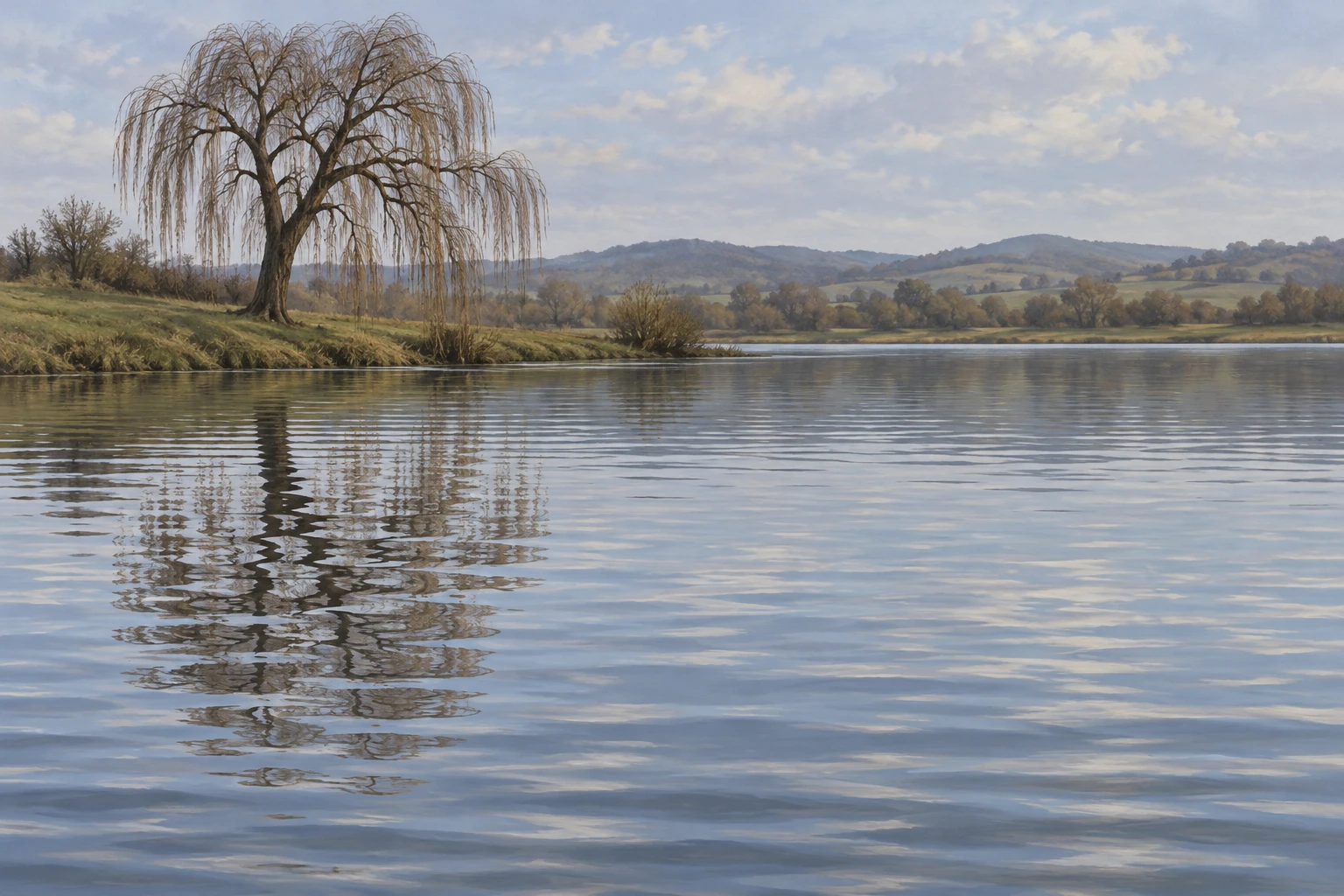
One Lakeside Willow · Ripple-Broken Reflection
A landscape reference showing water direction and movement through horizontal ripples that break a tree’s reflection into fragments.
One Lakeside Willow · Ripple-Broken Reflection
- Shape & line
- Draw the willow with a tapering trunk and a few long, downward-curving branch groups. Carry these recognizable shapes upside down into the water, then break their reflected contours into horizontal segments with small sideways shifts at each ripple.
- Color & light
- Use a pale blue-gray sky, muted olive bank, and dark brown tree under soft daylight. Keep the reflected tree darker than the surrounding water but slightly lighter and less saturated than the actual tree; pass narrow sky-colored gaps through its dark reflection.
- Texture & material
- Render the scene as an opaque painted landscape with broad, quiet brushwork on the bank. Describe water with sparse, nearly horizontal ripple strokes: broader and more separated near the bottom edge, finer and closer together toward the far bank, with soft ends rather than outlined wave symbols.
- Composition
- Align the reflected trunk beneath the image-left trunk’s contact with the shoreline, and let its fragments descend toward the lower-left water. Keep image-right water comparatively open so the broken reflection reads clearly; let the same ripple bands continue beyond the reflection into that open water.
Priority
Preserve the tree’s identity and vertical alignment while making horizontal ripple breaks unmistakable.
What to avoid & what to check
Avoid an intact mirror reflection, vertical smearing, or uniformly repeated zigzag waves.
Check that the inverted branches remain recognizable and that ripple gaps continue into the open water at image-right.
Exact prompt for this example
SUBJECT
One bare willow stands on a low grassy bank at image-left beside a small lake; its trunk and drooping branches reflect in the water directly below it, where gentle ripples interrupt their inverted shapes.

COMPOSITION
Frame the scene from the opposite shore in a slightly elevated view. Place the willow in the upper-left third, the far bank near the upper third, and open water across the lower two-thirds, leaving room beneath the tree for its complete reflection.

STYLE GUIDE
1. Shape & line
Draw the willow with a tapering trunk and a few long, downward-curving branch groups. Carry these recognizable shapes upside down into the water, then break their reflected contours into horizontal segments with small sideways shifts at each ripple.

2. Color & light
Use a pale blue-gray sky, muted olive bank, and dark brown tree under soft daylight. Keep the reflected tree darker than the surrounding water but slightly lighter and less saturated than the actual tree; pass narrow sky-colored gaps through its dark reflection.

3. Texture & material
Render the scene as an opaque painted landscape with broad, quiet brushwork on the bank. Describe water with sparse, nearly horizontal ripple strokes: broader and more separated near the bottom edge, finer and closer together toward the far bank, with soft ends rather than outlined wave symbols.

4. Composition
Align the reflected trunk beneath the image-left trunk’s contact with the shoreline, and let its fragments descend toward the lower-left water. Keep image-right water comparatively open so the broken reflection reads clearly; let the same ripple bands continue beyond the reflection into that open water.

PRIORITY
Preserve the requested identity, count, action, composition and output settings. Apply the style rules within those constraints; a style reference must not replace the subject or layout. Within the style: Preserve the tree’s identity and vertical alignment while making horizontal ripple breaks unmistakable.

AVOID
Avoid an intact mirror reflection, vertical smearing, or uniformly repeated zigzag waves.

OUTPUT
Create one landscape image in a 3:2 horizontal aspect ratio, with no lettering, captions, borders, or watermark.

SELF-CHECK
Check that the inverted branches remain recognizable and that ripple gaps continue into the open water at image-right.
Model information comes from image provenance. The same prompt may produce a different result.