Text to imageLandscapeStyle guide
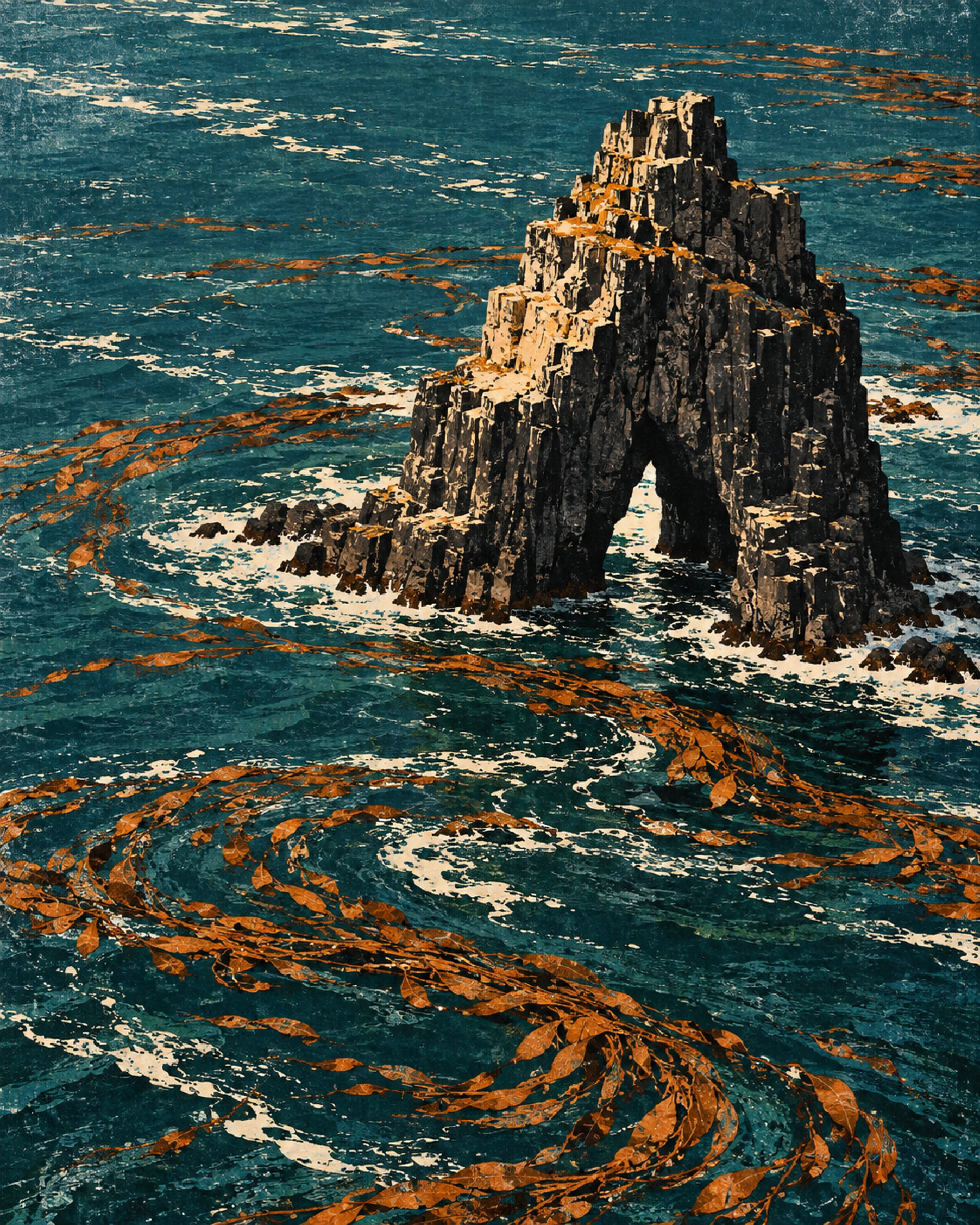
Kelp Bands Around a Sea Stack
An experimental ink-and-print landscape poster where a pierced sea stack and curling kelp bands interrupt an expansive sea.
Remix this referenceKelp Bands Around a Sea Stack
- Form language
- Reduce complex forms to interlocking wedges, broken ribbons and broad intervals while preserving their natural irregularity.
- Contour
- Alternate blunt printed edges with torn dry-ink breaks; slight registration slips may interrupt selected boundaries.
- Mark-making
- Combine dragged ink streaks with coarse relief-print bites; vary pressure and let incidental marks remain sparse.
- Surface rendering
- Build tone through overlapping translucent impressions and rubbed opaque passages, allowing uneven ink pickup to remain visible.
Priority
Make the interaction of drawn ink and imperfect print impressions visibly define the finished illustration.
What to avoid & what to check
Exact prompt for this example
MODULE OWNERSHIP
subject: Subject count, type, stable proportions and landmarks, resting face geometry, hair shape, physical materials, garment construction and permanent marks. No emotion, movement, color assignment or rendering recipe.
expression: Facial soft-tissue displacement and pupil direction, muscle coordination, regional intensity, asymmetry and onset/peak/release. No head/body pose, stable appearance, skin color or rendering.
gesture: Head/neck/body/limb orientation, joint movement, support, contact and pose-caused occlusion using existing anatomy. No eye/pupil movement, emotion, identity, props inventory or camera.
props: Prop count, type, construction, physical material and scale relative to the subject. Holding/contact belongs to gesture, position to composition, color to palette.
scene: Environment elements, terrain, backdrop/floor presence and structural detail. No canvas positions, camera, lighting, assigned colors or render texture.
camera: Projection, focal-length impression, camera elevation/yaw/roll, viewing distance and crop. No actor pose, world placement, lighting or canvas aspect ratio.
composition: Normalized 0-100% canvas positions, scale in frame, depth/overlap, focal hierarchy and margins. No joint pose, camera projection, rendering, subject/prop inventory or emotion.
palette: Color anchors, hue/saturation/value ranges, colors assigned to parts and approximate color coverage. No illumination direction, shading algorithm, physical material or layout.
lighting: Light-source direction/softness/intensity, ambient illumination, physical shadow direction/length and highlight position. Absence of directional illumination is allowed. No shading technique, palette or material changes.
style: Reusable form abstraction, contour weight/taper/edge quality, medium and mark scale/density/direction, surface rendering and tonal transition technique. No fixed subject proportions, anatomy, identity, expression, pose, palette, light-source direction, camera or layout.
output: Image count, aspect ratio, size, file/alpha requirements and global lettering/logo/watermark restrictions. No background scenery, crop, style, identity or pose.

SUBJECT
inventory: One naturally pierced basalt sea stack is the principal landform; no people or animals.
geometry: A blunt wedge rises from a broad foot, with a triangular passage and an uneven, stepped summit.
resting-face: No facial anatomy applies.
appearance: Exposed basalt has fractured columns, worn ledges and a wave-cut recess around its base.

PRIORITY


AVOID


CHECK


PROPS
inventory: No separate props.
construction: No prop construction applies.

PRIORITY


AVOID


CHECK


SCENE
inventory: An open coastal sea surrounds the stack, with floating kelp ribbons and sparse broken foam.
structure: A tidal eddy gathers kelp into incomplete loops; open water continues beyond the visible area.

PRIORITY


AVOID


CHECK


CAMERA
projection: Use a compressed perspective with a restrained telephoto impression.
viewpoint: Look obliquely downward from offshore, high enough to reveal the kelp loops and the rock passage.
crop: Include the complete stack and a generous reach of sea; exclude the horizon and nearby shore.

PRIORITY


AVOID


CHECK


COMPOSITION
placement: Set the stack right of center; a sweeping kelp loop enters from the lower edge and curves around it.
depth: The pierced rock is the primary focus; overlapping kelp bands provide a secondary path through the foreground.
spacing: Leave the upper-left sea spacious, with clear gaps separating the kelp loops from the rock silhouette.

PRIORITY


AVOID


CHECK


PALETTE
colors: Use deep petrol, warm bone, rust orange and a restrained near-black.
assignment: Petrol belongs to the sea, near-black to basalt, rust to kelp, and bone to foam and open passages.
balance: Let petrol dominate; keep rust concentrated and preserve broad quiet value intervals.

PRIORITY


AVOID


CHECK


LIGHTING
sources: Broad, moderately soft daylight arrives from the upper left with ample ambient light.
shadows: A short shadow extends to the lower right; the passage interior remains visibly darker.
highlights: Keep highlights broad on the upper-left ledges and sparse across the water.

PRIORITY


AVOID


CHECK


STYLE GUIDE
form-language: Reduce complex forms to interlocking wedges, broken ribbons and broad intervals while preserving their natural irregularity.
contour: Alternate blunt printed edges with torn dry-ink breaks; slight registration slips may interrupt selected boundaries.
mark-making: Combine dragged ink streaks with coarse relief-print bites; vary pressure and let incidental marks remain sparse.
surface-rendering: Build tone through overlapping translucent impressions and rubbed opaque passages, allowing uneven ink pickup to remain visible.

PRIORITY
Make the interaction of drawn ink and imperfect print impressions visibly define the finished illustration.

AVOID


CHECK


OUTPUT
format: Deliver one portrait image, 4:5 aspect ratio, 2400 × 3000 pixels, opaque PNG.
restrictions: No lettering, logos, signatures or watermarks.

PRIORITY


AVOID


CHECK


FINAL INTEGRATION
camera + composition: Choose the viewing angle so the passage remains legible within the spacious arrangement.
palette + style: Allow print overlaps to enrich the established colors without losing their distinct roles.
Model information comes from image provenance. The same prompt may produce a different result.