Text to imageSpace & architectureStyle guide
The Vent Wheel in the Seed Hall
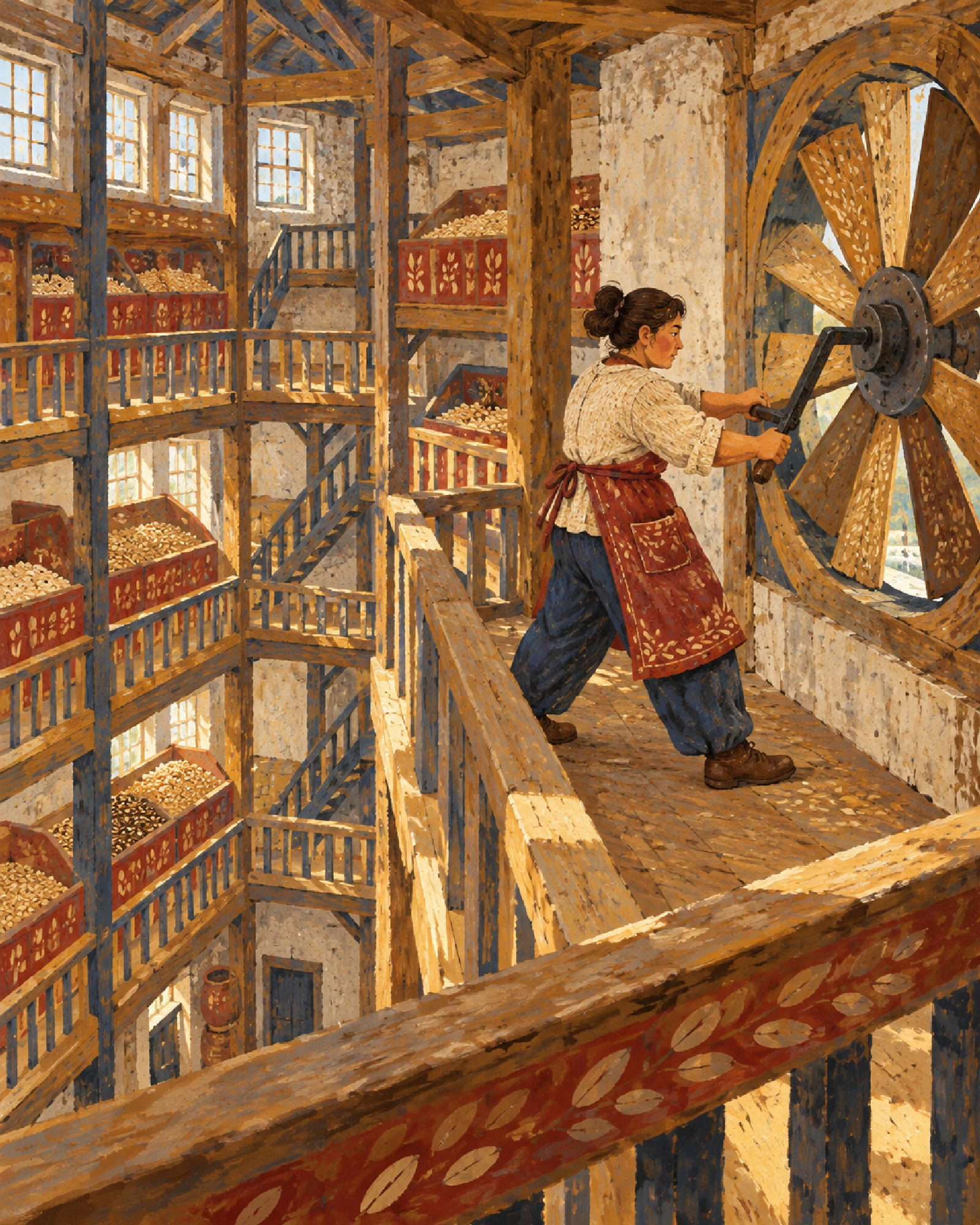
A keeper turns a great ventilation wheel in a tall seed hall surrounded by layered galleries and bins. Crooked folk contours and lively decorative brushwork animate the room.
Remix this referenceThe Vent Wheel in the Seed Hall
- Form language
- Use naive folk simplification: broad readable shapes and slightly mismatched repetitions that preserve handmade character.
- Contour
- Paint blunt, wandering outlines with occasional gaps and uneven width; let edges retain small hesitations.
- Mark-making
- Turn opaque brush dabs into loose seed-shaped ornaments and short rhythmic strokes, allowing natural variation in size and spacing.
- Surface rendering
- Layer matte paint in uneven patches, let underpaint peek through, and suggest volume with a few broad tonal steps.
Priority
Preserve the lively decorative simplification and visibly handmade surface of naive folk painting.
What to avoid & what to check
Exact prompt for this example
MODULE OWNERSHIP
subject: Subject count, type, stable proportions and landmarks, resting face geometry, hair shape, physical materials, garment construction and permanent marks. No emotion, movement, color assignment or rendering recipe.
expression: Facial soft-tissue displacement and pupil direction, muscle coordination, regional intensity, asymmetry and onset/peak/release. No head/body pose, stable appearance, skin color or rendering.
gesture: Head/neck/body/limb orientation, joint movement, support, contact and pose-caused occlusion using existing anatomy. No eye/pupil movement, emotion, identity, props inventory or camera.
props: Prop count, type, construction, physical material and scale relative to the subject. Holding/contact belongs to gesture, position to composition, color to palette.
scene: Environment elements, terrain, backdrop/floor presence and structural detail. No canvas positions, camera, lighting, assigned colors or render texture.
camera: Projection, focal-length impression, camera elevation/yaw/roll, viewing distance and crop. No actor pose, world placement, lighting or canvas aspect ratio.
composition: Normalized 0-100% canvas positions, scale in frame, depth/overlap, focal hierarchy and margins. No joint pose, camera projection, rendering, subject/prop inventory or emotion.
palette: Color anchors, hue/saturation/value ranges, colors assigned to parts and approximate color coverage. No illumination direction, shading algorithm, physical material or layout.
lighting: Light-source direction/softness/intensity, ambient illumination, physical shadow direction/length and highlight position. Absence of directional illumination is allowed. No shading technique, palette or material changes.
style: Reusable form abstraction, contour weight/taper/edge quality, medium and mark scale/density/direction, surface rendering and tonal transition technique. No fixed subject proportions, anatomy, identity, expression, pose, palette, light-source direction, camera or layout.
output: Image count, aspect ratio, size, file/alpha requirements and global lettering/logo/watermark restrictions. No background scenery, crop, style, identity or pose.

SUBJECT
inventory: A is one adult seed keeper; no other people or animals appear.
geometry: A has a sturdy adult build, broad hands, a rounded cheek, and a blunt nose.
resting-face: A has a broad brow, almond-shaped eye openings, and a short mouth with a fuller lower lip.
appearance: A has a compact hair bun and wears a woven work shirt, loose trousers, and a heavy canvas apron with a broad pocket.

PRIORITY


AVOID


CHECK


EXPRESSION — ACTOR A
brows: The visible brow draws slightly inward and down.
lids: The visible upper lid narrows slightly; the eye remains open.
cheeks: The visible cheek firms gently without lifting into a smile.
nose: The nostril stays relaxed, with no nose wrinkle.
mouth: Closed lips press together lightly, with level corners.
jaw: The jaw sets lightly without a pronounced clench.
gaze: The visible pupil tracks the crank grip.
coordination: Brow tension exceeds mouth tension; the far-side facial channels remain unprescribed.
timing: Hold the apex of quiet concentration, without a sudden reaction.

PRIORITY


AVOID


CHECK


GESTURE
head: A turns toward the wheel, keeping the near cheek and profile visible beyond the shoulder.
torso: A leans into the turn, with the back partly visible and the torso following the crank’s sweep.
limbs: One arm extends while the other bends to share the crank grip; staggered feet brace the body.
contact: Both hands grip the long crank handle, and both soles remain planted on the landing.

PRIORITY


AVOID


CHECK


PROPS
inventory: One ventilation wheel taller than A, with a connected hand crank; no loose tools.
construction: Timber blades radiate from an iron hub inside a wooden housing; the offset crank has a long grip for two hands.

PRIORITY


AVOID


CHECK


SCENE
inventory: A tall communal seed store with stacked timber galleries, built-in seed bins, narrow stairs, and high windows.
structure: Galleries wrap an open central shaft; a wheel aperture pierces the outer wall beside a broad working landing.

PRIORITY


AVOID


CHECK


CAMERA
projection: Use a wide perspective impression with gentle convergence.
viewpoint: Look diagonally into the hall from an upper gallery, slightly downward and without roll.
crop: Include A’s whole body and several gallery levels; nearby rails and upper rafters continue beyond the frame.

PRIORITY


AVOID


CHECK


COMPOSITION
placement: Place the wheel and keeper off-center to the right; the open shaft occupies the left half.
depth: A cropped near railing overlaps the lower scene; successive galleries lead inward to the working landing.
spacing: The cranking silhouette is the focal accent within the larger room; preserve clear space around the arms and profile.

PRIORITY


AVOID


CHECK


PALETTE
colors: Choose indigo, brick red, harvest ochre, chalk cream, and muted warm brown.
assignment: Use indigo for recesses and trousers, ochre for timber and skin, red for apron and bins, cream for plaster, brown for hair.
balance: Ochre and cream dominate; indigo anchors depth, while brick red recurs in small emphatic passages.

PRIORITY


AVOID


CHECK


LIGHTING
sources: Broad daylight enters through high windows on the left, softened by ample interior bounce.
shadows: Gallery undersides hold soft shelter shadows; the keeper casts a short shadow to the right.
highlights: Light catches upper rail edges, the near cheek, the extended forearm, and left-facing blade edges.

PRIORITY


AVOID


CHECK


STYLE GUIDE
form-language: Use naive folk simplification: broad readable shapes and slightly mismatched repetitions that preserve handmade character.
contour: Paint blunt, wandering outlines with occasional gaps and uneven width; let edges retain small hesitations.
mark-making: Turn opaque brush dabs into loose seed-shaped ornaments and short rhythmic strokes, allowing natural variation in size and spacing.
surface-rendering: Layer matte paint in uneven patches, let underpaint peek through, and suggest volume with a few broad tonal steps.

PRIORITY
Preserve the lively decorative simplification and visibly handmade surface of naive folk painting.

AVOID


CHECK


OUTPUT
format: One finished image, 4:5 aspect ratio, 1600 × 2000 pixels, opaque PNG.
restrictions: No lettering, labels, logos, signatures, or watermarks.

PRIORITY


AVOID


CHECK


FINAL INTEGRATION
gesture + props + composition: Keep the interaction legible within the surrounding space so the action explains the room’s use.
expression + style: Carry the restrained facial acting through the same simplified visual language as the rest of the painting.
Model information comes from image provenance. The same prompt may produce a different result.