Text to imageProductStyle guide
Forked Bootjack and Muddy Boot
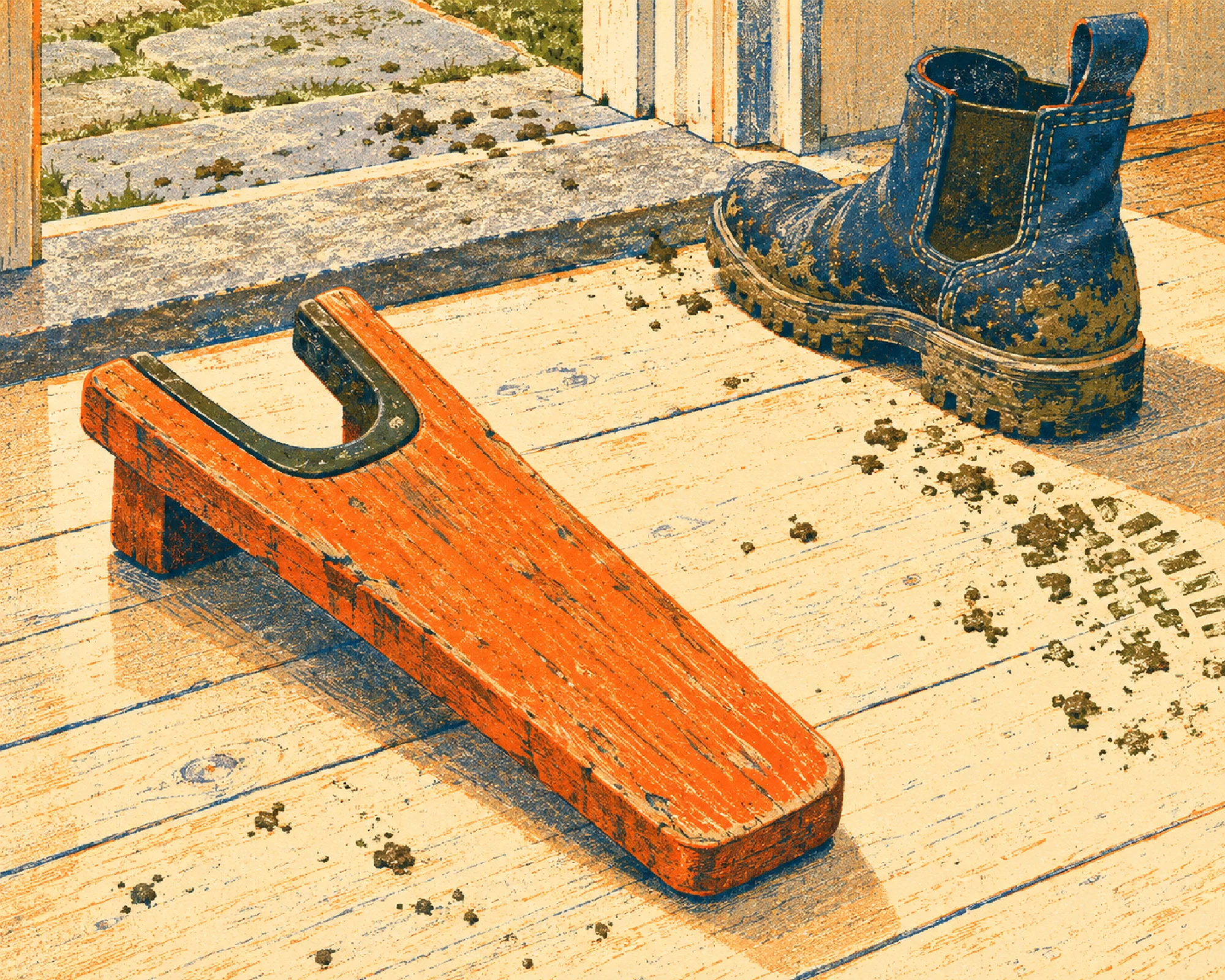
A sculptural wooden bootjack sits at a threshold beside a removed boot. Wood grain and muddy traces answer across spacious flooring in a riso product illustration with grain and playful registration shifts.
Remix this referenceForked Bootjack and Muddy Boot
- Form language
- Reduce volumes to generous cut shapes with slightly lopsided curves; preserve functional openings through clear shape contrast.
- Contour
- Use blunt, lightly ragged edges with occasional short contour strokes; let separate printed edges disagree playfully.
- Mark-making
- Let coarse riso grain interrupt broad areas, with loose lengthwise streaks and sparse stamped scuffs; vary the marks organically.
- Surface rendering
- Build tone from translucent spot-ink overlaps and broken halftone patches; registration shifts leave narrow exposed fringes.
Priority
Keep the riso process visible through grain, overprinting and lively registration offsets.
What to avoid & what to check
Exact prompt for this example
MODULE OWNERSHIP
subject: Subject count, type, stable proportions and landmarks, resting face geometry, hair shape, physical materials, garment construction and permanent marks. No emotion, movement, color assignment or rendering recipe.
expression: Facial soft-tissue displacement and pupil direction, muscle coordination, regional intensity, asymmetry and onset/peak/release. No head/body pose, stable appearance, skin color or rendering.
gesture: Head/neck/body/limb orientation, joint movement, support, contact and pose-caused occlusion using existing anatomy. No eye/pupil movement, emotion, identity, props inventory or camera.
props: Prop count, type, construction, physical material and scale relative to the subject. Holding/contact belongs to gesture, position to composition, color to palette.
scene: Environment elements, terrain, backdrop/floor presence and structural detail. No canvas positions, camera, lighting, assigned colors or render texture.
camera: Projection, focal-length impression, camera elevation/yaw/roll, viewing distance and crop. No actor pose, world placement, lighting or canvas aspect ratio.
composition: Normalized 0-100% canvas positions, scale in frame, depth/overlap, focal hierarchy and margins. No joint pose, camera projection, rendering, subject/prop inventory or emotion.
palette: Color anchors, hue/saturation/value ranges, colors assigned to parts and approximate color coverage. No illumination direction, shading algorithm, physical material or layout.
lighting: Light-source direction/softness/intensity, ambient illumination, physical shadow direction/length and highlight position. Absence of directional illumination is allowed. No shading technique, palette or material changes.
style: Reusable form abstraction, contour weight/taper/edge quality, medium and mark scale/density/direction, surface rendering and tonal transition technique. No fixed subject proportions, anatomy, identity, expression, pose, palette, light-source direction, camera or layout.
output: Image count, aspect ratio, size, file/alpha requirements and global lettering/logo/watermark restrictions. No background scenery, crop, style, identity or pose.

SUBJECT
inventory: One original wooden bootjack is the product subject; no human or animal subjects.
geometry: A long paddle body ends in a generous U-shaped heel cradle, raised by a low wedge beneath its forked end.
resting-face: No face or facial geometry applies.
appearance: Carved hardwood has softened edges and an inset rubber cradle lining; natural grain and minor wear may vary.

PRIORITY


AVOID


CHECK


PROPS
inventory: One muddy ankle boot accompanies the bootjack; its heel fits the cradle and its overall length is slightly shorter.
construction: The boot has a leather upper, a broad pull tab and a thick treaded rubber sole with lodged earth.

PRIORITY


AVOID


CHECK


SCENE
inventory: A mudroom floor meets a shallow stone threshold and a narrow strip of outdoor paving; no distant scenery.
structure: Broad floorboards end at the threshold; a few broken soil deposits and an incomplete tread impression suggest recent use.

PRIORITY


AVOID


CHECK


CAMERA
projection: Use gentle perspective with a normal focal-length impression and little near-edge enlargement.
viewpoint: Look down obliquely from standing height, slightly across the threshold, with no camera roll.
crop: Show the whole bootjack and boot within a roomy environmental product view; crop the surrounding doorway structure.

PRIORITY


AVOID


CHECK


COMPOSITION
placement: Place the bootjack diagonally in the lower-left half and the boot farther back at upper right; the threshold crosses near the top.
depth: Give the bootjack first emphasis, the boot second and the tread trace third; keep the two silhouettes separate.
spacing: Leave a broad irregular floor interval between the objects and generous breathing room toward the lower right.

PRIORITY


AVOID


CHECK


PALETTE
colors: Use warm cream, persimmon orange, petrol blue and a muted olive.
assignment: Give the bootjack orange, the boot petrol blue and the floor cream; use olive for soil traces and selected dark passages.
balance: Cream occupies the largest area; orange stays concentrated and blue forms a smaller counterweight.

PRIORITY


AVOID


CHECK


LIGHTING
sources: Soft daylight enters from the doorway at upper left, with moderate ambient fill inside.
shadows: Short soft shadows extend toward the lower right; a compact contact shadow reveals the bootjack's raised end.
highlights: Broad subdued highlights follow the upper cradle rim and the boot's doorway-facing shoulder.

PRIORITY


AVOID


CHECK


STYLE GUIDE
form-language: Reduce volumes to generous cut shapes with slightly lopsided curves; preserve functional openings through clear shape contrast.
contour: Use blunt, lightly ragged edges with occasional short contour strokes; let separate printed edges disagree playfully.
mark-making: Let coarse riso grain interrupt broad areas, with loose lengthwise streaks and sparse stamped scuffs; vary the marks organically.
surface-rendering: Build tone from translucent spot-ink overlaps and broken halftone patches; registration shifts leave narrow exposed fringes.

PRIORITY
Keep the riso process visible through grain, overprinting and lively registration offsets.

AVOID


CHECK


OUTPUT
format: One finished image, landscape 5:4, 2000 × 1600 pixels, opaque PNG.
restrictions: No lettering, logos, watermarks or presentation borders.

PRIORITY


AVOID


CHECK


FINAL INTEGRATION
subject + camera + style: Keep the product's functional construction readable as perspective and print abstraction work together.
scene + composition + style: Let incidental traces connect the environmental setting and product arrangement without becoming an explanatory diagram.
Model information comes from image provenance. The same prompt may produce a different result.