Text to imageLandscapeStyle guide
Farmed Hill · Terrain-Wrapping Furrows
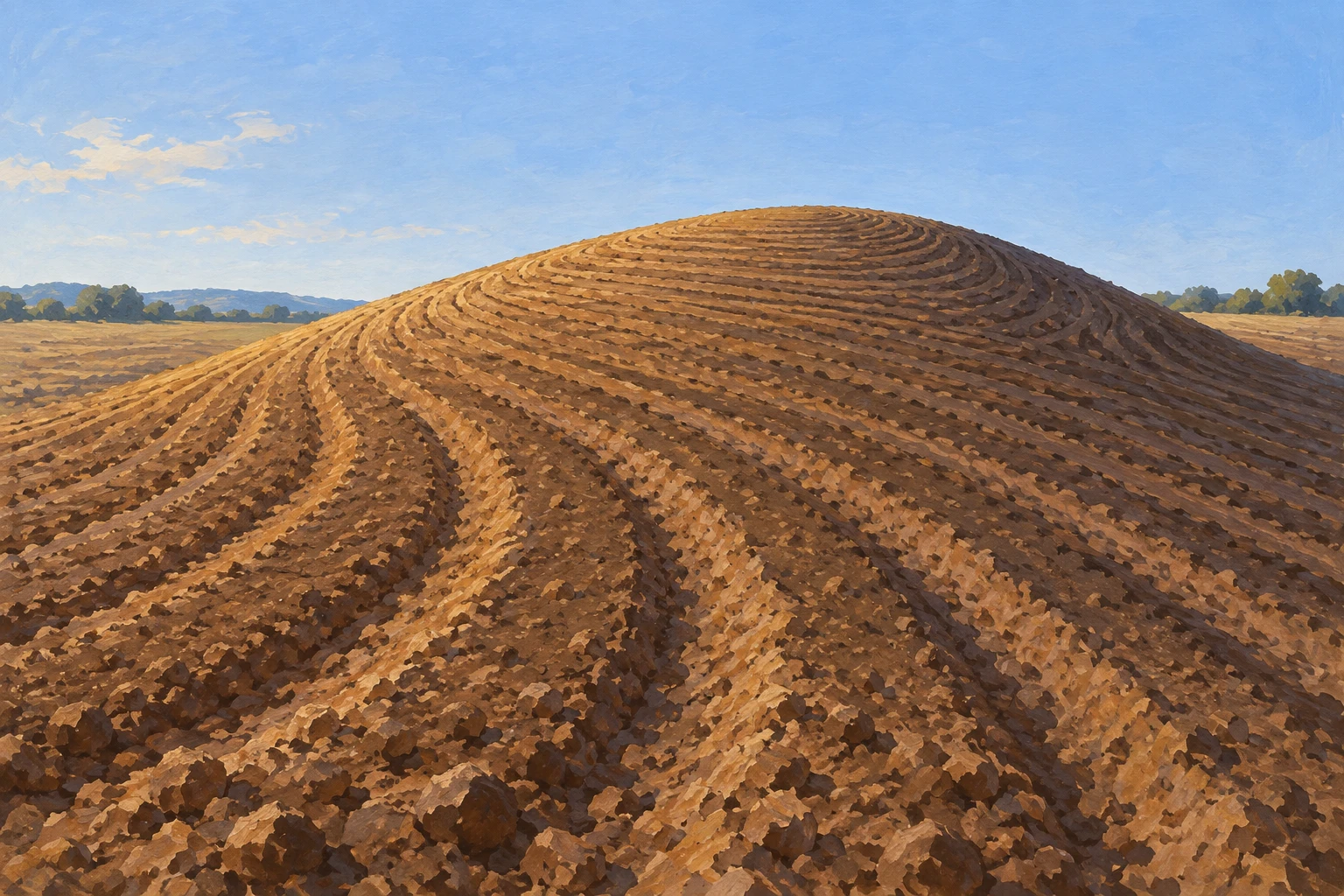
Reveal the volume of a low, rounded farmed hill through the curvature and spacing of furrows wrapping around its terrain.
Farmed Hill · Terrain-Wrapping Furrows
- Shape & line
- Draw the furrows as nested, gently bending curves that arc across the near slope and turn around both sides of the hill. Make the curves flatten as they approach the crest, and let some disappear behind the side contours so they describe a rounded landform.
- Color & light
- Light the hill from the upper left of the image, placing warm ochre highlights on the image-left lips of the furrows and muted brown shadows in their image-right troughs. Keep these alternating accents subordinate to the broad transition from the brighter left slope to the darker right slope.
- Texture & material
- Use opaque gouache with dry, broken brush marks to suggest crumbly soil between the furrows. Show a few broad clods on the lower foreground slope, then simplify the texture into small grouped marks toward the crest while retaining the continuous furrow paths.
- Composition
- Keep the widest visible gaps between furrows along the lower image edge, compressing the gaps progressively toward the crest. Leave a narrow strip of flat field on each side and a plain pale-blue sky above, so the curved rows remain the dominant guide to the hill's depth.
Priority
Prioritize furrow curvature that clearly follows the hill's rounded surface.
What to avoid & what to check
Avoid straight parallel stripes or curves that float above the soil.
Check that the curved paths, narrowing gaps, and consistent light make the hill read as a single solid volume.
Exact prompt for this example
SUBJECT
One low, rounded hill covered with freshly tilled soil and continuous curved furrows, surrounded by a simple flat field beneath a clear sky. The furrows follow the hill's surface and visibly wrap from its near slope toward its sides.

COMPOSITION
Use a landscape view from slightly above the adjoining field. Center the hill's crest just right of the image midpoint, with its near slope filling the lower half and its full silhouette visible against a quiet sky in the upper third.

STYLE GUIDE
1. Shape & line
Draw the furrows as nested, gently bending curves that arc across the near slope and turn around both sides of the hill. Make the curves flatten as they approach the crest, and let some disappear behind the side contours so they describe a rounded landform.

2. Color & light
Light the hill from the upper left of the image, placing warm ochre highlights on the image-left lips of the furrows and muted brown shadows in their image-right troughs. Keep these alternating accents subordinate to the broad transition from the brighter left slope to the darker right slope.

3. Texture & material
Use opaque gouache with dry, broken brush marks to suggest crumbly soil between the furrows. Show a few broad clods on the lower foreground slope, then simplify the texture into small grouped marks toward the crest while retaining the continuous furrow paths.

4. Composition
Keep the widest visible gaps between furrows along the lower image edge, compressing the gaps progressively toward the crest. Leave a narrow strip of flat field on each side and a plain pale-blue sky above, so the curved rows remain the dominant guide to the hill's depth.

PRIORITY
Preserve the requested identity, count, action, composition and output settings. Apply the style rules within those constraints; a style reference must not replace the subject or layout. Within the style: Prioritize furrow curvature that clearly follows the hill's rounded surface.

AVOID
Avoid straight parallel stripes or curves that float above the soil.

OUTPUT
Create one landscape image in a 3:2 aspect ratio, rendered as a restrained gouache landscape study, with no text, labels, border, or watermark.

SELF-CHECK
Check that the curved paths, narrowing gaps, and consistent light make the hill read as a single solid volume.
Model information comes from image provenance. The same prompt may produce a different result.