Text to imageAnimationStyle guide
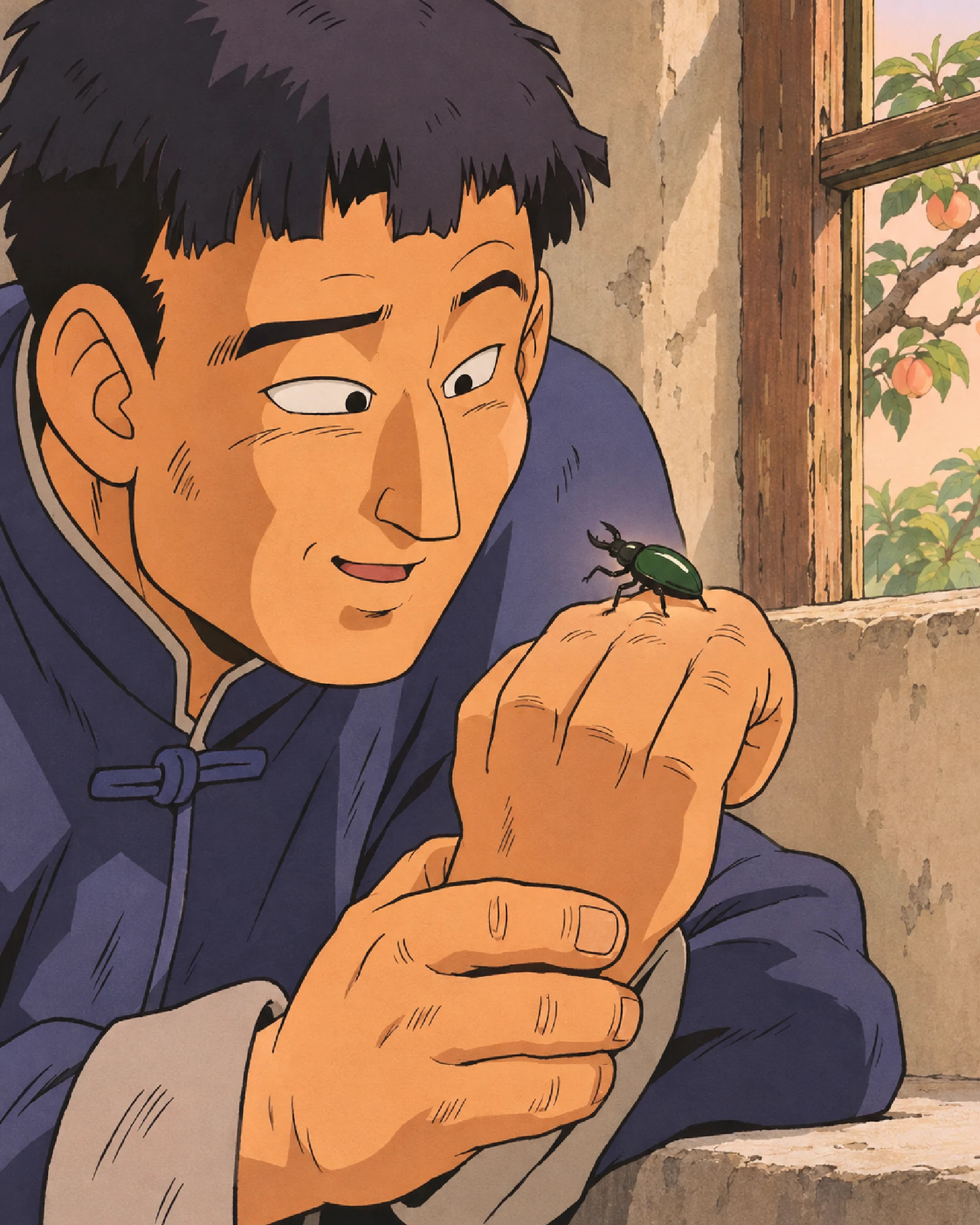
A Night Guard Watching a Beetle on His Knuckles
Inside a gatehouse at dawn, a guard studies a beetle on his knuckles. Large foreground hands and a tentative smile give this intimate cel-animation scene its quiet warmth.
Remix this referenceA Night Guard Watching a Beetle on His Knuckles
- Form language
- Combine rounded masses with clear wedge-like facets; simplify small forms into readable silhouettes while allowing slight irregularity.
- Contour
- Use continuous ink exterior contours and finer interior separators, with modest taper and a little hand-drawn drift.
- Mark-making
- Use short tapered crease strokes and sparse marks inside filled areas; let stroke length vary naturally within the same drawing language.
- Surface rendering
- Use hard-edged base fills and one secondary tonal plane, restrained cel-surface texture and occasional broad painted transitions.
Priority
Rendering medium: 2D Japanese television-anime cel illustration; formal rendering reference: Toei Animation · 1980s · Dragon Ball (1986)
What to avoid & what to check
Exact prompt for this example
MODULE OWNERSHIP
subject: Subject count, type, stable proportions and landmarks, resting face geometry, hair shape, physical materials, garment construction and permanent marks. No emotion, movement, color assignment or rendering recipe.
expression: Facial soft-tissue displacement and pupil direction, muscle coordination, regional intensity, asymmetry and onset/peak/release. No head/body pose, stable appearance, skin color or rendering.
gesture: Head/neck/body/limb orientation, joint movement, support, contact and pose-caused occlusion using existing anatomy. No eye/pupil movement, emotion, identity, props inventory or camera.
props: Prop count, type, construction, physical material and scale relative to the subject. Holding/contact belongs to gesture, position to composition, color to palette.
scene: Environment elements, terrain, backdrop/floor presence and structural detail. No canvas positions, camera, lighting, assigned colors or render texture.
camera: Projection, focal-length impression, camera elevation/yaw/roll, viewing distance and crop. No actor pose, world placement, lighting or canvas aspect ratio.
composition: Normalized 0-100% canvas positions, scale in frame, depth/overlap, focal hierarchy and margins. No joint pose, camera projection, rendering, subject/prop inventory or emotion.
palette: Color anchors, hue/saturation/value ranges, colors assigned to parts and approximate color coverage. No illumination direction, shading algorithm, physical material or layout.
lighting: Light-source direction/softness/intensity, ambient illumination, physical shadow direction/length and highlight position. Absence of directional illumination is allowed. No shading technique, palette or material changes.
style: Reusable form abstraction, contour weight/taper/edge quality, medium and mark scale/density/direction, surface rendering and tonal transition technique. No fixed subject proportions, anatomy, identity, expression, pose, palette, light-source direction, camera or layout.
output: Image count, aspect ratio, size, file/alpha requirements and global lettering/logo/watermark restrictions. No background scenery, crop, style, identity or pose.

SUBJECT
inventory: One original middle-aged human gate guard, actor A, and one small stag beetle.
geometry: A has a broad compact build, substantial hands, a long narrow nose and a cropped fringe shaped into an uneven shelf.
resting-face: A has broad cheeks, low straight brows, narrow almond eye openings and a small mouth with a full lower lip.
appearance: A wears a cotton work jacket with a standing collar and broad turned cuffs; the beetle has an oval shell and short forked mandibles.

PRIORITY


AVOID


CHECK


EXPRESSION — ACTOR A
brows: Lift the inner brows slightly, with one rising a little sooner.
lids: Open the upper lids modestly; keep the lower lids softly engaged.
cheeks: Let one cheek rise faintly as the smile begins.
nose: Keep the nostrils relaxed without flaring or wrinkling.
mouth: Part the lips narrowly and lift one corner into a tentative smile.
jaw: Release the jaw slightly, without a pronounced drop.
gaze: Direct both pupils toward the beetle, with gentle near-focus convergence.
coordination: Let attentive eyes lead the smaller, slower change around the mouth.
timing: Catch curiosity at onset, just as a restrained smile begins to form.

PRIORITY


AVOID


CHECK


GESTURE
head: A dips his chin and extends his neck slightly toward his raised hand.
torso: He leans forward from the waist, shoulders uneven as one elbow takes his weight.
limbs: One forearm rises with loosely curled fingers; the other hand cups the raised wrist.
contact: The supporting elbow rests on the sill; the beetle straddles two knuckles with one foreleg lifted.

PRIORITY


AVOID


CHECK


PROPS
inventory: No separate props.
construction: No prop construction applies.

PRIORITY


AVOID


CHECK


SCENE
inventory: A modest gatehouse interior with a deep stone window sill, an open window and a glimpse of orchard branches.
structure: Thick plaster walls surround the recessed window; a worn wooden jamb provides a simple architectural edge.

PRIORITY


AVOID


CHECK


CAMERA
projection: Perspective with a mild short-telephoto impression and little near-hand distortion.
viewpoint: Close viewing distance, near eye height, with a three-quarter view of A and a level camera.
crop: An intimate bust crop clips the hair crown and lower sleeves while retaining the complete raised hand.

PRIORITY


AVOID


CHECK


COMPOSITION
placement: A's face occupies the upper-left third; raised knuckles occupy the lower-right third, with the beetle between them.
depth: The hands overlap the jacket in the foreground; the face follows behind, with window architecture at the rear.
spacing: The face leads and the tiny beetle rewards a second look; preserve an open wedge between cheek and knuckles.

PRIORITY


AVOID


CHECK


PALETTE
colors: Muted indigo, warm limestone, honey amber, pale apricot and a concentrated bottle-green accent.
assignment: Indigo jacket, amber skin, charcoal hair, limestone walls, apricot window opening and bottle-green beetle shell.
balance: Indigo and limestone occupy most of the image; amber forms the main warm area and green remains a tiny accent.

PRIORITY


AVOID


CHECK


LIGHTING
sources: Broad soft dawn light enters from the upper right; weak interior ambient light keeps the opposite side legible.
shadows: The nose and fingers cast soft shadows down-left; a small contact shadow anchors the beetle to the knuckles.
highlights: Place restrained highlights on the upper-right cheek, knuckle ridges and beetle shell.

PRIORITY


AVOID


CHECK


STYLE GUIDE
form-language: Combine rounded masses with clear wedge-like facets; simplify small forms into readable silhouettes while allowing slight irregularity.
contour: Use continuous ink exterior contours and finer interior separators, with modest taper and a little hand-drawn drift.
mark-making: Use short tapered crease strokes and sparse marks inside filled areas; let stroke length vary naturally within the same drawing language.
surface-rendering: Use hard-edged base fills and one secondary tonal plane, restrained cel-surface texture and occasional broad painted transitions.

PRIORITY
Rendering medium: 2D Japanese television-anime cel illustration; formal rendering reference: Toei Animation · 1980s · Dragon Ball (1986)

AVOID


CHECK


OUTPUT
format: One finished image, 4:5 portrait aspect ratio, 1600 × 2000 pixels, opaque PNG.
restrictions: No lettering, logos, captions or watermarks.

PRIORITY


AVOID


CHECK


FINAL INTEGRATION
expression + gesture + composition: Coordinate the facial response, supported hand and intervening space so their relationship reads immediately.
Art direction
토에이 애니메이션 / Toei Animation · 1980s · 드래곤볼(1986) / Dragon Ball (1986) ↗- Combine rounded masses and wedge-like facets into readable form abstractions
- Continuous ink exterior contours with finer interior separators
- Short tapered crease marks and sparse marks inside filled areas
- Hard-edged base and single secondary tonal planes with restrained cel-surface texture
Model information comes from image provenance. The same prompt may produce a different result.