Text to imageProductStyle guide
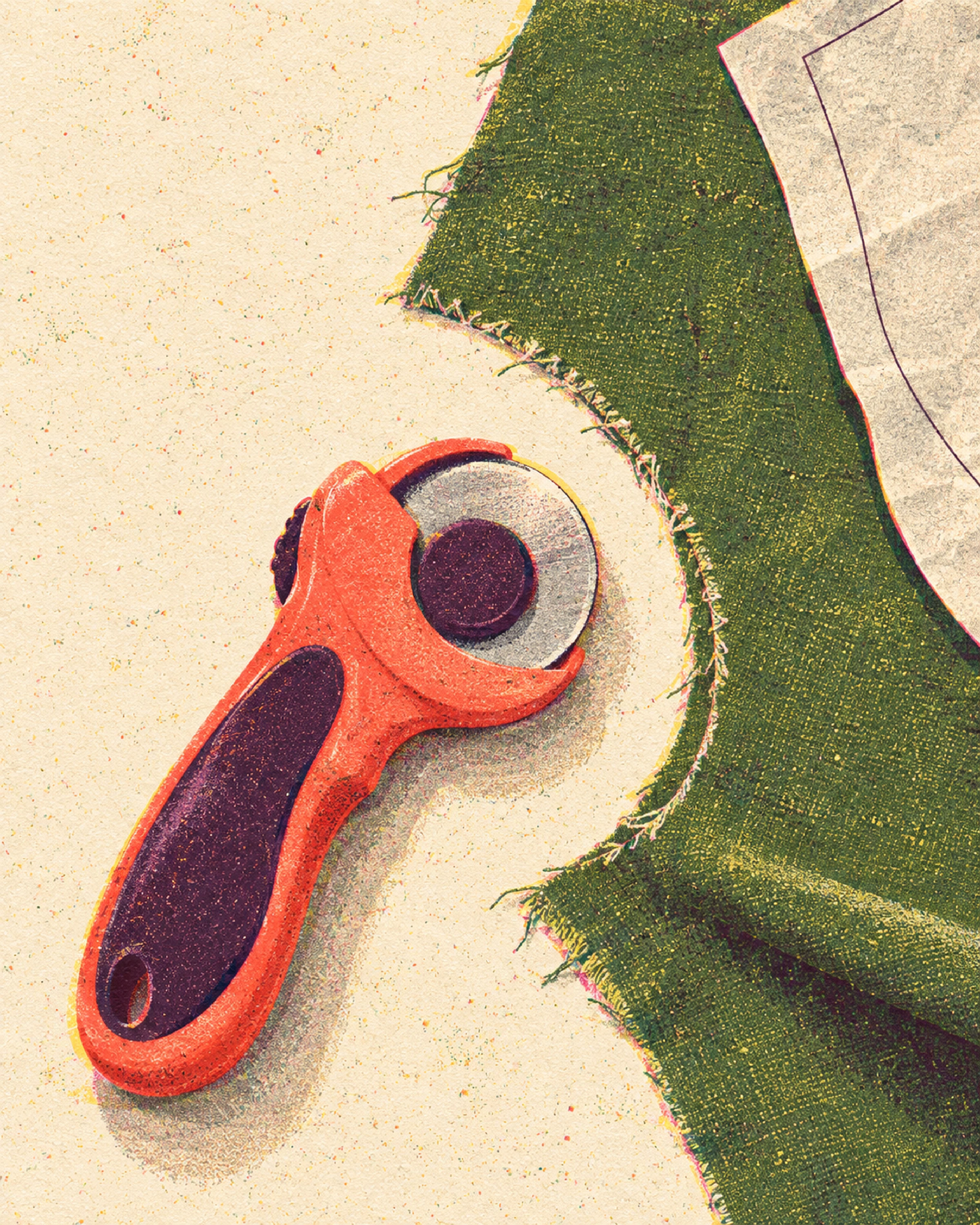
Rotary Cutter Beside a Crescent Cut
A product illustration pairing a rotary cutter with a crescent-shaped fabric cut and generous negative space. Grainy riso ink and playful registration offsets give the cutting tool a lively graphic rhythm.
Remix this referenceRotary Cutter Beside a Crescent Cut
- Form language
- Reduce forms into bold cut-stencil masses with a few useful internal openings; allow small shape variations.
- Contour
- Use slightly ragged ink boundaries and occasional heavy contour fragments rather than continuous outlines.
- Mark-making
- Let irregular riso grain break through broad ink areas; offset selected color plates to create lively edge echoes.
- Surface rendering
- Build tone through translucent overprints and broken ink density, retaining uneven absorption and exposed paper.
Priority
Make grain and selective registration offsets visibly characteristic of riso printing.
What to avoid & what to check
Exact prompt for this example
MODULE OWNERSHIP
subject: Subject count, type, stable proportions and landmarks, resting face geometry, hair shape, physical materials, garment construction and permanent marks. No emotion, movement, color assignment or rendering recipe.
expression: Facial soft-tissue displacement and pupil direction, muscle coordination, regional intensity, asymmetry and onset/peak/release. No head/body pose, stable appearance, skin color or rendering.
gesture: Head/neck/body/limb orientation, joint movement, support, contact and pose-caused occlusion using existing anatomy. No eye/pupil movement, emotion, identity, props inventory or camera.
props: Prop count, type, construction, physical material and scale relative to the subject. Holding/contact belongs to gesture, position to composition, color to palette.
scene: Environment elements, terrain, backdrop/floor presence and structural detail. No canvas positions, camera, lighting, assigned colors or render texture.
camera: Projection, focal-length impression, camera elevation/yaw/roll, viewing distance and crop. No actor pose, world placement, lighting or canvas aspect ratio.
composition: Normalized 0-100% canvas positions, scale in frame, depth/overlap, focal hierarchy and margins. No joint pose, camera projection, rendering, subject/prop inventory or emotion.
palette: Color anchors, hue/saturation/value ranges, colors assigned to parts and approximate color coverage. No illumination direction, shading algorithm, physical material or layout.
lighting: Light-source direction/softness/intensity, ambient illumination, physical shadow direction/length and highlight position. Absence of directional illumination is allowed. No shading technique, palette or material changes.
style: Reusable form abstraction, contour weight/taper/edge quality, medium and mark scale/density/direction, surface rendering and tonal transition technique. No fixed subject proportions, anatomy, identity, expression, pose, palette, light-source direction, camera or layout.
output: Image count, aspect ratio, size, file/alpha requirements and global lettering/logo/watermark restrictions. No background scenery, crop, style, identity or pose.

SUBJECT
inventory: One original handheld rotary fabric cutter.
geometry: A circular blade sits within a broad crescent guard beneath a short, substantial curved handle.
resting-face: No face or facial landmarks.
appearance: Molded polymer housing, a steel blade, and a recessed rubber grip; no permanent markings.

PRIORITY


AVOID


CHECK


PROPS
inventory: One cotton panel with a crescent cutaway and one tissue-paper pattern, each broader than the cutter.
construction: The cotton has a loose folded edge and slight fraying; the thin pattern is an irregular curved template.

PRIORITY


AVOID


CHECK


SCENE
inventory: A bare worktable surface with no surrounding room visible.
structure: The tabletop is continuous, without a visible rim or additional fittings.

PRIORITY


AVOID


CHECK


CAMERA
projection: Near-orthographic projection keeps the blade and pattern shapes easy to read.
viewpoint: Look almost straight down from close overhead, with no camera roll.
crop: Show the entire cutter while allowing the fabric and pattern to extend beyond the frame.

PRIORITY


AVOID


CHECK


COMPOSITION
placement: Place the cutter diagonally in the lower left; the fabric sweeps inward from the right around its blade.
depth: The pattern overlaps the fabric at the right edge; the cutter remains the first read, the curved cut the second.
spacing: Leave a broad open upper-left field and a clear crescent of tabletop between the tool and cut edge.

PRIORITY


AVOID


CHECK


PALETTE
colors: Use punch coral, moss green, deep plum, and warm paper cream.
assignment: Give the housing coral, the fabric moss, the grip and blade accents plum, and the table and pattern cream.
balance: Let cream dominate, with a broad muted green area and concentrated coral and plum accents.

PRIORITY


AVOID


CHECK


LIGHTING
sources: Broad soft daylight enters from the upper left with gentle ambient fill.
shadows: Short, soft shadows fall toward the lower right beneath the cutter and folded edge.
highlights: Keep a restrained highlight along the upper-left blade rim.

PRIORITY


AVOID


CHECK


STYLE GUIDE
form-language: Reduce forms into bold cut-stencil masses with a few useful internal openings; allow small shape variations.
contour: Use slightly ragged ink boundaries and occasional heavy contour fragments rather than continuous outlines.
mark-making: Let irregular riso grain break through broad ink areas; offset selected color plates to create lively edge echoes.
surface-rendering: Build tone through translucent overprints and broken ink density, retaining uneven absorption and exposed paper.

PRIORITY
Make grain and selective registration offsets visibly characteristic of riso printing.

AVOID


CHECK


OUTPUT
format: One finished image, portrait 4:5, 2400 × 3000 pixels, opaque PNG; no text, logos, or watermarks.
restrictions: One finished image, portrait 4:5, 2400 × 3000 pixels, opaque PNG; no text, logos, or watermarks.

PRIORITY


AVOID


CHECK
Model information comes from image provenance. The same prompt may produce a different result.