Text to imageCharacterStyle guide
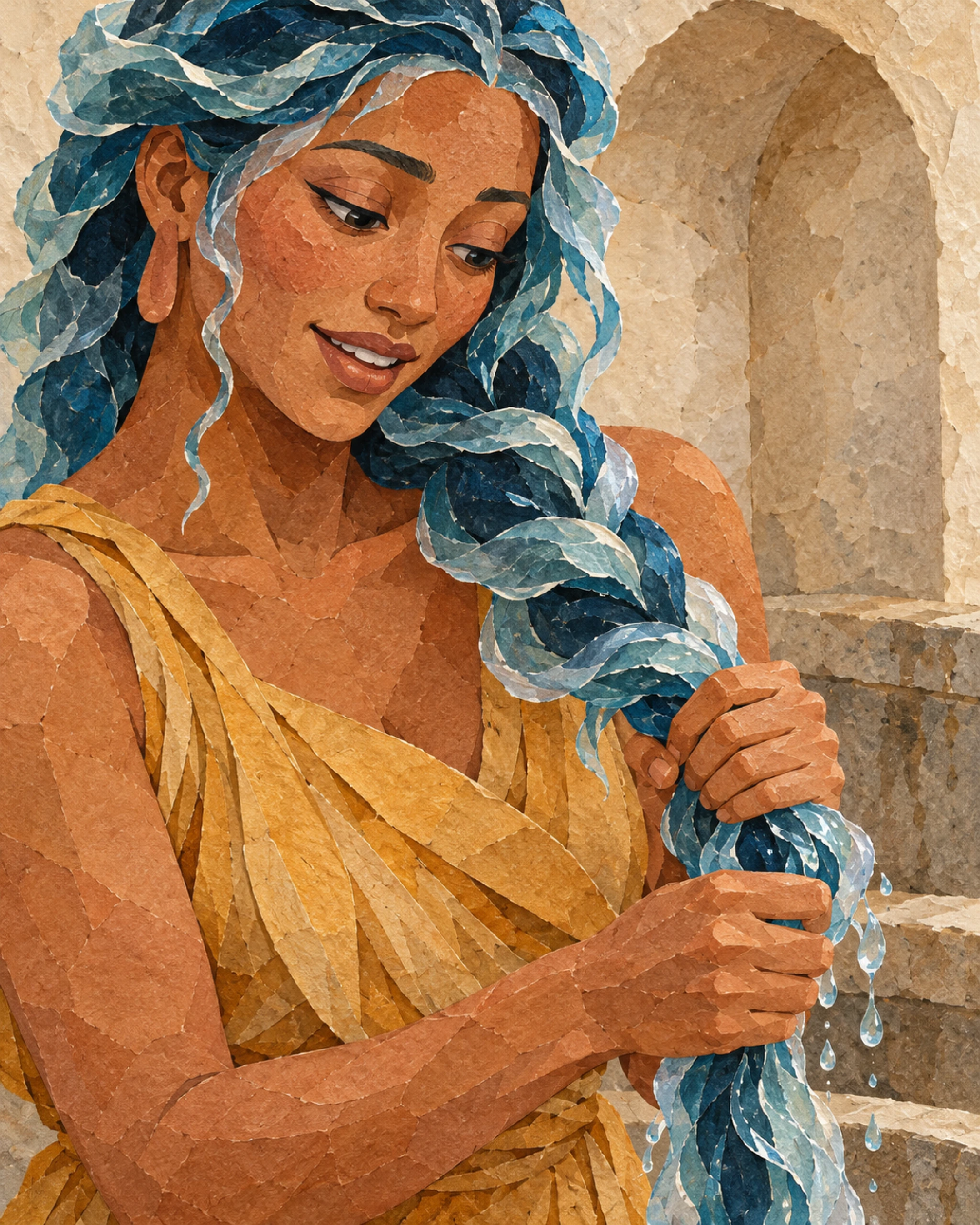
Rain-Haired Woman Wringing Her Braid
A rain spirit smiles while wringing her thick braid of water. Overlapping colored paper, translucent tissue, and expressive cropping create an intimate, tactile portrait.
Remix this referenceRain-Haired Woman Wringing Her Braid
- Form language
- Build forms from broad, interlocking cut-paper shapes; stacked opaque paper and translucent tissue create tangible depth.
- Contour
- Let cut edges define contours without a continuous outline; combine decisive scissor curves with occasional softly torn edges.
- Mark-making
- Use sparse dry-brushed streaks and uneven pigment deposits within the paper pieces; allow small handmade variations.
- Surface rendering
- Create tonal shifts through overlapping stained sheets and tissue transparency; retain wrinkles, lifted corners, and visible paper fibers.
Priority
The finished image must visibly read as layered cut-paper collage with tactile overlaps.
What to avoid & what to check
Exact prompt for this example
MODULE OWNERSHIP
subject: Subject count, type, stable proportions and landmarks, resting face geometry, hair shape, physical materials, garment construction and permanent marks. No emotion, movement, color assignment or rendering recipe.
expression: Facial soft-tissue displacement and pupil direction, muscle coordination, regional intensity, asymmetry and onset/peak/release. No head/body pose, stable appearance, skin color or rendering.
gesture: Head/neck/body/limb orientation, joint movement, support, contact and pose-caused occlusion using existing anatomy. No eye/pupil movement, emotion, identity, props inventory or camera.
props: Prop count, type, construction, physical material and scale relative to the subject. Holding/contact belongs to gesture, position to composition, color to palette.
scene: Environment elements, terrain, backdrop/floor presence and structural detail. No canvas positions, camera, lighting, assigned colors or render texture.
camera: Projection, focal-length impression, camera elevation/yaw/roll, viewing distance and crop. No actor pose, world placement, lighting or canvas aspect ratio.
composition: Normalized 0-100% canvas positions, scale in frame, depth/overlap, focal hierarchy and margins. No joint pose, camera projection, rendering, subject/prop inventory or emotion.
palette: Color anchors, hue/saturation/value ranges, colors assigned to parts and approximate color coverage. No illumination direction, shading algorithm, physical material or layout.
lighting: Light-source direction/softness/intensity, ambient illumination, physical shadow direction/length and highlight position. Absence of directional illumination is allowed. No shading technique, palette or material changes.
style: Reusable form abstraction, contour weight/taper/edge quality, medium and mark scale/density/direction, surface rendering and tonal transition technique. No fixed subject proportions, anatomy, identity, expression, pose, palette, light-source direction, camera or layout.
output: Image count, aspect ratio, size, file/alpha requirements and global lettering/logo/watermark restrictions. No background scenery, crop, style, identity or pose.

SUBJECT
inventory: A is one original adult rain spirit with a human body and hair made of coherent ribbons of water.
geometry: Use a long oval face, broad shoulders, elongated earlobes, and a thick braid joining broad, scalloped hair ribbons.
resting-face: At rest, the brows are shallow arches, the eyes almond-shaped, the nose broad-tipped, and the lips full.
appearance: She has ordinary skin and a sleeveless linen wrap tunic; the water braid has no ties or ornaments.

PRIORITY


AVOID


CHECK


EXPRESSION — ACTOR A
brows: The inner brows lift slightly without drawing together.
lids: The lower lids rise gently; the upper lids stay relaxed.
cheeks: The cheeks begin to lift, slightly more on her left.
nose: The nostrils remain relaxed with no bridge wrinkle.
mouth: A small parted smile begins, with her left corner leading.
jaw: The jaw releases just enough to separate the lips.
gaze: Both pupils turn down toward the falling droplets.
coordination: The cheek lift supports the uneven smile while the forehead stays soft.
timing: Catch the first delighted response as droplets emerge, before a full smile.

PRIORITY


AVOID


CHECK


GESTURE
head: A dips her chin and inclines her neck toward the braid.
torso: Her torso turns slightly toward the braid, with one shoulder advanced.
limbs: Bent arms bring both hands together; the hands counter-rotate around the braid.
contact: Her upper hand braces the braid while the lower hand compresses it, releasing a short run of droplets.

PRIORITY


AVOID


CHECK


PROPS
inventory: No separate props.
construction: No prop construction applies.

PRIORITY


AVOID


CHECK


SCENE
inventory: A shallow plaster washing alcove provides the backdrop; the floor is unseen.
structure: One rounded recess and a low stone splash ledge suggest a modest washing space.

PRIORITY


AVOID


CHECK


CAMERA
projection: Use restrained perspective with the natural compression of a short portrait lens.
viewpoint: View from face height in a gentle three-quarter view, with no camera roll.
crop: Frame closely from the crown to the upper torso; trim the crown and near upper arm while retaining both hands.

PRIORITY


AVOID


CHECK


COMPOSITION
placement: Place the face near 35% across and 32% down; the hands and braid form a secondary focus around the lower right.
depth: The braid overlaps the near shoulder, the hands overlap the braid, and the alcove stays behind the figure.
spacing: Let the figure fill most of the frame, with a quiet opening between face and braid that keeps the droplets legible.

PRIORITY


AVOID


CHECK


PALETTE
colors: Use warm terracotta, deep petrol blue, pale celadon, chalk cream, and a restrained saffron accent.
assignment: Assign terracotta to skin, petrol and celadon to water hair, saffron to the tunic, and cream to the alcove.
balance: Warm skin and pale surroundings occupy the broad areas; the darkest blue belongs to the braid's inner divisions.

PRIORITY


AVOID


CHECK


LIGHTING
sources: Broad, soft light enters from the upper left, supported by gentle ambient illumination.
shadows: Short shadows fall down and right beneath raised edges, fingers, and the chin.
highlights: Soft highlights touch the upper-left edges of the water ribbons and the cheek nearest the light.

PRIORITY


AVOID


CHECK


STYLE GUIDE
form-language: Build forms from broad, interlocking cut-paper shapes; stacked opaque paper and translucent tissue create tangible depth.
contour: Let cut edges define contours without a continuous outline; combine decisive scissor curves with occasional softly torn edges.
mark-making: Use sparse dry-brushed streaks and uneven pigment deposits within the paper pieces; allow small handmade variations.
surface-rendering: Create tonal shifts through overlapping stained sheets and tissue transparency; retain wrinkles, lifted corners, and visible paper fibers.

PRIORITY
The finished image must visibly read as layered cut-paper collage with tactile overlaps.

AVOID


CHECK


OUTPUT
format: Produce one finished image, portrait 4:5, 2048 × 2560 pixels, as an opaque PNG.
restrictions: Include no lettering, logos, or watermarks.

PRIORITY


AVOID


CHECK


FINAL INTEGRATION
subject + style: Translate the water hair through the collage vocabulary while preserving its identity as part of the character.
gesture + expression + composition: Let the visible action and facial response connect across the open interval without competing for attention.
Model information comes from image provenance. The same prompt may produce a different result.