Text to imageCharacterStyle guide
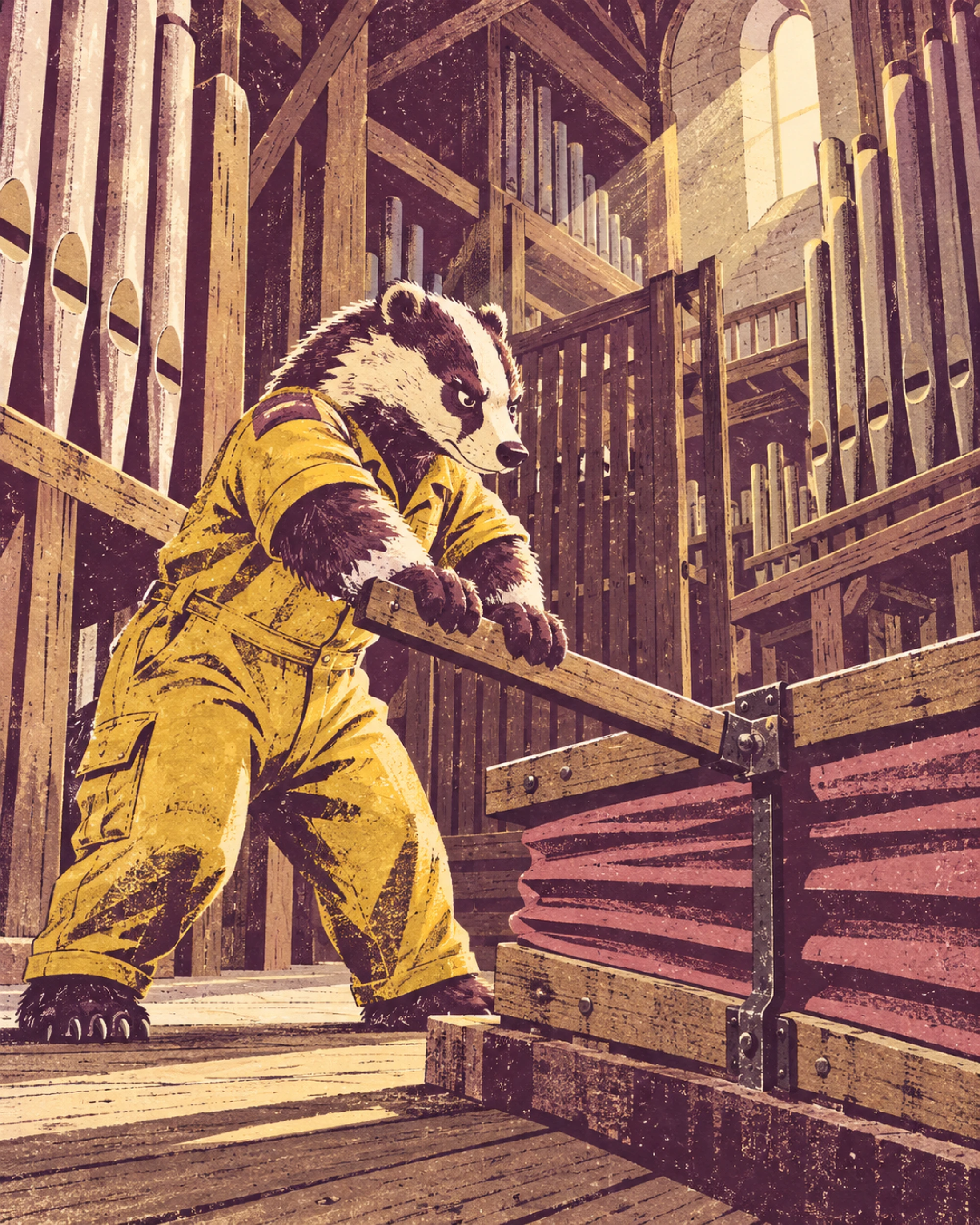
Badger at the Organ Bellows
A badger keeper presses an organ's bellows handle with his whole weight. Layered pipes and broken ink edges turn the enclosed loft into a forceful screen print.
Remix this referenceBadger at the Organ Bellows
- Form language
- Build a reusable rhythm of blunt wedges, bowed rectangles and interrupted vertical bars; simplify small details into assertive shape groups.
- Contour
- Let printed shape boundaries carry most edges; use a few thick tapered cuts, with occasional rough ink breaks instead of uniform outlines.
- Mark-making
- Drag short broken squeegee-like streaks through selected masses; permit slight registration slips where separate ink passes meet.
- Surface rendering
- Use opaque screen-printed ink planes, overprint intersections and exposed paper flecks; step tones decisively without polishing away ink variation.
Priority
Preserve the decisive shape rhythms and visibly separate ink passes of a graphic screen print.
What to avoid & what to check
Exact prompt for this example
MODULE OWNERSHIP
subject: Subject count, type, stable proportions and landmarks, resting face geometry, hair shape, physical materials, garment construction and permanent marks. No emotion, movement, color assignment or rendering recipe.
expression: Facial soft-tissue displacement and pupil direction, muscle coordination, regional intensity, asymmetry and onset/peak/release. No head/body pose, stable appearance, skin color or rendering.
gesture: Head/neck/body/limb orientation, joint movement, support, contact and pose-caused occlusion using existing anatomy. No eye/pupil movement, emotion, identity, props inventory or camera.
props: Prop count, type, construction, physical material and scale relative to the subject. Holding/contact belongs to gesture, position to composition, color to palette.
scene: Environment elements, terrain, backdrop/floor presence and structural detail. No canvas positions, camera, lighting, assigned colors or render texture.
camera: Projection, focal-length impression, camera elevation/yaw/roll, viewing distance and crop. No actor pose, world placement, lighting or canvas aspect ratio.
composition: Normalized 0-100% canvas positions, scale in frame, depth/overlap, focal hierarchy and margins. No joint pose, camera projection, rendering, subject/prop inventory or emotion.
palette: Color anchors, hue/saturation/value ranges, colors assigned to parts and approximate color coverage. No illumination direction, shading algorithm, physical material or layout.
lighting: Light-source direction/softness/intensity, ambient illumination, physical shadow direction/length and highlight position. Absence of directional illumination is allowed. No shading technique, palette or material changes.
style: Reusable form abstraction, contour weight/taper/edge quality, medium and mark scale/density/direction, surface rendering and tonal transition technique. No fixed subject proportions, anatomy, identity, expression, pose, palette, light-source direction, camera or layout.
output: Image count, aspect ratio, size, file/alpha requirements and global lettering/logo/watermark restrictions. No background scenery, crop, style, identity or pose.

SUBJECT
inventory: One original anthropomorphic badger organ keeper, A; no other characters.
geometry: A has a pear-shaped trunk, short sturdy legs, broad forepaws, a wedge-shaped muzzle and small rounded ears.
resting-face: Low brow pads sit above narrow eyes; the broad nose and short mouth line give the muzzle a blunt resting shape.
appearance: Coarse fur bears broad tapered facial stripes; a canvas boiler suit has short sleeves and reinforced shoulders.

PRIORITY


AVOID


CHECK


EXPRESSION — ACTOR A
brows: Brow pads draw down and inward, slightly stronger on the near side.
lids: Upper lids lower and lower lids firm into a focused narrow opening.
cheeks: Cheek pads tighten lightly without lifting into a smile.
nose: Nostrils widen slightly while the nose bridge remains unwrinkled.
mouth: Lips press into a short firm line with level corners.
jaw: The jaw sets firmly without baring teeth.
gaze: Pupils aim down-right toward the pump handle.
coordination: Brow compression and lid tension carry the effort; the mouth remains contained.
timing: Hold the apex of concentration.

PRIORITY


AVOID


CHECK


GESTURE
head: Incline the head toward the handle while keeping the near cheek visible.
torso: Lean the trunk forward over the working arms, with the shoulders descending into the press.
limbs: Both forepaws push downward; bend the forward knee and extend the rear leg into a broad brace.
contact: Both forepaws stay planted on the handle and both hind feet bear weight on the floor.

PRIORITY


AVOID


CHECK


PROPS
inventory: One organ bellows assembly with an attached pump handle; its folding chamber is wider than A's torso.
construction: A pleated leather chamber sits between timber boards; an iron linkage joins the long wooden handle.

PRIORITY


AVOID


CHECK


SCENE
inventory: An enclosed organ loft contains pipe ranks, maintenance galleries, a plank floor, heavy overhead beams and a broad opening high in a wall.
structure: Nested pipe banks and a slatted partition divide connected service bays, with gaps revealing further pipework.

PRIORITY


AVOID


CHECK


CAMERA
projection: Use moderate wide-angle perspective with clear but controlled near-far expansion.
viewpoint: Look slightly upward from below A's chest height, at a three-quarter yaw with no roll.
crop: Show the whole character and working bellows while cropping the upper pipe ranks.

PRIORITY


AVOID


CHECK


COMPOSITION
placement: A occupies the lower-left middle; the bellows spreads across the lower right beneath the handle diagonal.
depth: A near pipe bank clips one edge, the working pair forms the middle layer, and successive galleries recede behind.
spacing: Make the paw-handle junction the first read; keep a clear gap around the head amid dense vertical pipe rhythms.

PRIORITY


AVOID


CHECK


PALETTE
colors: Use ink plum, sour yellow, dusty rose and warm paper cream, with restrained saturation outside the yellow.
assignment: Plum and cream divide the fur; yellow marks the suit, rose the bellows, and plum the pipework against cream.
balance: Plum supplies broad dark masses, cream opens them, and yellow remains the concentrated accent.

PRIORITY


AVOID


CHECK


LIGHTING
sources: Broad, firm side light arrives from the upper right, supported by low ambient fill.
shadows: Cast shadows travel down-left across the floor; overlapping machinery produces broad attached shadows.
highlights: Light catches upper-right pipe rims, the near shoulder and the handle's upper edge.

PRIORITY


AVOID


CHECK


STYLE GUIDE
form-language: Build a reusable rhythm of blunt wedges, bowed rectangles and interrupted vertical bars; simplify small details into assertive shape groups.
contour: Let printed shape boundaries carry most edges; use a few thick tapered cuts, with occasional rough ink breaks instead of uniform outlines.
mark-making: Drag short broken squeegee-like streaks through selected masses; permit slight registration slips where separate ink passes meet.
surface-rendering: Use opaque screen-printed ink planes, overprint intersections and exposed paper flecks; step tones decisively without polishing away ink variation.

PRIORITY
Preserve the decisive shape rhythms and visibly separate ink passes of a graphic screen print.

AVOID


CHECK


OUTPUT
format: Deliver one finished image, 4:5 aspect ratio, 2000 × 2500 pixels, opaque PNG.
restrictions: No lettering, logos or watermarks.

PRIORITY


AVOID


CHECK


FINAL INTEGRATION
expression + gesture: Synchronize A's concentration apex with the downward press.
scene + lighting: Use the wall opening as the source of the directional light.
Model information comes from image provenance. The same prompt may produce a different result.