Text to imageAnimationStyle guide
Flying Fish Through the Boathouse
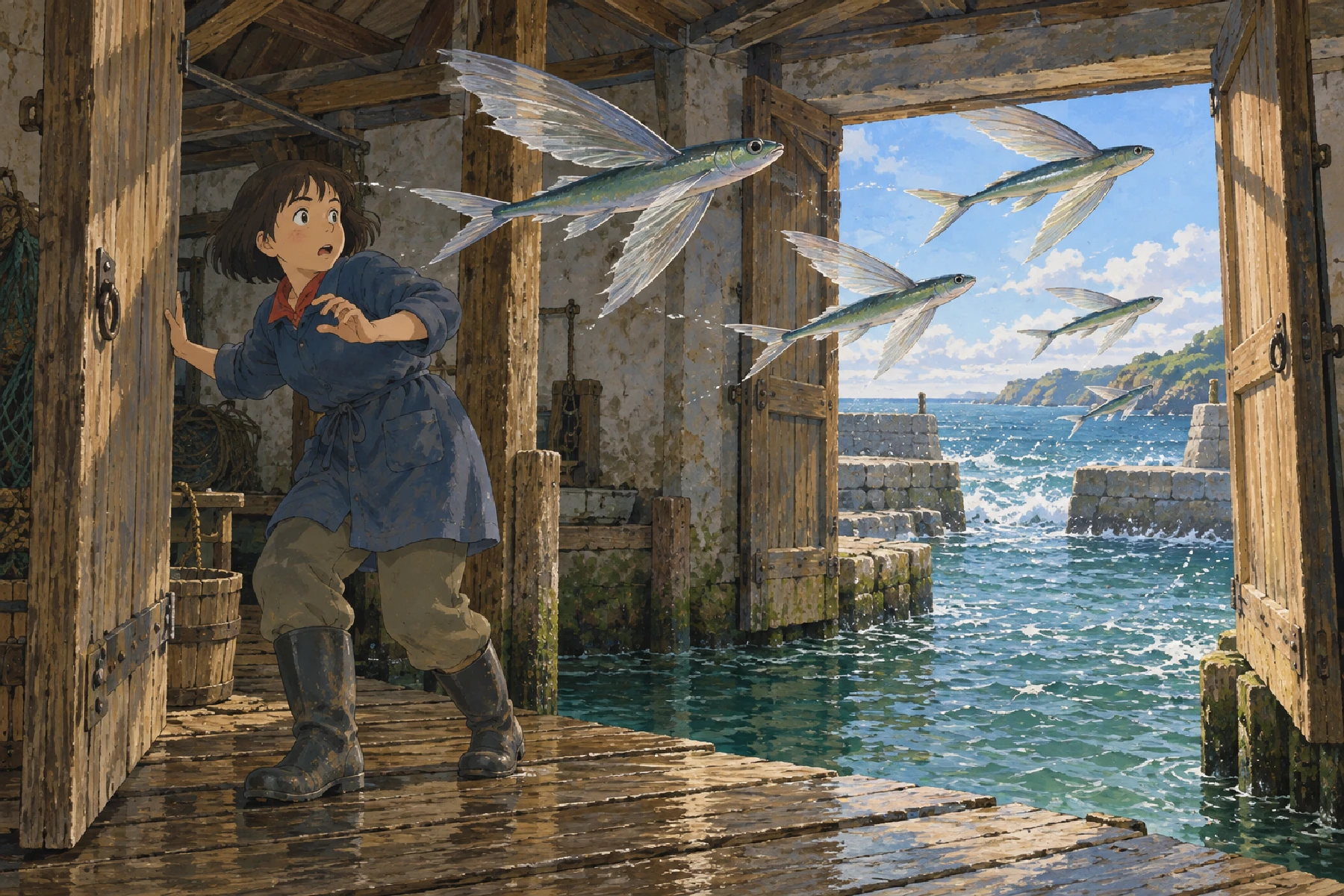
A woman opening the boathouse door recoils as flying fish glide inside. Overlapping fins, weathered beams and the sea beyond the doorway create a richly painted, unexpected encounter.
Remix this referenceFlying Fish Through the Boathouse
- Form language
- Build broad interlocking planes first, then suggest smaller irregularities with selective painted patches; simplify minor details freely.
- Contour
- Alternate firm and softened painted boundaries; let occasional edges dissolve instead of enclosing every form in a continuous line.
- Mark-making
- Layer visible brush traces along each plane, with sparse dry-brush skips and naturally varied stroke lengths.
- Surface rendering
- Combine uneven opaque paint patches with softly blended tonal passages; retain shallow paper-and-pigment texture without uniform noise.
Priority
Rendering medium: 2D hand-painted animated-film background illustration; formal rendering reference: Studio Ghibli · 2020s · The Boy and the Heron (2023), background art
What to avoid & what to check
Exact prompt for this example
MODULE OWNERSHIP
subject: Subject count, type, stable proportions and landmarks, resting face geometry, hair shape, physical materials, garment construction and permanent marks. No emotion, movement, color assignment or rendering recipe.
expression: Facial soft-tissue displacement and pupil direction, muscle coordination, regional intensity, asymmetry and onset/peak/release. No head/body pose, stable appearance, skin color or rendering.
gesture: Head/neck/body/limb orientation, joint movement, support, contact and pose-caused occlusion using existing anatomy. No eye/pupil movement, emotion, identity, props inventory or camera.
props: Prop count, type, construction, physical material and scale relative to the subject. Holding/contact belongs to gesture, position to composition, color to palette.
scene: Environment elements, terrain, backdrop/floor presence and structural detail. No canvas positions, camera, lighting, assigned colors or render texture.
camera: Projection, focal-length impression, camera elevation/yaw/roll, viewing distance and crop. No actor pose, world placement, lighting or canvas aspect ratio.
composition: Normalized 0-100% canvas positions, scale in frame, depth/overlap, focal hierarchy and margins. No joint pose, camera projection, rendering, subject/prop inventory or emotion.
palette: Color anchors, hue/saturation/value ranges, colors assigned to parts and approximate color coverage. No illumination direction, shading algorithm, physical material or layout.
lighting: Light-source direction/softness/intensity, ambient illumination, physical shadow direction/length and highlight position. Absence of directional illumination is allowed. No shading technique, palette or material changes.
style: Reusable form abstraction, contour weight/taper/edge quality, medium and mark scale/density/direction, surface rendering and tonal transition technique. No fixed subject proportions, anatomy, identity, expression, pose, palette, light-source direction, camera or layout.
output: Image count, aspect ratio, size, file/alpha requirements and global lettering/logo/watermark restrictions. No background scenery, crop, style, identity or pose.

SUBJECT
inventory: One adult woman, actor A, and five flying fish; no other figures.
geometry: A has a sturdy adult build and broad hands; the fish have slender bodies, forked tails and long pectoral fins.
resting-face: A has a broad oval face, straight brows, a short nose and a wide mouth with a rounded upper lip.
appearance: A has a blunt bob, a cotton work smock over trousers and rubber boots; fish have scaled bodies and translucent fin membranes.

PRIORITY


AVOID


CHECK


EXPRESSION — ACTOR A
brows: Both brows lift, with the nearer brow slightly higher.
lids: Upper lids rise; lower lids remain softly supported.
cheeks: Cheeks remain loose without a smile-driven lift.
nose: Nostrils remain relaxed and the bridge stays unwrinkled.
mouth: Lips part into a small uneven opening, with neither corner strongly pulled.
jaw: The jaw releases just enough to separate the lips.
gaze: Pupils track the nearest passing fish.
coordination: The widened eyes lead the quieter mouth response.
timing: Capture the first recognition, before surprise becomes a broad reaction.

PRIORITY


AVOID


CHECK


GESTURE
head: A draws her neck back and dips her head beneath a passing fin.
torso: Her torso recoils over the rear foot with a slight twist away from the doorway.
limbs: Her knees soften and free forearm rises with loose fingers; fish bank with fins spread and tails flexed.
contact: Her other palm braces the open door while both boots remain planted on the dock.

PRIORITY


AVOID


CHECK


PROPS
inventory: No separate props.
construction: No prop construction applies.

PRIORITY


AVOID


CHECK


SCENE
inventory: An old tidal boathouse with an indoor dock, water channel, open double doors and exposed roof beams; sea beyond.
structure: The wet plank dock borders the channel; salt-worn plaster meets timber posts, and a short stone slipway connects to the sea.

PRIORITY


AVOID


CHECK


CAMERA
projection: Natural perspective with a moderately wide, roughly 35 mm lens impression.
viewpoint: View from inside at adult chest height, obliquely across the doorway, with a level horizon.
crop: An environmental full-body view includes the dock edge; upper rafters extend beyond the crop.

PRIORITY


AVOID


CHECK


COMPOSITION
placement: A occupies the left third, her face near 30% width and 45% height; the fish sweep across the middle toward the right.
depth: A foreground fish overlaps a doorpost; smaller fish bridge the doorway depth without covering A's face.
spacing: Lead with the face and nearest fish, then the open doorway; retain breathing room above the shoal and between fin silhouettes.

PRIORITY


AVOID


CHECK


PALETTE
colors: Sea green, ochre, deep blue and chalk cream form a muted range with a small vermilion accent.
assignment: Use ochre timber, cream plaster, green water, blue clothing, warm beige skin and silver-green fish; vermilion marks the smock collar.
balance: Keep architectural earth hues dominant, water hues substantial and the collar accent scarce.

PRIORITY


AVOID


CHECK


LIGHTING
sources: Broad, soft afternoon light enters through the doorway from the rear right; gentle ambient light opens the interior.
shadows: Doorposts and figures cast soft, moderately long shadows inward toward the front left.
highlights: Restrained highlights touch doorway-facing fin edges, the shoulder and the upper edges of planks.

PRIORITY


AVOID


CHECK


STYLE GUIDE
form-language: Build broad interlocking planes first, then suggest smaller irregularities with selective painted patches; simplify minor details freely.
contour: Alternate firm and softened painted boundaries; let occasional edges dissolve instead of enclosing every form in a continuous line.
mark-making: Layer visible brush traces along each plane, with sparse dry-brush skips and naturally varied stroke lengths.
surface-rendering: Combine uneven opaque paint patches with softly blended tonal passages; retain shallow paper-and-pigment texture without uniform noise.

PRIORITY
Rendering medium: 2D hand-painted animated-film background illustration; formal rendering reference: Studio Ghibli · 2020s · The Boy and the Heron (2023), background art

AVOID


CHECK


OUTPUT
format: One finished image, 3:2 landscape, 1800 × 1200 pixels, opaque PNG.
restrictions: No lettering, logos or watermarks.

PRIORITY


AVOID


CHECK


FINAL INTEGRATION
expression + gesture + composition: Coordinate the brief reaction with the passing silhouettes so the encounter reads immediately.
scene + lighting + style: Let the architectural structure organize the painted passages while physical illumination remains legible.
Art direction
스튜디오 지브리 / Studio Ghibli · 2020s · 그대들은 어떻게 살 것인가(2023)의 배경 미술 / The Boy and the Heron (2023), background art ↗- Establish broad form planes before describing smaller surface variations with painted patches
- Use hard and soft painted boundaries rather than strong continuous outlines
- Overlapping brush traces following the plane direction with sparse dry-brush marks
- Shallow paper-and-pigment texture, uneven painted planes and blended tonal transitions
Model information comes from image provenance. The same prompt may produce a different result.