Text to imagePortraitStyle guide
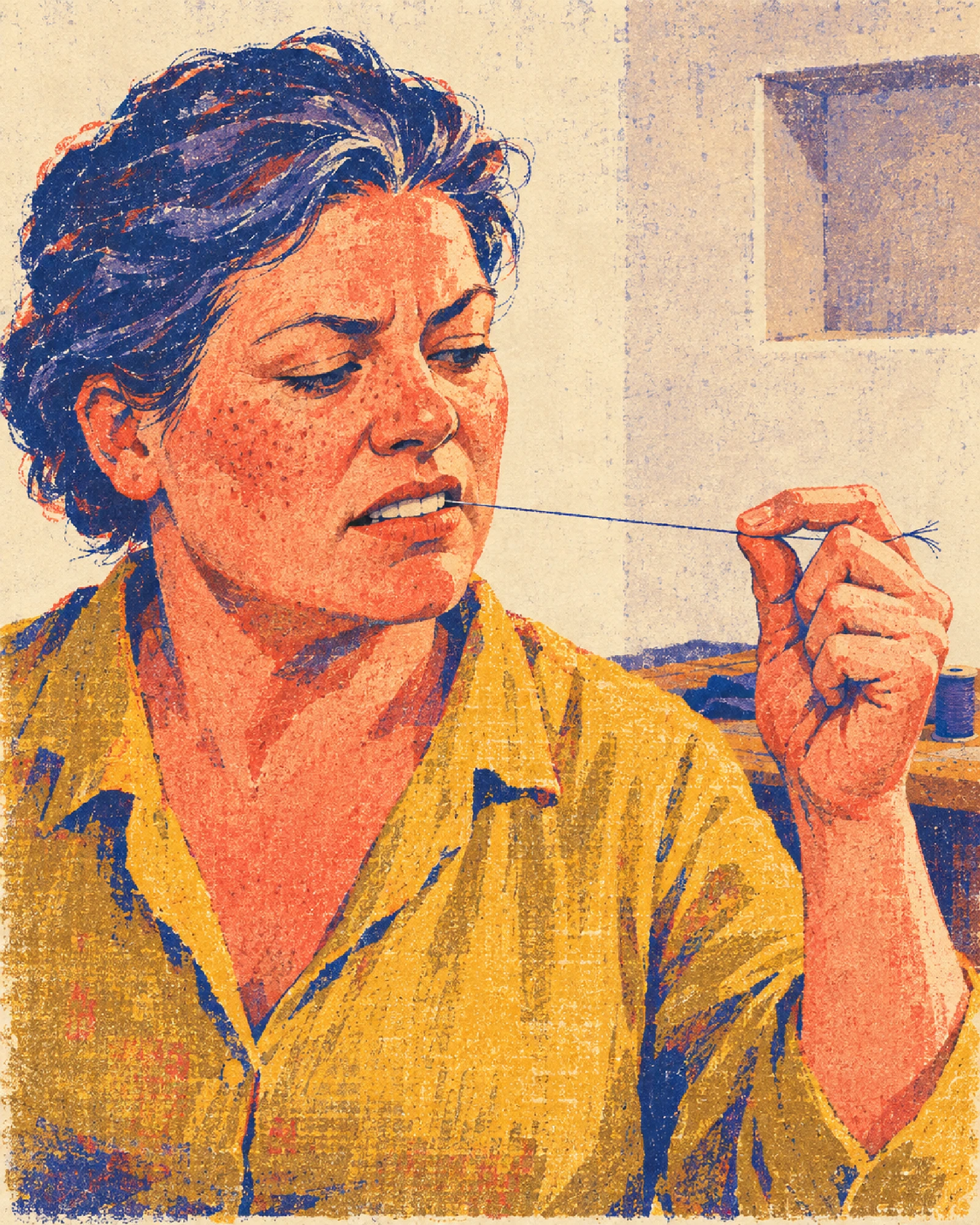
Woman Biting Thread
A riso portrait of a woman catching sewing thread between her teeth, with generous space, grainy ink and playful registration slips.
Remix this referenceWoman Biting Thread
- Form language
- Reduce forms to broad irregular blocks and a few descriptive notches; let secondary details vary within this economical language.
- Contour
- Use intermittent, blunt-edged contours with occasional dry breaks; vary their weight without polishing every boundary.
- Mark-making
- Let coarse ink grain and occasional roller streaks interrupt solid passages, with naturally uneven clusters and open patches.
- Surface rendering
- Build tones through translucent riso overprints and broken ink coverage; allow playful plate slips along selected broad edges.
Priority
Make the riso process visible through tactile ink deposits and lively registration.
What to avoid & what to check
Exact prompt for this example
MODULE OWNERSHIP
subject: Subject count, type, stable proportions and landmarks, resting face geometry, hair shape, physical materials, garment construction and permanent marks. No emotion, movement, color assignment or rendering recipe.
expression: Facial soft-tissue displacement and pupil direction, muscle coordination, regional intensity, asymmetry and onset/peak/release. No head/body pose, stable appearance, skin color or rendering.
gesture: Head/neck/body/limb orientation, joint movement, support, contact and pose-caused occlusion using existing anatomy. No eye/pupil movement, emotion, identity, props inventory or camera.
props: Prop count, type, construction, physical material and scale relative to the subject. Holding/contact belongs to gesture, position to composition, color to palette.
scene: Environment elements, terrain, backdrop/floor presence and structural detail. No canvas positions, camera, lighting, assigned colors or render texture.
camera: Projection, focal-length impression, camera elevation/yaw/roll, viewing distance and crop. No actor pose, world placement, lighting or canvas aspect ratio.
composition: Normalized 0-100% canvas positions, scale in frame, depth/overlap, focal hierarchy and margins. No joint pose, camera projection, rendering, subject/prop inventory or emotion.
palette: Color anchors, hue/saturation/value ranges, colors assigned to parts and approximate color coverage. No illumination direction, shading algorithm, physical material or layout.
lighting: Light-source direction/softness/intensity, ambient illumination, physical shadow direction/length and highlight position. Absence of directional illumination is allowed. No shading technique, palette or material changes.
style: Reusable form abstraction, contour weight/taper/edge quality, medium and mark scale/density/direction, surface rendering and tonal transition technique. No fixed subject proportions, anatomy, identity, expression, pose, palette, light-source direction, camera or layout.
output: Image count, aspect ratio, size, file/alpha requirements and global lettering/logo/watermark restrictions. No background scenery, crop, style, identity or pose.

SUBJECT
inventory: One original middle-aged woman.
geometry: A broad jaw, substantial nose and sturdy shoulders give her a grounded, recognizable build.
resting-face: Heavy upper eyelids, a wide mouth and a shallow upper-lip bow define her resting face.
appearance: Short swept-back hair, scattered cheek freckles and a linen work shirt with a broad open collar.

PRIORITY


AVOID


CHECK


EXPRESSION — ACTOR A
brows: Inner brows draw slightly together without a deep furrow.
lids: Upper lids lower a little; lower lids remain lightly firm.
cheeks: One cheek tightens subtly beside the working mouth corner.
nose: Nostrils remain relaxed, with no nose wrinkle.
mouth: Lips part narrowly to expose the front teeth; one corner pulls slightly sideways.
jaw: The jaw nearly closes, with a small visible tension at its hinge.
gaze: Both pupils turn downward toward the nearby thread.
coordination: Keep the mouth more active than the brow, with slight one-sided effort.
timing: Hold the peak instant just before the thread parts.

PRIORITY


AVOID


CHECK


GESTURE
head: Turn the head slightly to her left and lower the chin toward the raised hand.
torso: Keep the torso upright with one shoulder gently advanced.
limbs: Raise one bent arm beside the face; pinch the thread between thumb and forefinger.
contact: Catch the other end between the front teeth and draw the hand outward until the thread is taut.

PRIORITY


AVOID


CHECK


PROPS
inventory: One short length of sewing thread, long enough to span mouth to hand.
construction: Fine twisted cotton thread with a lightly frayed free end.

PRIORITY


AVOID


CHECK


SCENE
inventory: A small sewing room with a plaster wall, a shallow empty cubby and a worktable edge.
structure: A plain wall recess and a simple horizontal table surface supply only a few architectural interruptions.

PRIORITY


AVOID


CHECK


CAMERA
projection: Natural perspective with the gentle compression of a portrait lens.
viewpoint: Eye-level camera with a slight three-quarter view and no roll.
crop: Close chest-up portrait including the complete raised hand and the thread.

PRIORITY


AVOID


CHECK


COMPOSITION
placement: Place the face near 35% canvas width; the hand and thread extend into the spacious right half.
depth: Face and hand form the primary reading; the wall recess stays subordinate behind them.
spacing: Leave a broad quiet interval around the fine thread and comfortable space above the hair.

PRIORITY


AVOID


CHECK


PALETTE
colors: Warm cream, vermilion, mustard and deep indigo, with muted violet in mixed passages.
assignment: Cream surrounds vermilion skin, mustard clothing and indigo hair and thread.
balance: Cream occupies the largest area; concentrated indigo gives the small details their weight.

PRIORITY


AVOID


CHECK


LIGHTING
sources: Broad soft window light enters from the upper right with gentle room ambience.
shadows: Short soft shadows fall toward the lower left beneath the jaw and fingers.
highlights: Restrained broad highlights touch the upper-right temple and knuckles.

PRIORITY


AVOID


CHECK


STYLE GUIDE
form-language: Reduce forms to broad irregular blocks and a few descriptive notches; let secondary details vary within this economical language.
contour: Use intermittent, blunt-edged contours with occasional dry breaks; vary their weight without polishing every boundary.
mark-making: Let coarse ink grain and occasional roller streaks interrupt solid passages, with naturally uneven clusters and open patches.
surface-rendering: Build tones through translucent riso overprints and broken ink coverage; allow playful plate slips along selected broad edges.

PRIORITY
Make the riso process visible through tactile ink deposits and lively registration.

AVOID


CHECK


OUTPUT
format: One finished image, 4:5 aspect ratio, 1600 × 2000 pixels, opaque PNG.
restrictions: No lettering, logos or watermarks.

PRIORITY


AVOID


CHECK


FINAL INTEGRATION
style + expression: Let the irregular print language support the small facial articulation without obscuring it.
Model information comes from image provenance. The same prompt may produce a different result.