Text to imageComicsStyle guide
Unrolling a Bridge Across the Gorge
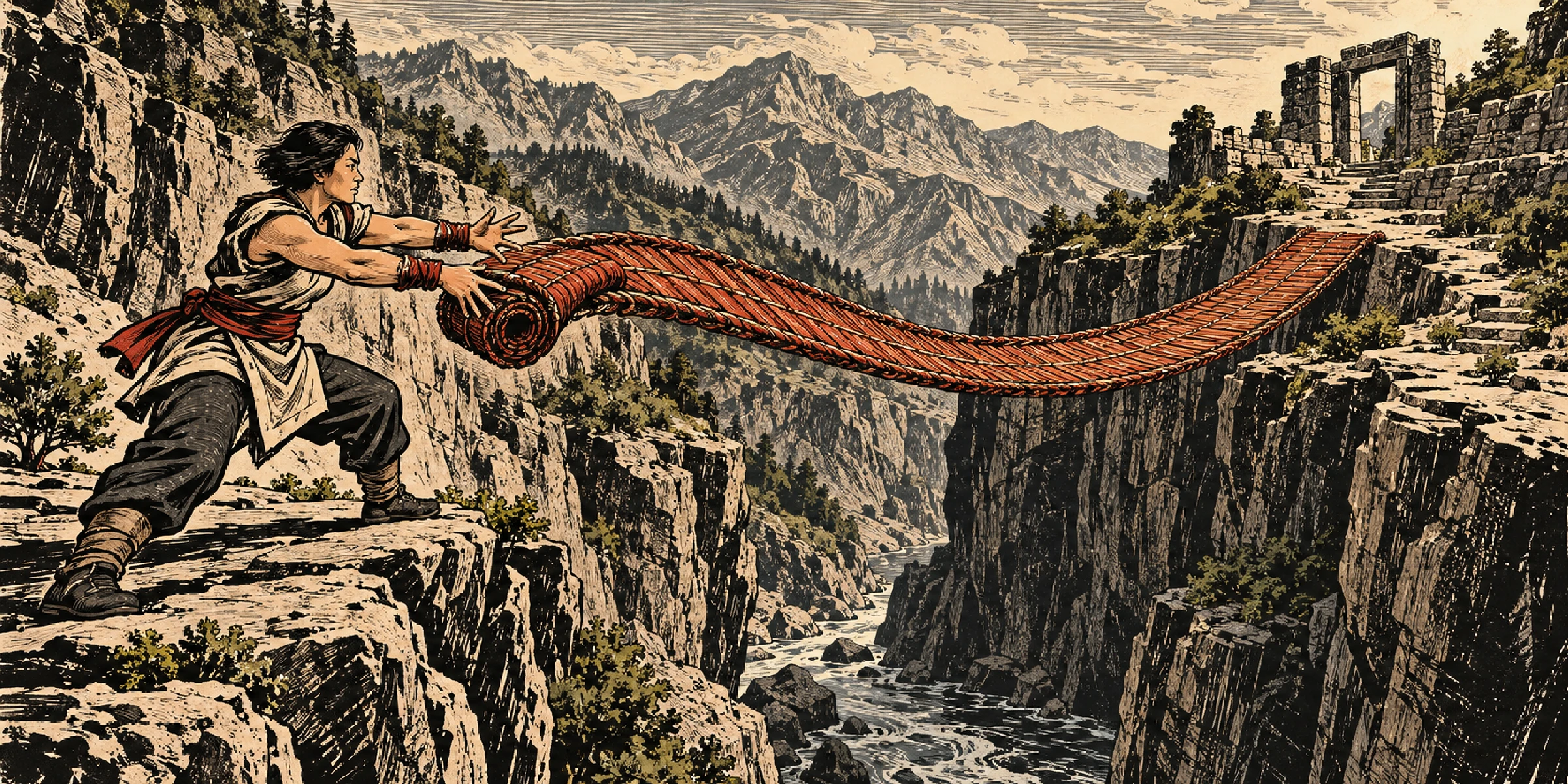
A bridge weaver casts a woven crossing over a gorge. Rough woodcut lines and broad ink masses carry this panoramic comic illustration from the near work ledge to a distant mountain trail.
Remix this referenceUnrolling a Bridge Across the Gorge
- Form language
- Simplify forms into interlocking wedges and broad hooked curves; retain irregular silhouettes and allow small details to vary within that vocabulary.
- Contour
- Build contours from thick, blunt ink edges interrupted by narrow cutaways; vary pressure so outlines feel carved rather than uniformly traced.
- Mark-making
- Use long curved gouges beside short splintered cuts, letting tool chatter and uneven stroke endings remain visible.
- Surface rendering
- Cut pale channels through dense ink masses; shift tone through opening hatch spacing and patchy ink transfer, with occasional rough overprints.
Priority
Rendering medium: woodcut graphic-novel comic illustration with visibly carved relief-print marks.
What to avoid & what to check
Exact prompt for this example
MODULE OWNERSHIP
subject: Subject count, type, stable proportions and landmarks, resting face geometry, hair shape, physical materials, garment construction and permanent marks. No emotion, movement, color assignment or rendering recipe.
expression: Facial soft-tissue displacement and pupil direction, muscle coordination, regional intensity, asymmetry and onset/peak/release. No head/body pose, stable appearance, skin color or rendering.
gesture: Head/neck/body/limb orientation, joint movement, support, contact and pose-caused occlusion using existing anatomy. No eye/pupil movement, emotion, identity, props inventory or camera.
props: Prop count, type, construction, physical material and scale relative to the subject. Holding/contact belongs to gesture, position to composition, color to palette.
scene: Environment elements, terrain, backdrop/floor presence and structural detail. No canvas positions, camera, lighting, assigned colors or render texture.
camera: Projection, focal-length impression, camera elevation/yaw/roll, viewing distance and crop. No actor pose, world placement, lighting or canvas aspect ratio.
composition: Normalized 0-100% canvas positions, scale in frame, depth/overlap, focal hierarchy and margins. No joint pose, camera projection, rendering, subject/prop inventory or emotion.
palette: Color anchors, hue/saturation/value ranges, colors assigned to parts and approximate color coverage. No illumination direction, shading algorithm, physical material or layout.
lighting: Light-source direction/softness/intensity, ambient illumination, physical shadow direction/length and highlight position. Absence of directional illumination is allowed. No shading technique, palette or material changes.
style: Reusable form abstraction, contour weight/taper/edge quality, medium and mark scale/density/direction, surface rendering and tonal transition technique. No fixed subject proportions, anatomy, identity, expression, pose, palette, light-source direction, camera or layout.
output: Image count, aspect ratio, size, file/alpha requirements and global lettering/logo/watermark restrictions. No background scenery, crop, style, identity or pose.

SUBJECT
inventory: One adult woman, actor A, a bridge weaver.
geometry: A sturdy adult build with broad hands, a square jaw and a short neck; retain recognizable human proportions.
resting-face: Wide-set eyes, straight brows, a broad nasal bridge and a full lower lip define her resting facial structure.
appearance: Short wedge-shaped hair, a canvas wrap tunic over trousers, cloth wrist wraps and ankle boots; minor garment details may vary.

PRIORITY


AVOID


CHECK


EXPRESSION — ACTOR A
brows: Brows draw inward, with the nearer brow slightly lower.
lids: Upper lids narrow slightly; lower lids remain taut.
cheeks: Cheeks tighten subtly beside the mouth without lifting into a smile.
nose: Nostrils widen slightly at the peak of effort.
mouth: Lips press together, with one corner tucked inward.
jaw: The jaw firms without opening the mouth.
gaze: Pupils track the far landing rather than the bridge edge.
coordination: Keep the upper face restrained while the compressed mouth carries most of the effort.
timing: Hold facial tension at its apex, before the brows and lips begin to relax.

PRIORITY


AVOID


CHECK


GESTURE
head: Her neck extends and her head turns toward the opposite bank, leaving the nearer facial features readable.
torso: Her torso follows through over a bent front leg while the rear foot braces on the ledge.
limbs: Both arms extend forward at slightly different heights; fingers spread at the end of the throwing motion.
contact: Both boots bear weight on the ledge; her fingertips have just released the woven bridge's leading edge.

PRIORITY


AVOID


CHECK


PROPS
inventory: One continuous roll of woven footbridge, wide enough for a person to walk along.
construction: Interlaced reed slats and braided fiber edges form a flexible bridge that magically stiffens as it unfurls.

PRIORITY


AVOID


CHECK


SCENE
inventory: A mountain gorge with opposing rock ledges, a narrow river, an old stepped trail, a roofless stone gateway and mountain ridges.
structure: The broken trail resumes beyond the gap, climbing through exposed strata toward the gateway; sparse shrubs occupy rock cracks.

PRIORITY


AVOID


CHECK


CAMERA
projection: Use perspective with a moderately wide lens impression and little edge distortion.
viewpoint: Look obliquely across the gorge from slightly above the woman's shoulder height, with a level horizon.
crop: Show her full figure within a broad environmental view; let the nearest rock face continue beyond the lower edge.

PRIORITY


AVOID


CHECK


COMPOSITION
placement: Anchor A in the lower-left third; sweep the bridge through the open middle toward a smaller landing on the right.
depth: The near ledge overlaps the river valley; the far trail lies beyond the crossing, with ridges farther back.
spacing: Give A roughly half the frame height. Make her release the first focal beat, the crossing the second, and the gateway the last.

PRIORITY


AVOID


CHECK


PALETTE
colors: Use charcoal black, warm parchment, muted vermilion and a small amount of gray olive.
assignment: Parchment belongs to sky and exposed rock, charcoal to hair and deep terrain, vermilion to bridge and wrist wraps, olive to vegetation.
balance: Let parchment and charcoal dominate; keep vermilion continuous but limited, with subdued intermediate values elsewhere.

PRIORITY


AVOID


CHECK


LIGHTING
sources: Broad afternoon light enters from the upper right with soft ambient fill in the gorge.
shadows: Cast shadows travel leftward with softened edges; rock overhangs retain deeper shade.
highlights: Broad highlights touch the right-facing cheek, sleeves and upper rock shelves without a rim-light halo.

PRIORITY


AVOID


CHECK


STYLE GUIDE
form-language: Simplify forms into interlocking wedges and broad hooked curves; retain irregular silhouettes and allow small details to vary within that vocabulary.
contour: Build contours from thick, blunt ink edges interrupted by narrow cutaways; vary pressure so outlines feel carved rather than uniformly traced.
mark-making: Use long curved gouges beside short splintered cuts, letting tool chatter and uneven stroke endings remain visible.
surface-rendering: Cut pale channels through dense ink masses; shift tone through opening hatch spacing and patchy ink transfer, with occasional rough overprints.

PRIORITY
Rendering medium: woodcut graphic-novel comic illustration with visibly carved relief-print marks.

AVOID


CHECK


OUTPUT
format: One finished image, panoramic 2:1 aspect ratio, 2400 × 1200 pixels, opaque PNG.
restrictions: No lettering, speech balloons, logos or watermarks.

PRIORITY


AVOID


CHECK
Model information comes from image provenance. The same prompt may produce a different result.