Text to imageAnimationStyle guide
Fox Asleep in the Swimming Pool
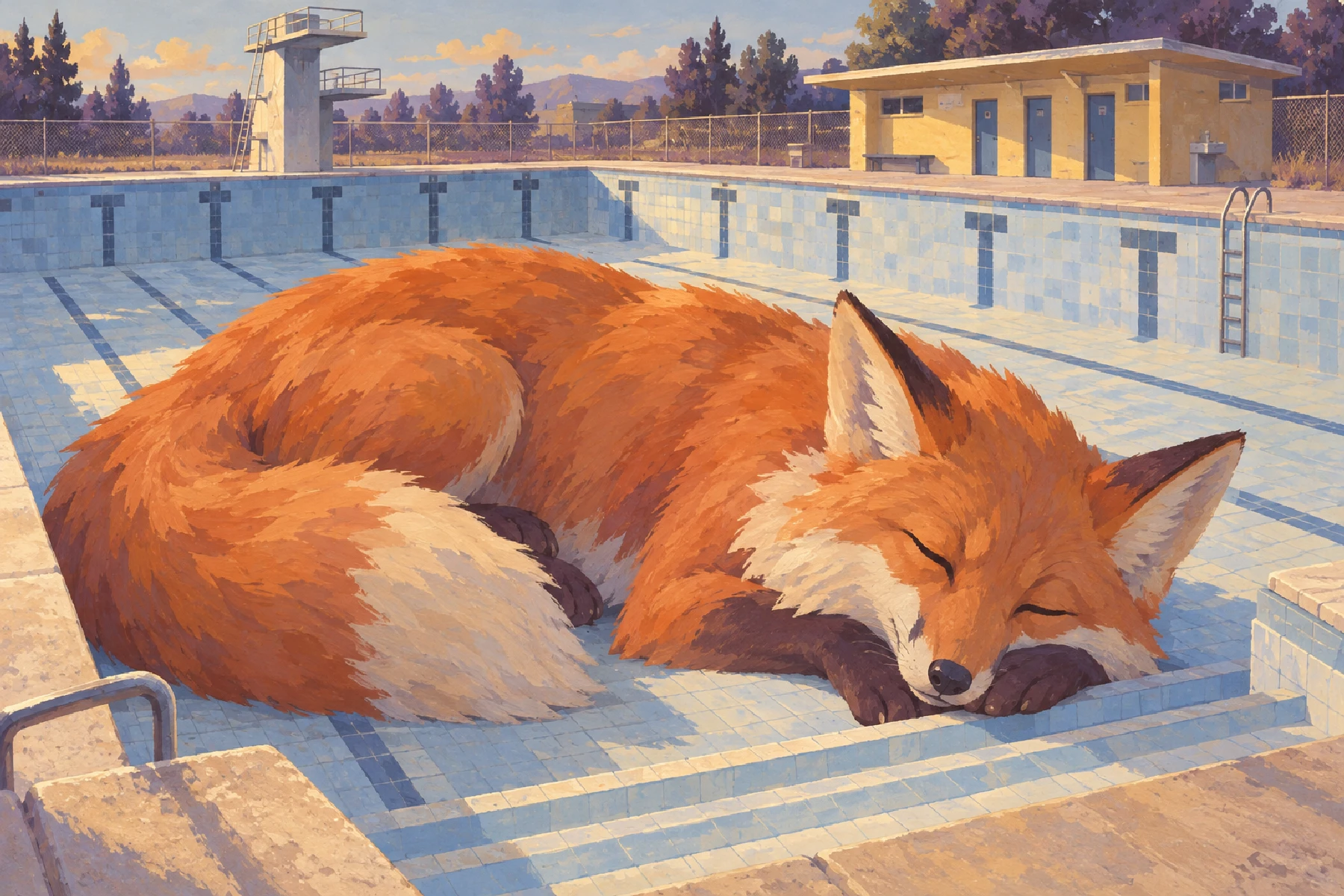
An enormous fox curls up asleep in a closed outdoor swimming pool. Empty lanes and a small changing pavilion reveal its unexpected scale in opaque gouache.
Remix this referenceFox Asleep in the Swimming Pool
- Form language
- Translate forms into broad interlocking planes, combining generous curves with a few decisive angular facets; simplify small details freely.
- Contour
- Let opaque painted boundaries carry contours, with occasional broken dry-brush edges and no continuous enclosing ink line.
- Mark-making
- Use broad overlapping brush traces within planes and smaller dragged strokes at turns; vary their length and pressure naturally.
- Surface rendering
- Build matte opaque gouache in a few distinct tonal steps, allowing shallow paper tooth and uneven repainting to interrupt the surfaces.
Priority
Rendering medium: 2D opaque-gouache animated-film concept illustration; formal rendering reference: Walt Disney Studios · 1950s · Peter Pan concept art (1953)
What to avoid & what to check
Exact prompt for this example
MODULE OWNERSHIP
subject: Subject count, type, stable proportions and landmarks, resting face geometry, hair shape, physical materials, garment construction and permanent marks. No emotion, movement, color assignment or rendering recipe.
expression: Facial soft-tissue displacement and pupil direction, muscle coordination, regional intensity, asymmetry and onset/peak/release. No head/body pose, stable appearance, skin color or rendering.
gesture: Head/neck/body/limb orientation, joint movement, support, contact and pose-caused occlusion using existing anatomy. No eye/pupil movement, emotion, identity, props inventory or camera.
props: Prop count, type, construction, physical material and scale relative to the subject. Holding/contact belongs to gesture, position to composition, color to palette.
scene: Environment elements, terrain, backdrop/floor presence and structural detail. No canvas positions, camera, lighting, assigned colors or render texture.
camera: Projection, focal-length impression, camera elevation/yaw/roll, viewing distance and crop. No actor pose, world placement, lighting or canvas aspect ratio.
composition: Normalized 0-100% canvas positions, scale in frame, depth/overlap, focal hierarchy and margins. No joint pose, camera projection, rendering, subject/prop inventory or emotion.
palette: Color anchors, hue/saturation/value ranges, colors assigned to parts and approximate color coverage. No illumination direction, shading algorithm, physical material or layout.
lighting: Light-source direction/softness/intensity, ambient illumination, physical shadow direction/length and highlight position. Absence of directional illumination is allowed. No shading technique, palette or material changes.
style: Reusable form abstraction, contour weight/taper/edge quality, medium and mark scale/density/direction, surface rendering and tonal transition technique. No fixed subject proportions, anatomy, identity, expression, pose, palette, light-source direction, camera or layout.
output: Image count, aspect ratio, size, file/alpha requirements and global lettering/logo/watermark restrictions. No background scenery, crop, style, identity or pose.

SUBJECT
inventory: A: one enormous adult fox, the only character.
geometry: A long-bodied fox with slender legs, tall triangular ears, a tapered muzzle and a full brush tail.
resting-face: A narrow forehead flows into a wedge-shaped muzzle; rounded cheek pads flank a small triangular nose.
appearance: Dense fur with longer tufts at the cheeks, chest and tail; no clothing or permanent accessories.

PRIORITY


AVOID


CHECK


EXPRESSION — ACTOR A
brows: Brow tissue settles without a central pinch.
lids: Both lids close softly, with a slightly deeper fold on the nearer eye.
cheeks: Cheeks hang loosely without a smile lift.
nose: The nose bridge stays smooth and the nostrils relaxed.
mouth: The lips meet loosely; neither corner pulls upward.
jaw: The jaw releases its tension while remaining closed.
gaze: Pupils remain concealed behind the closed lids.
coordination: Soft lids and slack mouth muscles read as sleep after exertion.
timing: Capture the release into sleep, after the last facial tension has subsided.

PRIORITY


AVOID


CHECK


GESTURE
head: A lowers its head sideways onto its forepaws, with the ears loosely angled outward.
torso: The torso curls onto one side, its weight settled against the basin floor.
limbs: Forepaws overlap gently; hind legs tuck beneath the flank and the tail curves around the haunches.
contact: The forepaws rest on the pool entry step, supporting the cheek and lower muzzle.

PRIORITY


AVOID


CHECK


PROPS
inventory: No separate props.
construction: No prop construction applies.

PRIORITY


AVOID


CHECK


SCENE
inventory: An empty outdoor municipal swimming pool, a changing pavilion, perimeter fencing and sparse grass beyond.
structure: The tiled basin has lane markings, broad entry steps and a diving tower; the pavilion has low doors and a shallow roof.

PRIORITY


AVOID


CHECK


CAMERA
projection: Gentle perspective with a moderate wide-angle impression and restrained convergence.
viewpoint: Look diagonally down from above the pool rim, with a level horizon and no roll.
crop: A wide environmental view includes the entire fox and most of the pool enclosure.

PRIORITY


AVOID


CHECK


COMPOSITION
placement: The fox occupies about two-thirds of the frame, its head near the lower-right third and its back toward the left.
depth: A near pool rim overlaps the basin; the small pavilion and diving tower sit behind the fox.
spacing: The face leads, the tail follows; an open wedge of lane markings gives the silhouette breathing room.

PRIORITY


AVOID


CHECK


PALETTE
colors: A compact palette of burnt apricot, chalk blue, butter yellow, warm ivory and deep plum.
assignment: Apricot fur, ivory muzzle and tail tip, plum paws and nose; blue tiles, yellow pavilion and muted plum grass.
balance: Apricot and pale blue dominate; yellow stays restrained and the deepest plum appears in small accents.

PRIORITY


AVOID


CHECK


LIGHTING
sources: Broad, soft late-day sunlight enters from the left above gentle open-sky ambient light.
shadows: Soft shadows extend rightward across the basin, with deeper contact shadows beneath the body and paws.
highlights: Broad highlights touch the upper back, left ear edges and exposed pool coping.

PRIORITY


AVOID


CHECK


STYLE GUIDE
form-language: Translate forms into broad interlocking planes, combining generous curves with a few decisive angular facets; simplify small details freely.
contour: Let opaque painted boundaries carry contours, with occasional broken dry-brush edges and no continuous enclosing ink line.
mark-making: Use broad overlapping brush traces within planes and smaller dragged strokes at turns; vary their length and pressure naturally.
surface-rendering: Build matte opaque gouache in a few distinct tonal steps, allowing shallow paper tooth and uneven repainting to interrupt the surfaces.

PRIORITY
Rendering medium: 2D opaque-gouache animated-film concept illustration; formal rendering reference: Walt Disney Studios · 1950s · Peter Pan concept art (1953)

AVOID


CHECK


OUTPUT
format: One finished image, landscape 3:2, 1800 × 1200 pixels, opaque PNG.
restrictions: No lettering, logos or watermarks.

PRIORITY


AVOID


CHECK


FINAL INTEGRATION
subject + scene + composition: Familiar architectural scale makes the animal's extraordinary size immediately legible.
expression + gesture: Facial release and supported body weight cooperate to make the sleep feel settled.
Art direction
디즈니 / Walt Disney Studios · 1950s · 피터 팬 콘셉트 아트(1953) / Peter Pan concept art (1953) ↗- Render forms as broad planar masses with simplified curved and angular facets
- Separate forms primarily through opaque painted boundaries rather than continuous outlines
- Broad brush traces within planes and small dry-brush interruptions at their edges
- Matte opaque gouache planes, shallow paper texture and a small set of tonal levels
Model information comes from image provenance. The same prompt may produce a different result.