Text to imageAnimationStyle guide
Kite Mender Unfolding a Fish Kite
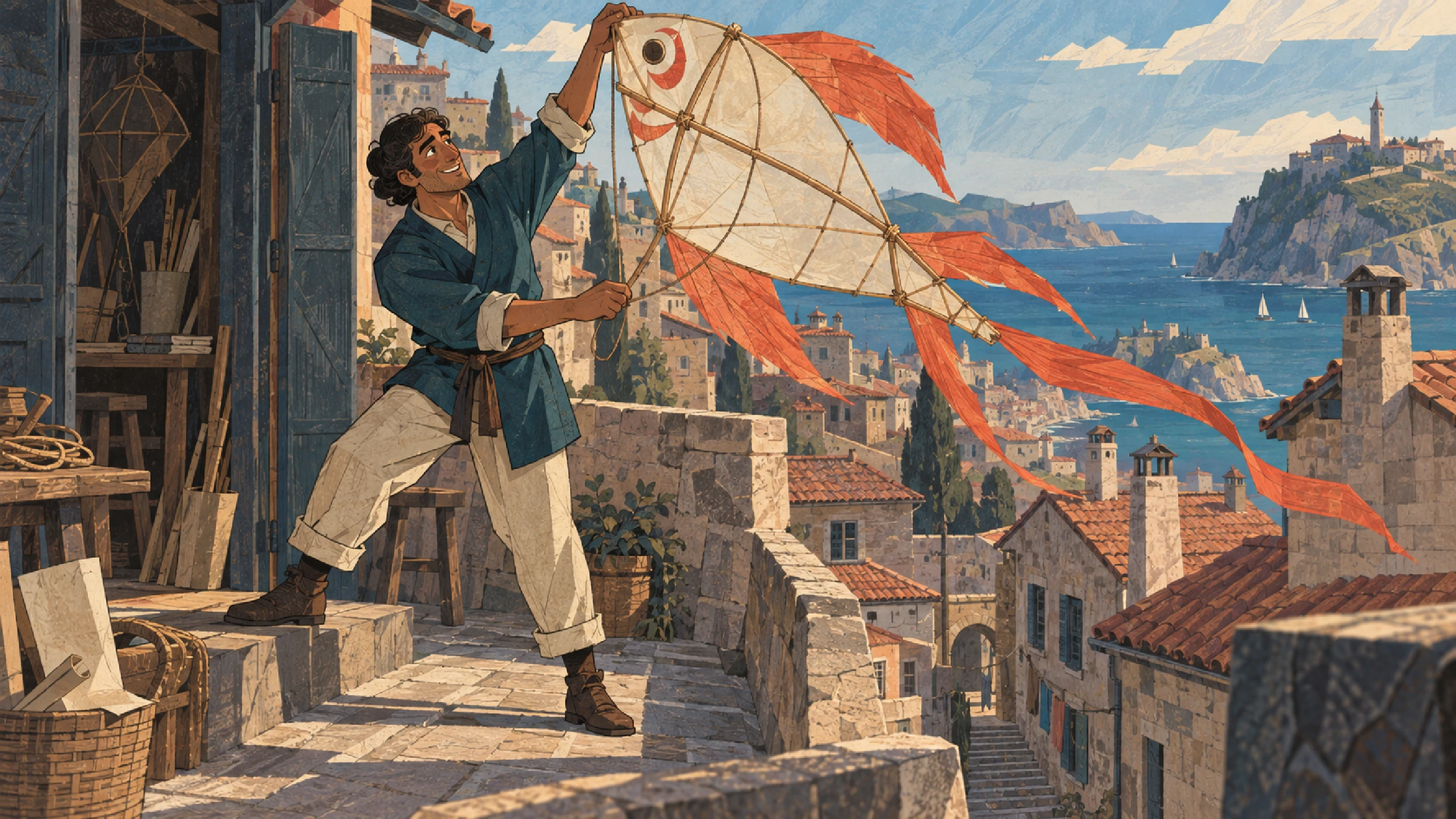
Above a terraced hillside town, a mender unfolds an enormous fish kite outside a rooftop workshop. A dawning smile and an expansive reach animate a layered city of angular planes, irregular carved contours, and quiet printed surfaces.
Remix this referenceKite Mender Unfolding a Fish Kite
- Form language
- Abstract forms into interlocking angular planes, replacing minor curvature with a few decisive facets while retaining generous simple masses. .s .s .s
- Contour
- Use slightly irregular straight and angular carved contours; vary weight and taper naturally, with occasional blunt turns and short edge interruptions. .s .s .s
- Mark-making
- Place short parallel hatch groups and restrained scratched strokes in selected passages; let spacing, length, and alignment vary with a hand-cut rhythm. .s .s .s
- Surface rendering
- Treat surfaces as broad printed planes with limited paper texture and discrete hatched tonal regions; omit continuous volumetric modeling and allow small ink-density variations. .s .s
Priority
Rendering medium: 2D woodcut-print animated-film illustration; formal rendering reference: Cartoon Saloon · 2020s · Wolfwalkers (2020), town sequences
What to avoid & what to check
Avoid glossy continuous modeling and mechanically uniform hatch spacing.
Faceted planes, carved contours, and selective hatching visibly share one handmade print language.
Exact prompt for this example
MODULE OWNERSHIP
subject: Subject count, type, stable proportions and landmarks, resting face geometry, hair shape, physical materials, garment construction and permanent marks. No emotion, movement, color assignment or rendering recipe.
expression: Facial soft-tissue displacement and pupil direction, muscle coordination, regional intensity, asymmetry and onset/peak/release. No head/body pose, stable appearance, skin color or rendering.
gesture: Head/neck/body/limb orientation, joint movement, support, contact and pose-caused occlusion using existing anatomy. No eye/pupil movement, emotion, identity, props inventory or camera.
props: Prop count, type, construction, physical material and scale relative to the subject. Holding/contact belongs to gesture, position to composition, color to palette.
scene: Environment elements, terrain, backdrop/floor presence and structural detail. No canvas positions, camera, lighting, assigned colors or render texture.
camera: Projection, focal-length impression, camera elevation/yaw/roll, viewing distance and crop. No actor pose, world placement, lighting or canvas aspect ratio.
composition: Normalized 0-100% canvas positions, scale in frame, depth/overlap, focal hierarchy and margins. No joint pose, camera projection, rendering, subject/prop inventory or emotion.
palette: Color anchors, hue/saturation/value ranges, colors assigned to parts and approximate color coverage. No illumination direction, shading algorithm, physical material or layout.
lighting: Light-source direction/softness/intensity, ambient illumination, physical shadow direction/length and highlight position. Absence of directional illumination is allowed. No shading technique, palette or material changes.
style: Reusable form abstraction, contour weight/taper/edge quality, medium and mark scale/density/direction, surface rendering and tonal transition technique. No fixed subject proportions, anatomy, identity, expression, pose, palette, light-source direction, camera or layout.
output: Image count, aspect ratio, size, file/alpha requirements and global lettering/logo/watermark restrictions. No background scenery, crop, style, identity or pose.

SUBJECT
inventory: A is one original adult kite mender, with an unadorned working appearance and no additional characters.
geometry: Use adult proportions: a compact head, sturdy trunk, long forearms, and substantial hands; retain a recognizable human silhouette.
resting-face: The resting face has long cheeks, a tapered chin, a broad shallow nose, gently arched brows, and a wide mouth.
appearance: Close coils form a swept hair cap. A cotton wrap jacket has overlapping fronts and rolled cuffs; cuffed trousers meet leather ankle boots.

PRIORITY
Keep the mender recognizable through practical adult construction.

AVOID
Avoid a childlike oversized head.

CHECK
The hair cap and wrap jacket remain distinct identity landmarks.

EXPRESSION — ACTOR A
brows: Both brows rise gently, with a slightly greater lift on the kite-facing side; keep the inner ends unknittedத்                        .stream                     .s
lids: Upper lids open modestly while lower lids gather softly beneath the eyes, preserving an attentive rather than startled look.                     .s                     .s
cheeks: Cheeks begin to rise, subtly bunching beside the mouth and narrowing the lower eye openings.                     .s                     .s                     .s
nose: Leave the nose bridge and nostrils relaxed, without wrinkling or emphatic flare.                     .s                     .s                     .s                     .s
mouth: The lips part into a small widening smile; the kite-facing corner rises first, with only a narrow glimpse of upper teeth.                     .s                     .s
jaw: Release the jaw slightly downward, enough for the parted smile without a broad open-mouth laugh.                     .s                     .s                     .s
gaze: Direct both pupils toward the kite's upper rib; keep their shared focus clear within the visible eye openings.                     .s                     .s                     .s
coordination: Let cheek lift support the mouth corners while the brow response stays quieter, giving the smile an uneven, lived-in onset.                     .s                     .s
timing: Capture the instant the smile becomes legible, before its fullest expansion; the lips lead and the cheeks follow.                     .s                     .s                     .s

PRIORITY
Make the dawning, slightly asymmetric smile the facial signature.

AVOID
Avoid uniformly widened eyes and a fear-like mouth stretch.

CHECK
The gaze and emerging smile read together as quiet delight.

GESTURE
head: A turns the head toward the raised kite, chin gently lifted and neck extending naturally from the shoulders.
torso: The torso twists into the reach with a slight forward inclination; the shoulders open at different heights.
limbs: One arm extends high and outward while the other bends across the trunk. Soft knees and a staggered stance support the expansive reach.
contact: The raised hand grips the kite's upper spine and the lower hand steadies its lower rib. One boot rests on the workshop threshold, the other on the terrace.

PRIORITY
Build a broad, unequal reach with a visibly grounded stance.

AVOID
Avoid rigid parallel arms that flatten the unfolding action.

CHECK
Both grips and the two visible foot supports are easy to understand.

PROPS
inventory: Include one handmade fish kite, approximately as long as A is tall, with a broad body and two narrow trailing fins.
construction: Bowed cane ribs support translucent paper panels around a flexible central spine; cloth fin strips and a short cord bridle complete the simple construction.

PRIORITY
Let the rib-supported paper body explain the kite's handmade character.

AVOID
Avoid mechanical gadgetry on the kite.

CHECK
The kite reads as a lightweight crafted object with a coherent frame.

SCENE
inventory: An elevated kite workshop opens onto a stone terrace above a hillside courtyard; tiled roofs, chimneys, stair passages, and a distant sea belong to the setting.
structure: Stepped retaining walls connect uneven building levels. Open workshop shutters, a low parapet, and occasional roof vents give the town a useful, inhabited construction.

PRIORITY
Make the workshop part of a continuous, inhabited hillside town.

AVOID
Avoid a blank backdrop or repeated identical houses.

CHECK
Terrace, courtyard, and roof levels form a believable connected setting.

CAMERA
projection: Use a moderate wide-lens perspective, with enough depth to enter the town and restrained enlargement of nearby forms.
viewpoint: View obliquely from the adjoining terrace at slightly below A's eye level; keep the camera level with no roll.
crop: Use an environmental full-figure view containing the whole kite; let the nearest parapet and workshop edge continue beyond the crop.

PRIORITY
Keep the unfolding action readable within an immersive environmental view.

AVOID
Avoid extreme wide-angle distortion.

CHECK
The face, hands, feet, and complete kite remain visible.

COMPOSITION
placement: Anchor A near 35% of canvas width, with the kite spreading across the upper-right half; the joined silhouette is the dominant focal group.
depth: A cropped foreground parapet overlaps the terrace base; roofs descend behind the focal group toward a narrow distant sea opening.
spacing: Let A occupy roughly half the frame height. Preserve generous breathing room around the kite's upper edge and a clear pocket around the face.

PRIORITY
The expansive focal group should emerge clearly from layered surroundings.

AVOID
Avoid roof edges tangling with the face or raised hand.

CHECK
The eye finds the face and kite before exploring the descending town.

PALETTE
colors: Build around deep petrol blue, dusty brick, parchment cream, and a concentrated coral accent; keep most saturation muted.
assignment: Give A a petrol jacket, cream trousers, warm brown skin, and near-black hair and boots. The kite is cream with coral fins; roofs are dusty brick and the sea muted petrol.
balance: Let muted brick and cream occupy most of the image, petrol provide broad dark anchors, and coral remain a small vivid counterpoint.

PRIORITY
Reserve the clearest chromatic accent for the kite.

AVOID
Avoid equally saturated roofs and focal accents.

CHECK
The limited anchors unite the town while distinguishing the kite.

LIGHTING
sources: Broad, soft daylight enters from the upper left, supported by gentle open-sky ambient illumination.
shadows: Cast shadows extend loosely toward the lower right across the terrace; recesses beneath eaves remain quieter and darker.
highlights: Place restrained highlights on upper-left-facing cheeks, fingers, kite ribs, and parapet tops, without sharp glitter.

PRIORITY
Use one broad daylight direction to unite the visible setting.

AVOID
Avoid competing hard light sources.

CHECK
Highlights and cast shadows agree on a soft upper-left source.

STYLE GUIDE
form-language: Abstract forms into interlocking angular planes, replacing minor curvature with a few decisive facets while retaining generous simple masses.                 .s                 .s                 .s
contour: Use slightly irregular straight and angular carved contours; vary weight and taper naturally, with occasional blunt turns and short edge interruptions.                 .s                 .s                 .s
mark-making: Place short parallel hatch groups and restrained scratched strokes in selected passages; let spacing, length, and alignment vary with a hand-cut rhythm.                 .s                 .s                 .s
surface-rendering: Treat surfaces as broad printed planes with limited paper texture and discrete hatched tonal regions; omit continuous volumetric modeling and allow small ink-density variations.                 .s                 .s

PRIORITY
Rendering medium: 2D woodcut-print animated-film illustration; formal rendering reference: Cartoon Saloon · 2020s · Wolfwalkers (2020), town sequences

AVOID
Avoid glossy continuous modeling and mechanically uniform hatch spacing.

CHECK
Faceted planes, carved contours, and selective hatching visibly share one handmade print language.

OUTPUT
format: Deliver one finished image, landscape 16:9, at 2560 × 1440 pixels, as an opaque PNG.
restrictions: Include no lettering, captions, logos, signatures, or watermarks anywhere in the image.

PRIORITY
Deliver one complete animated-film reference image.

AVOID
Avoid contact sheets or alternate versions within the deliverable.

CHECK
The single opaque image meets the specified dimensions and aspect ratio.

FINAL INTEGRATION
expression + gesture + camera + composition: Coordinate these modules so visible acting remains legible throughout the expansive action.
subject + props + scene + style: Apply the same formal language across independently defined constructions; incidental details may vary coherently.
palette + lighting + style: Let color relationships and physical illumination remain readable through the chosen surface treatment.
Art direction
카툰 살롱 / Cartoon Saloon · 2020s · 울프워커스(2020)의 도시 장면 / Wolfwalkers (2020), town sequences ↗- Transfer the angular planar abstraction of the town sequences to generic form surfaces
- Slightly irregular straight and angular contours resembling carved lines
- Short parallel hatch groups and restrained scratched marks
- Flat planes with limited paper texture and hatched tonal regions, without continuous modeling
Model information comes from image provenance. The same prompt may produce a different result.