Text to imagePortraitStyle guide
Man Above the Sea Stair
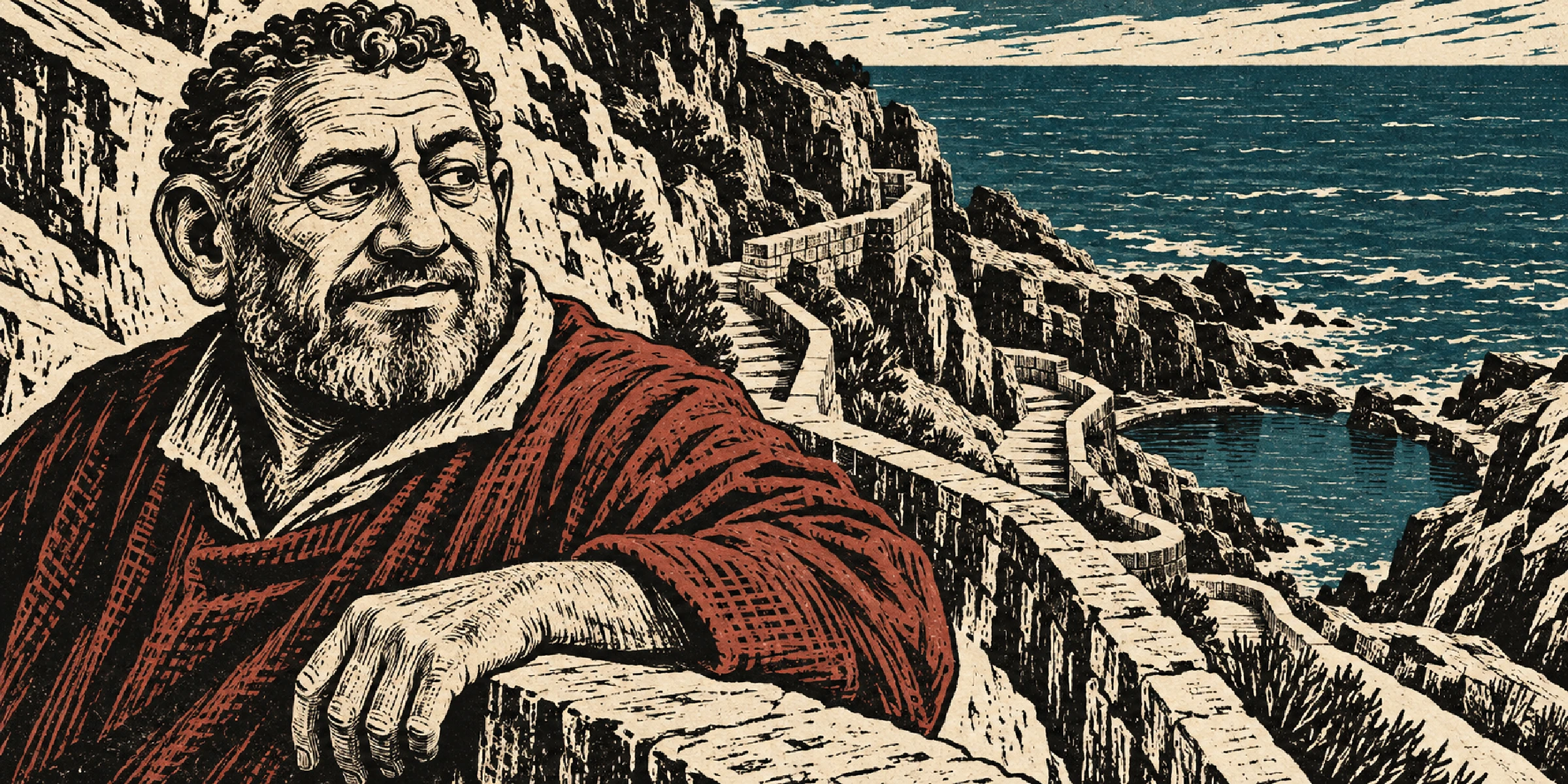
A bold linocut portrait catches a man's fading smile above a cliff stair. His large foreground face begins a visual journey along the winding descent to a distant sea pool.
Remix this referenceMan Above the Sea Stair
- Form language
- Reduce forms to interlocking angular masses, allowing irregular notches and simplified secondary detail.
- Contour
- Use stout, slightly wavering relief-print edges that occasionally merge into broad uninterrupted shapes.
- Mark-making
- Carve rhythmic gouges in bending clusters; vary their length and spacing so the hand-cut resistance remains visible.
- Surface rendering
- Build tone through alternating ink masses and exposed paper cuts, with occasional uneven ink bite and slight registration drift.
Priority
The finished image must visibly read as bold linocut with carved rhythmic marks.
What to avoid & what to check
Exact prompt for this example
MODULE OWNERSHIP
subject: Subject count, type, stable proportions and landmarks, resting face geometry, hair shape, physical materials, garment construction and permanent marks. No emotion, movement, color assignment or rendering recipe.
expression: Facial soft-tissue displacement and pupil direction, muscle coordination, regional intensity, asymmetry and onset/peak/release. No head/body pose, stable appearance, skin color or rendering.
gesture: Head/neck/body/limb orientation, joint movement, support, contact and pose-caused occlusion using existing anatomy. No eye/pupil movement, emotion, identity, props inventory or camera.
props: Prop count, type, construction, physical material and scale relative to the subject. Holding/contact belongs to gesture, position to composition, color to palette.
scene: Environment elements, terrain, backdrop/floor presence and structural detail. No canvas positions, camera, lighting, assigned colors or render texture.
camera: Projection, focal-length impression, camera elevation/yaw/roll, viewing distance and crop. No actor pose, world placement, lighting or canvas aspect ratio.
composition: Normalized 0-100% canvas positions, scale in frame, depth/overlap, focal hierarchy and margins. No joint pose, camera projection, rendering, subject/prop inventory or emotion.
palette: Color anchors, hue/saturation/value ranges, colors assigned to parts and approximate color coverage. No illumination direction, shading algorithm, physical material or layout.
lighting: Light-source direction/softness/intensity, ambient illumination, physical shadow direction/length and highlight position. Absence of directional illumination is allowed. No shading technique, palette or material changes.
style: Reusable form abstraction, contour weight/taper/edge quality, medium and mark scale/density/direction, surface rendering and tonal transition technique. No fixed subject proportions, anatomy, identity, expression, pose, palette, light-source direction, camera or layout.
output: Image count, aspect ratio, size, file/alpha requirements and global lettering/logo/watermark restrictions. No background scenery, crop, style, identity or pose.

SUBJECT
inventory: One older adult man, actor A; no other people.
geometry: A broad head, prominent rounded ears, sturdy neck and substantial shoulders establish his recognizable build.
resting-face: Broad cheekbones, a long rounded nose, heavy upper lids and a wide mouth define the resting face.
appearance: Short flattened curls, a square trimmed beard and a heavy woven smock with a folded collar; minor wear may vary.

PRIORITY


AVOID


CHECK


EXPRESSION — ACTOR A
brows: Both brows settle toward rest, with one outer end still slightly lifted.
lids: Lower lids retain a gentle upward squeeze; upper lids remain comfortably open.
cheeks: Cheek lift is subsiding, leaving one cheek slightly fuller than the other.
nose: Nostrils rest without flaring and the nose bridge stays unwrinkled.
mouth: Closed lips retain unevenly raised corners, with the stronger corner just beginning to relax.
jaw: The jaw hangs loosely beneath the closed lips without a clenched bite.
gaze: Pupils look to his left toward the distant end of the stair.
coordination: Residual cheek and mouth lift agree with the softened lids; the asymmetry stays subtle.
timing: Catch the release immediately after a small smile, before the face returns fully to rest.

PRIORITY


AVOID


CHECK


GESTURE
head: Turn his head slightly left with the chin gently lowered and the neck comfortably shortened.
torso: Let the torso lean into the parapet, with one shoulder a little lower than the other.
limbs: The nearer forearm rests across the parapet; its hand drapes loosely over the edge.
contact: Forearm and lower chest bear gently against the parapet; the far arm is naturally concealed.

PRIORITY


AVOID


CHECK


PROPS
inventory: No separate props.
construction: No prop construction applies.

PRIORITY


AVOID


CHECK


SCENE
inventory: A coastal cliff stair, its stone parapet, a sheltered tidal pool, open sea and sky.
structure: The stair switches back through the cliff before reaching the pool; worn masonry follows the rock ledges.

PRIORITY


AVOID


CHECK


CAMERA
projection: Use natural perspective with a normal-lens impression and clear environmental depth.
viewpoint: View from eye level, slightly to the man's left, without camera roll.
crop: An environmental chest-up portrait includes the nearer forearm, with its lower edge partly cropped.

PRIORITY


AVOID


CHECK


COMPOSITION
placement: Place the face near 25% canvas width, occupying much of the height; let the stair travel across the open right. Keep the visible sky a narrow band.
depth: The portrait overlaps the first stair bend; successive turns diminish toward the small distant pool.
spacing: Make the face primary, the stair the connecting rhythm and the pool the final pause; leave breathing room above the descent.

PRIORITY


AVOID


CHECK


PALETTE
colors: Use ink black, chalk cream, deep marine teal and muted brick red.
assignment: Cream and black describe the face and masonry; teal belongs to the sea and brick red to the smock.
balance: Black and cream dominate; the restrained red gives the broad teal field a warm counterweight.

PRIORITY


AVOID


CHECK


LIGHTING
sources: Broad daylight arrives from the upper right with moderate softness and gentle open-sky fill.
shadows: The nose and collar cast short shadows down-left; the parapet shades the stair immediately beneath it.
highlights: Broad light catches the right forehead, upper cheek and exposed parapet tops.

PRIORITY


AVOID


CHECK


STYLE GUIDE
form-language: Reduce forms to interlocking angular masses, allowing irregular notches and simplified secondary detail.
contour: Use stout, slightly wavering relief-print edges that occasionally merge into broad uninterrupted shapes.
mark-making: Carve rhythmic gouges in bending clusters; vary their length and spacing so the hand-cut resistance remains visible.
surface-rendering: Build tone through alternating ink masses and exposed paper cuts, with occasional uneven ink bite and slight registration drift.

PRIORITY
The finished image must visibly read as bold linocut with carved rhythmic marks.

AVOID


CHECK


OUTPUT
format: One image, panoramic 2:1 aspect ratio, 2400 × 1200 pixels, opaque PNG; no lettering, logos or watermarks.
restrictions: One image, panoramic 2:1 aspect ratio, 2400 × 1200 pixels, opaque PNG; no lettering, logos or watermarks.

PRIORITY


AVOID


CHECK


FINAL INTEGRATION
camera + composition + scene: Keep the environmental journey legible while preserving the intimacy expected of a portrait.
expression + style + lighting: Translate small facial changes into economical printed shapes without losing the release phase.
Model information comes from image provenance. The same prompt may produce a different result.