Text to imageIllustrationStyle guide
Bats from the Lantern
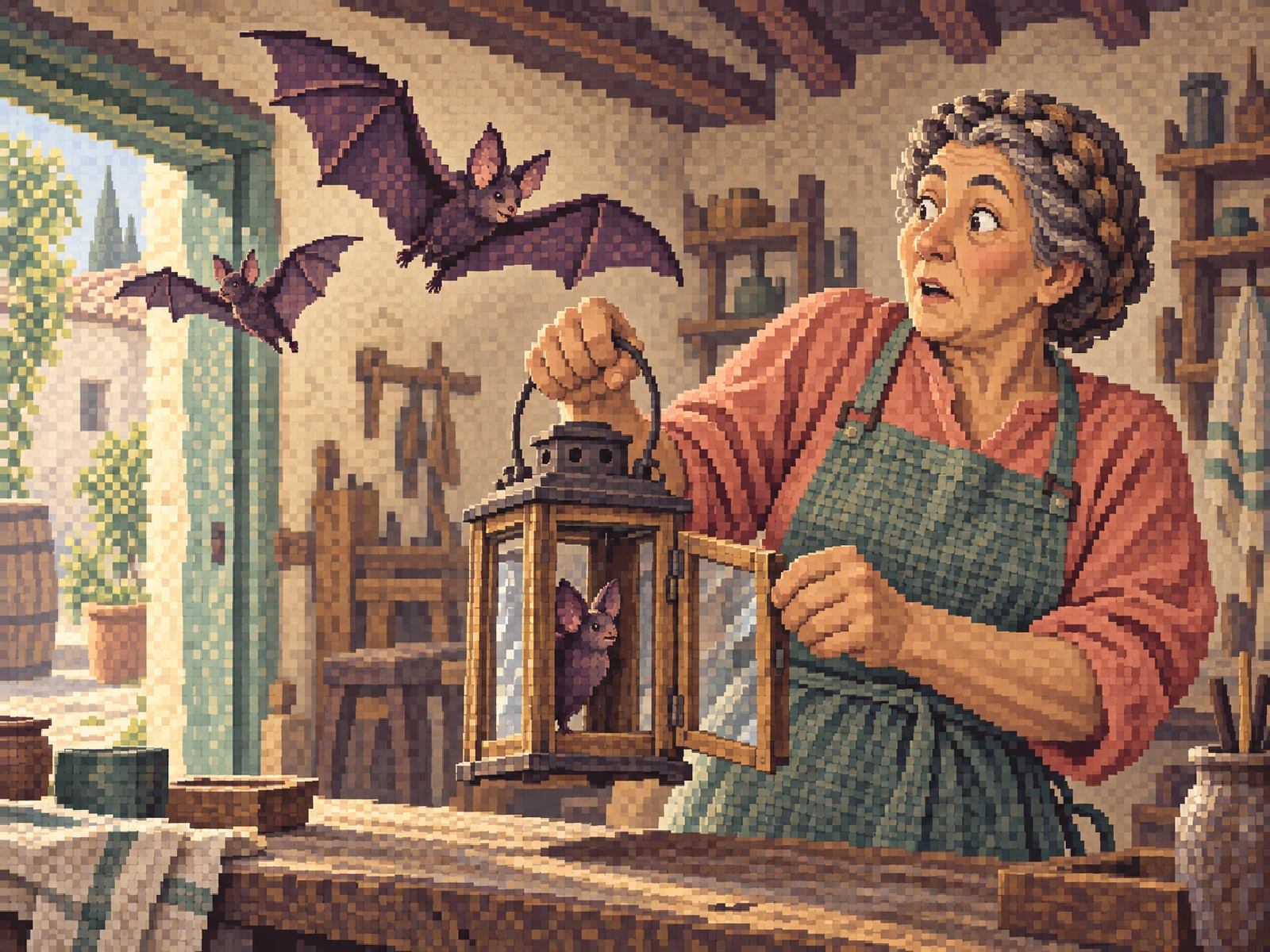
A repairer opens a lantern's little door and bats spill into the workshop. Overlapping wings, hands and lantern frame become a lively illustration of interwoven pixel clusters.
Remix this referenceBats from the Lantern
- Form language
- Reduce forms into interlocking pixel masses, alternating broad blocks with narrow woven bridges; small shapes may vary naturally.
- Contour
- Keep deliberate low-resolution stair-step edges; broken dark edge clusters replace continuous outlines and vary in thickness.
- Mark-making
- Interlace short horizontal and vertical pixel runs like warp and weft, with irregular interruptions rather than a uniform checkerboard.
- Surface rendering
- Shift tone through mingled pixel clusters and sparse stepped bands; preserve quiet solid passages between visibly woven transitions.
Priority
The image must visibly combine woven pixel structure with deliberate low-resolution edges.
What to avoid & what to check
Exact prompt for this example
MODULE OWNERSHIP
subject: Subject count, type, stable proportions and landmarks, resting face geometry, hair shape, physical materials, garment construction and permanent marks. No emotion, movement, color assignment or rendering recipe.
expression: Facial soft-tissue displacement and pupil direction, muscle coordination, regional intensity, asymmetry and onset/peak/release. No head/body pose, stable appearance, skin color or rendering.
gesture: Head/neck/body/limb orientation, joint movement, support, contact and pose-caused occlusion using existing anatomy. No eye/pupil movement, emotion, identity, props inventory or camera.
props: Prop count, type, construction, physical material and scale relative to the subject. Holding/contact belongs to gesture, position to composition, color to palette.
scene: Environment elements, terrain, backdrop/floor presence and structural detail. No canvas positions, camera, lighting, assigned colors or render texture.
camera: Projection, focal-length impression, camera elevation/yaw/roll, viewing distance and crop. No actor pose, world placement, lighting or canvas aspect ratio.
composition: Normalized 0-100% canvas positions, scale in frame, depth/overlap, focal hierarchy and margins. No joint pose, camera projection, rendering, subject/prop inventory or emotion.
palette: Color anchors, hue/saturation/value ranges, colors assigned to parts and approximate color coverage. No illumination direction, shading algorithm, physical material or layout.
lighting: Light-source direction/softness/intensity, ambient illumination, physical shadow direction/length and highlight position. Absence of directional illumination is allowed. No shading technique, palette or material changes.
style: Reusable form abstraction, contour weight/taper/edge quality, medium and mark scale/density/direction, surface rendering and tonal transition technique. No fixed subject proportions, anatomy, identity, expression, pose, palette, light-source direction, camera or layout.
output: Image count, aspect ratio, size, file/alpha requirements and global lettering/logo/watermark restrictions. No background scenery, crop, style, identity or pose.

SUBJECT
inventory: One older adult lantern repairer, actor A, and three small bats.
geometry: A has a wiry build and broad hands; the bats have compact bodies, triangular ears and broad membranous wings.
resting-face: A has a broad nose, shallow-set eyes and a rounded chin; the resting mouth has a level, soft lip seam.
appearance: A wears a woven apron over a loose cuffed shirt; hair forms a crown braid. Small garment details may vary.

PRIORITY


AVOID


CHECK


EXPRESSION — ACTOR A
brows: Both brows rise, with one slightly higher for an uneven surprised arch.
lids: Upper lids lift clearly; lower lids remain loose rather than tightly braced.
cheeks: Cheeks remain mostly relaxed, with only a slight lift beside the mouth.
nose: Nose wings stay relaxed, without wrinkling or conspicuous flaring.
mouth: Lips part into a small uneven opening, with one corner barely lifted.
jaw: The jaw drops slightly, keeping the surprise gentle rather than a full gape.
gaze: Both pupils track the nearest airborne bat.
coordination: Raised brows and open lids carry the reaction; the mouth responds more softly.
timing: Capture the surprise at its apex, just as the unexpected visitor becomes clear.

PRIORITY


AVOID


CHECK


GESTURE
head: A draws the neck back slightly and turns the head toward the emerging bat.
torso: A leans back from the waist in a small recoil while keeping the shoulders loose.
limbs: One hand suspends the lantern by its handle; the other pulls its door outward. Two bats fly, one clings inside.
contact: The handle rests within curled fingers; fingertips grip the door edge, and the perched bat grips the inner frame.

PRIORITY


AVOID


CHECK


PROPS
inventory: One portable lantern, roughly the height of A's forearm; no separate repair tools.
construction: The lantern has a timber frame, glass panes, a hinged access door and a metal loop handle.

PRIORITY


AVOID


CHECK


SCENE
inventory: A modest workshop with a workbench, plaster walls, exposed roof beams and an open courtyard doorway.
structure: The broad doorway interrupts the enclosing wall; plain shelves and a worn floor establish a working interior.

PRIORITY


AVOID


CHECK


CAMERA
projection: Use restrained perspective with a normal-lens impression and little near-field distortion.
viewpoint: View from slightly above bench height, obliquely across the workshop, with no camera roll.
crop: Use a medium-wide view showing A from the hips upward and retaining the airborne wings.

PRIORITY


AVOID


CHECK


COMPOSITION
placement: A occupies the right third; the lantern sits near the lower middle and flying silhouettes sweep toward the upper left.
depth: Overlap wings with the lantern frame and sleeve; the bench crosses the foreground, with the doorway farther behind on the left.
spacing: The face–lantern encounter leads, followed by the escaping bats; leave generous space ahead of their flight.

PRIORITY


AVOID


CHECK


PALETTE
colors: Build around deep plum, dusty coral, pale straw and muted jade, with restrained saturation.
assignment: Use plum for bats and beams, coral for the shirt, straw for skin and walls, and jade for apron and doorway.
balance: Pale straw supplies the largest field; plum forms compact dark masses, with coral and jade as smaller accents.

PRIORITY


AVOID


CHECK


LIGHTING
sources: Broad, soft daylight enters through the doorway; its direction is from the left, with gentle interior ambient light.
shadows: Soft shadows fall toward the right and remain short on the bench; the lantern interior stays shaded.
highlights: Broad highlights touch left-facing facial planes, fingers and glass edges; the lantern emits no light.

PRIORITY


AVOID


CHECK


STYLE GUIDE
form-language: Reduce forms into interlocking pixel masses, alternating broad blocks with narrow woven bridges; small shapes may vary naturally.
contour: Keep deliberate low-resolution stair-step edges; broken dark edge clusters replace continuous outlines and vary in thickness.
mark-making: Interlace short horizontal and vertical pixel runs like warp and weft, with irregular interruptions rather than a uniform checkerboard.
surface-rendering: Shift tone through mingled pixel clusters and sparse stepped bands; preserve quiet solid passages between visibly woven transitions.

PRIORITY
The image must visibly combine woven pixel structure with deliberate low-resolution edges.

AVOID


CHECK


OUTPUT
format: Deliver one landscape 4:3 PNG, 1600 × 1200 pixels, with an opaque alpha channel.
restrictions: No lettering, logos or watermarks.

PRIORITY


AVOID


CHECK


FINAL INTEGRATION
expression + gesture + composition: Coordinate the visible reaction and hand action so the overlapping encounter reads immediately.
style + palette + lighting: Let woven tonal transitions carry the illumination while preserving the palette's distinct color roles.
Model information comes from image provenance. The same prompt may produce a different result.