Text to imageAnimationStyle guide
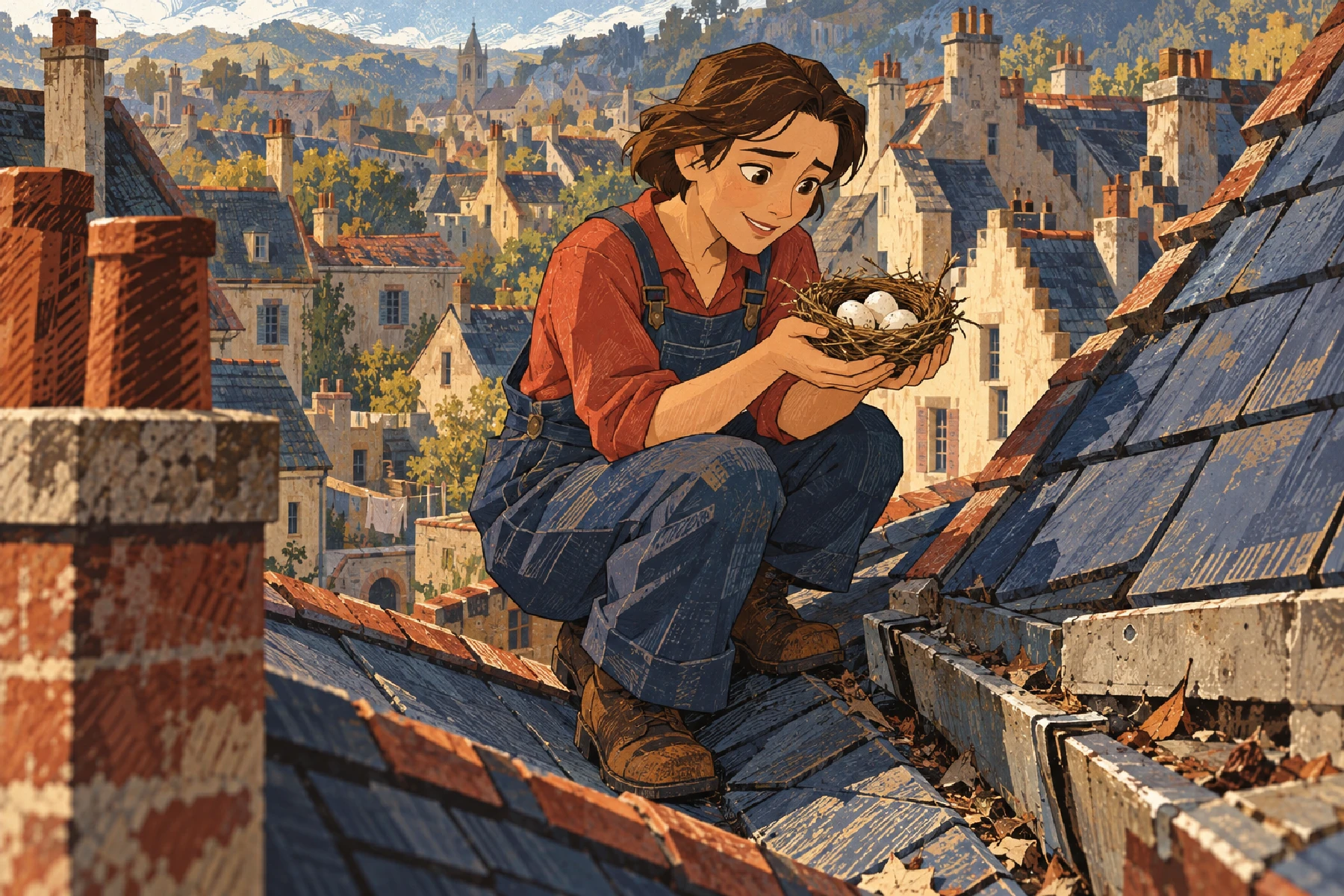
A Roofer Lifting a Nest from a Broken Gutter
Above a layered neighborhood of roofs, a roofer lifts a small nest in both hands. Carved contours and short hatching give the weathered town a tactile rhythm around her careful gesture.
Remix this referenceA Roofer Lifting a Nest from a Broken Gutter
- Form language
- Abstract forms into interlocking angular planes; let small irregular facets interrupt long surfaces without explaining every volume.
- Contour
- Use slightly uneven carved contours built from straight runs and abrupt turns, with occasional taper and broken edges.
- Mark-making
- Place short parallel hatch groups and restrained scratches in varied hand-cut rhythms; leave generous intervals between groups.
- Surface rendering
- Build flat printed planes with limited paper grain and hatched tonal regions; use stepped value changes instead of continuous modeling.
Priority
Rendering medium: 2D woodcut-print animated-film illustration; formal rendering reference: Cartoon Saloon · 2020s · Wolfwalkers (2020), town sequences
What to avoid & what to check
Exact prompt for this example
MODULE OWNERSHIP
subject: Subject count, type, stable proportions and landmarks, resting face geometry, hair shape, physical materials, garment construction and permanent marks. No emotion, movement, color assignment or rendering recipe.
expression: Facial soft-tissue displacement and pupil direction, muscle coordination, regional intensity, asymmetry and onset/peak/release. No head/body pose, stable appearance, skin color or rendering.
gesture: Head/neck/body/limb orientation, joint movement, support, contact and pose-caused occlusion using existing anatomy. No eye/pupil movement, emotion, identity, props inventory or camera.
props: Prop count, type, construction, physical material and scale relative to the subject. Holding/contact belongs to gesture, position to composition, color to palette.
scene: Environment elements, terrain, backdrop/floor presence and structural detail. No canvas positions, camera, lighting, assigned colors or render texture.
camera: Projection, focal-length impression, camera elevation/yaw/roll, viewing distance and crop. No actor pose, world placement, lighting or canvas aspect ratio.
composition: Normalized 0-100% canvas positions, scale in frame, depth/overlap, focal hierarchy and margins. No joint pose, camera projection, rendering, subject/prop inventory or emotion.
palette: Color anchors, hue/saturation/value ranges, colors assigned to parts and approximate color coverage. No illumination direction, shading algorithm, physical material or layout.
lighting: Light-source direction/softness/intensity, ambient illumination, physical shadow direction/length and highlight position. Absence of directional illumination is allowed. No shading technique, palette or material changes.
style: Reusable form abstraction, contour weight/taper/edge quality, medium and mark scale/density/direction, surface rendering and tonal transition technique. No fixed subject proportions, anatomy, identity, expression, pose, palette, light-source direction, camera or layout.
output: Image count, aspect ratio, size, file/alpha requirements and global lettering/logo/watermark restrictions. No background scenery, crop, style, identity or pose.

SUBJECT
inventory: One adult human roofer, actor A; no other figures or animals.
geometry: A sturdy, compact build with broad hands, a short neck and a recognizable square jaw.
resting-face: At rest, straight brows sit above almond-shaped eyes; a wedge-shaped nose ends above a broad mouth.
appearance: Short blunt hair tucked behind the ears; canvas bib overalls over a collarless shirt, with leather ankle boots.

PRIORITY


AVOID


CHECK


EXPRESSION — ACTOR A
brows: The brows begin to relax, retaining a slight lift at their inner ends.
lids: Upper lids settle slightly while the lower lids lose their tension.
cheeks: The cheeks soften, with only a small lift beside the mouth.
nose: The nostrils relax without flaring or wrinkling.
mouth: Lips part for a small exhale; one corner rises before the other.
jaw: The jaw releases just enough to separate the lips.
gaze: Both pupils look down toward the eggs inside the nest.
coordination: Residual tension above the eyes gives way to a softer mouth before a full smile forms.
timing: Capture the onset of relief, just as the strained expression begins to release.

PRIORITY


AVOID


CHECK


GESTURE
head: A tucks her chin slightly and turns her head toward her cupped hands.
torso: From a low crouch, A leans forward at the hips while drawing her shoulders back from the gutter.
limbs: Both forearms rise together, elbows bent near the ribs; her boots remain planted in the roof valley.
contact: Her palms cradle the nest from beneath, leaving its opening visible as it clears the broken gutter.

PRIORITY


AVOID


CHECK


PROPS
inventory: One shallow bird nest containing three eggs; the nest is slightly wider than A's two cupped palms.
construction: Interwoven twigs and dry grass form an uneven bowl around three small, smooth-shelled eggs.

PRIORITY


AVOID


CHECK


SCENE
inventory: A dense hillside town of tiled roofs, chimney stacks, plaster houses and narrow inner courtyards.
structure: Two roof slopes meet in a broad valley beside a cracked gutter; stepped gables and recessed windows distinguish the surrounding houses.

PRIORITY


AVOID


CHECK


CAMERA
projection: Moderate wide-angle perspective with gentle convergence and no exaggerated lens distortion.
viewpoint: Look from slightly above roof level in a three-quarter side view, with a level camera roll.
crop: A medium-wide view includes A's whole body and enough surrounding architecture to establish the neighborhood.

PRIORITY


AVOID


CHECK


COMPOSITION
placement: A occupies about one third of the image height near 65% across; the raised nest sits just inward of her face.
depth: A cropped foreground chimney overlaps the lower left; the working roof opens onto successive rooftops and distant courtyards.
spacing: Make the hands and nest the first read, then the face and town; an uncluttered wall interval separates the hands from roof detail.

PRIORITY


AVOID


CHECK


PALETTE
colors: Use smoky indigo, muted ochre, brick vermilion and chalk ivory, with restrained saturation.
assignment: Indigo roofs and overalls; ochre walls, skin and nest; vermilion shirt and chimney accents; ivory eggs and window recesses.
balance: Indigo and ochre dominate; vermilion stays a small accent, while ivory provides sparse clear notes.

PRIORITY


AVOID


CHECK


LIGHTING
sources: Broad, soft daylight enters from the upper left, supported by gentle open-sky ambient light.
shadows: Chimneys cast moderately long shadows toward the lower right; shadows beneath the hands remain soft.
highlights: Subtle highlights touch the upper-left edges of the hands, eggs and roof ridges.

PRIORITY


AVOID


CHECK


STYLE GUIDE
form-language: Abstract forms into interlocking angular planes; let small irregular facets interrupt long surfaces without explaining every volume.
contour: Use slightly uneven carved contours built from straight runs and abrupt turns, with occasional taper and broken edges.
mark-making: Place short parallel hatch groups and restrained scratches in varied hand-cut rhythms; leave generous intervals between groups.
surface-rendering: Build flat printed planes with limited paper grain and hatched tonal regions; use stepped value changes instead of continuous modeling.

PRIORITY
Rendering medium: 2D woodcut-print animated-film illustration; formal rendering reference: Cartoon Saloon · 2020s · Wolfwalkers (2020), town sequences

AVOID


CHECK


OUTPUT
format: One finished image, landscape 3:2, 1800 × 1200 pixels, opaque PNG.
restrictions: No lettering, logos, captions or watermarks.

PRIORITY


AVOID


CHECK


FINAL INTEGRATION
expression + gesture + composition: Let the visible hand action lead into the restrained facial response, with enough separation to read both.
scene + style: Allow architectural detail to vary naturally while maintaining the same carved visual language throughout.
Art direction
카툰 살롱 / Cartoon Saloon · 2020s · 울프워커스(2020)의 도시 장면 / Wolfwalkers (2020), town sequences ↗- Transfer the angular planar abstraction of the town sequences to generic form surfaces
- Slightly irregular straight and angular contours resembling carved lines
- Short parallel hatch groups and restrained scratched marks
- Flat planes with limited paper texture and hatched tonal regions, without continuous modeling
Model information comes from image provenance. The same prompt may produce a different result.