Text to imageArt stylesStyle guide
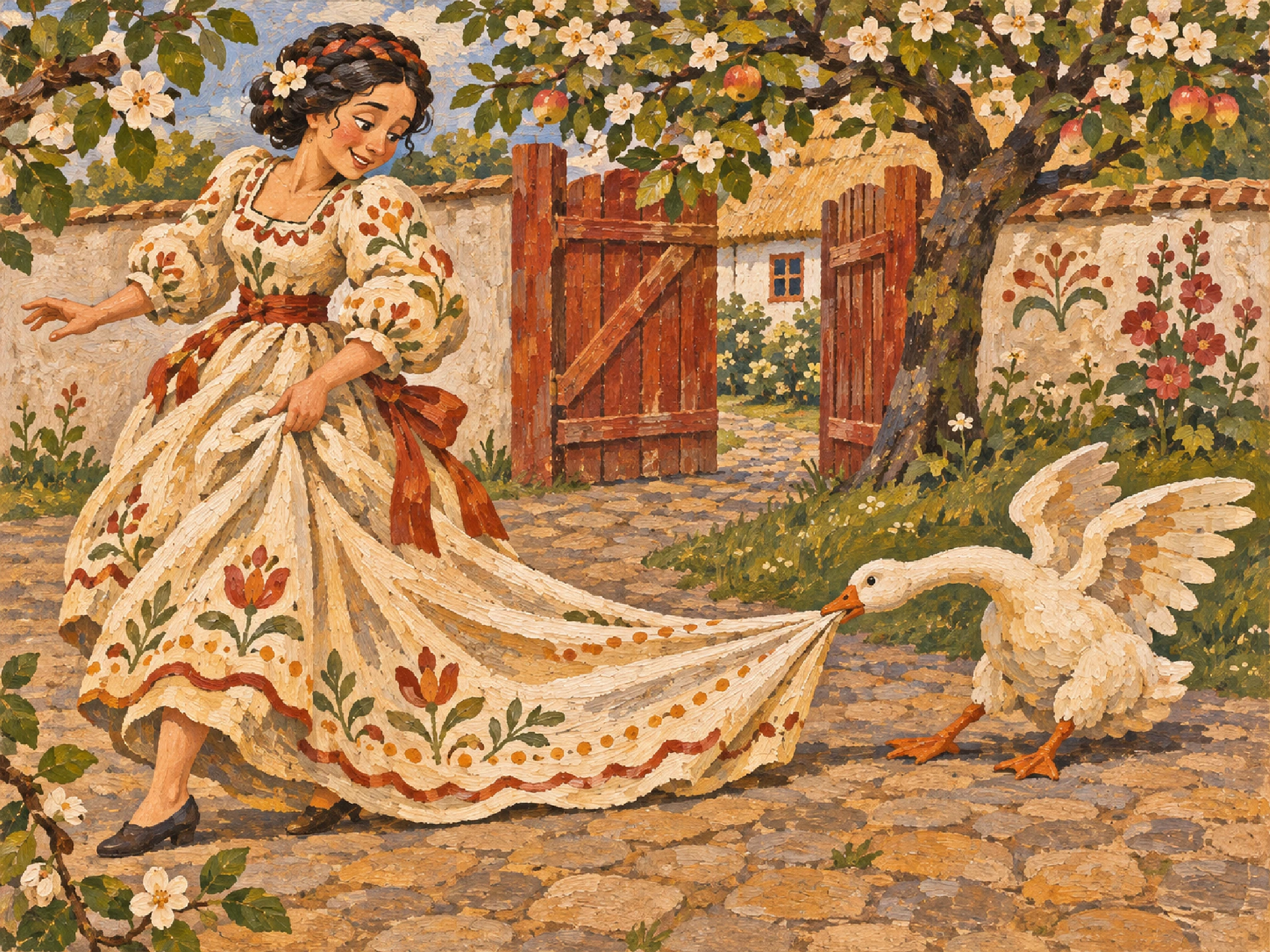
A Goose Tugging the Bride’s Train
A goose catches a bride’s train as she crosses a courtyard. Overlapping skirts and garden shapes, animated by irregular decorative brushwork, turn the small mishap into a lively folk painting.
Remix this referenceA Goose Tugging the Bride’s Train
- Form language
- Simplify forms into slightly lopsided lobes, wedges and scalloped masses; decorative repeats may vary freely while silhouettes stay legible.
- Contour
- Use uneven brush contours that swell, taper and occasionally break; let selected adjoining edges merge instead of outlining every shape.
- Mark-making
- Opaque gouache leaves bristly dabs and looping strokes; hand-spaced dots and short bars gather into loose decorative rhythms.
- Surface rendering
- Patchy opaque layers expose occasional flecks of the wood-panel ground; broad rubbed tonal patches give modest volume with visible overlaps.
Priority
Make the lively decorative simplification of naive folk painting unmistakable.
What to avoid & what to check
Exact prompt for this example
MODULE OWNERSHIP
subject: Subject count, type, stable proportions and landmarks, resting face geometry, hair shape, physical materials, garment construction and permanent marks. No emotion, movement, color assignment or rendering recipe.
expression: Facial soft-tissue displacement and pupil direction, muscle coordination, regional intensity, asymmetry and onset/peak/release. No head/body pose, stable appearance, skin color or rendering.
gesture: Head/neck/body/limb orientation, joint movement, support, contact and pose-caused occlusion using existing anatomy. No eye/pupil movement, emotion, identity, props inventory or camera.
props: Prop count, type, construction, physical material and scale relative to the subject. Holding/contact belongs to gesture, position to composition, color to palette.
scene: Environment elements, terrain, backdrop/floor presence and structural detail. No canvas positions, camera, lighting, assigned colors or render texture.
camera: Projection, focal-length impression, camera elevation/yaw/roll, viewing distance and crop. No actor pose, world placement, lighting or canvas aspect ratio.
composition: Normalized 0-100% canvas positions, scale in frame, depth/overlap, focal hierarchy and margins. No joint pose, camera projection, rendering, subject/prop inventory or emotion.
palette: Color anchors, hue/saturation/value ranges, colors assigned to parts and approximate color coverage. No illumination direction, shading algorithm, physical material or layout.
lighting: Light-source direction/softness/intensity, ambient illumination, physical shadow direction/length and highlight position. Absence of directional illumination is allowed. No shading technique, palette or material changes.
style: Reusable form abstraction, contour weight/taper/edge quality, medium and mark scale/density/direction, surface rendering and tonal transition technique. No fixed subject proportions, anatomy, identity, expression, pose, palette, light-source direction, camera or layout.
output: Image count, aspect ratio, size, file/alpha requirements and global lettering/logo/watermark restrictions. No background scenery, crop, style, identity or pose.

SUBJECT
inventory: A is one adult bride; B is one domestic goose. No other figures.
geometry: A has a long oval face and sturdy adult proportions; B has a long neck, broad breast and wedge-shaped bill.
resting-face: A has gently arched brows, almond-shaped eyes, a broad nose tip and a wide mouth; B retains ordinary goose features.
appearance: A wears a woven gown with a gathered skirt, long train and tied sash; her hair forms a braided crown. B has layered feathers.

PRIORITY


AVOID


CHECK


EXPRESSION — ACTOR A
brows: One brow lifts slightly higher than the other.
lids: Lower lids rise gently while the eyes remain open.
cheeks: Cheeks begin lifting, more noticeably on one side.
nose: Nostrils remain relaxed, without a nose wrinkle.
mouth: One mouth corner rises first; the lips part slightly.
jaw: The jaw releases just enough for the small opening.
gaze: Pupils turn downward toward the goose’s bill.
coordination: The uneven smile leads; cheek and lower-lid lifts follow softly.
timing: Catch the onset of amusement before it becomes a full laugh.

PRIORITY


AVOID


CHECK


EXPRESSION — ACTOR B
brows: No brow displacement applies; keep the brow region at rest.
lids: Lids stay naturally open without expressive squinting.
cheeks: No expressive cheek lift or compression.
nose: Nostril openings show no expressive change.
mouth: Bill corners show no expressive lift or pull.
jaw: The jaw shows no expressive gape or exaggerated tension.
gaze: The visible pupil points toward the train’s hem.
coordination: Keep the eye region quiet and the bill free of humanlike smiling cues.
timing: Hold the neutral facial state at a steady apex.

PRIORITY


AVOID


CHECK


GESTURE
head: A turns her head back and tips it down; B extends its neck toward the train.
torso: A twists gently at the waist while continuing her step; B leans backward against the cloth’s pull.
limbs: A gathers her skirt with one hand and extends the other for balance; B braces its feet with wings partly open.
contact: B grips the train’s hem in its bill, drawing a taut fold; A’s forward foot supports her weight.

PRIORITY


AVOID


CHECK


PROPS
inventory: No separate props.
construction: No prop construction applies.

PRIORITY


AVOID


CHECK


SCENE
inventory: A village courtyard contains cobbles, a grass verge, a flowering fruit tree, a low plaster wall and an open wooden gate.
structure: The uneven paving meets the grass without a curb; the gate interrupts the wall beneath spreading branches.

PRIORITY


AVOID


CHECK


CAMERA
projection: Use a mild perspective impression with little near-to-far size exaggeration.
viewpoint: Observe from slightly above standing eye level, at an oblique view into the courtyard, without roll.
crop: Use a full-figure view including the complete train and goose, with surrounding courtyard context.

PRIORITY


AVOID


CHECK


COMPOSITION
placement: Place A left of center and B in the right third; the train links them across the lower middle.
depth: Let the skirt overlap the gate and foliage; foreground branches enter from an edge without covering the face or bill.
spacing: Make the cloth-and-bill junction the main focus, followed by A’s face; retain open paving around the connecting sweep.

PRIORITY


AVOID


CHECK


PALETTE
colors: Use warm cream, rust red, moss green, golden ochre and charcoal, with mostly muted saturation.
assignment: Cream belongs to gown and goose, rust to sash and gate, moss to foliage, ochre to paving and skin, charcoal to hair and accents.
balance: Let cream and ochre occupy broad areas, green form a substantial counterweight, and red remain a compact accent.

PRIORITY


AVOID


CHECK


LIGHTING
sources: Broad, soft daylight arrives from the upper left with generous ambient fill.
shadows: Short, soft shadows fall toward the lower right beneath the feet and trailing cloth.
highlights: Keep broad, quiet highlights on upper-left-facing folds and feather masses.

PRIORITY


AVOID


CHECK


STYLE GUIDE
form-language: Simplify forms into slightly lopsided lobes, wedges and scalloped masses; decorative repeats may vary freely while silhouettes stay legible.
contour: Use uneven brush contours that swell, taper and occasionally break; let selected adjoining edges merge instead of outlining every shape.
mark-making: Opaque gouache leaves bristly dabs and looping strokes; hand-spaced dots and short bars gather into loose decorative rhythms.
surface-rendering: Patchy opaque layers expose occasional flecks of the wood-panel ground; broad rubbed tonal patches give modest volume with visible overlaps.

PRIORITY
Make the lively decorative simplification of naive folk painting unmistakable.

AVOID


CHECK


OUTPUT
format: One finished image, landscape 4:3, 2048 × 1536 pixels, opaque PNG.
restrictions: No lettering, logos or watermarks.

PRIORITY


AVOID


CHECK


FINAL INTEGRATION
gesture + composition: Coordinate the pose and overlaps so the small tug remains readable within the busy narrative.
Model information comes from image provenance. The same prompt may produce a different result.