Text to imageCharacterStyle guide
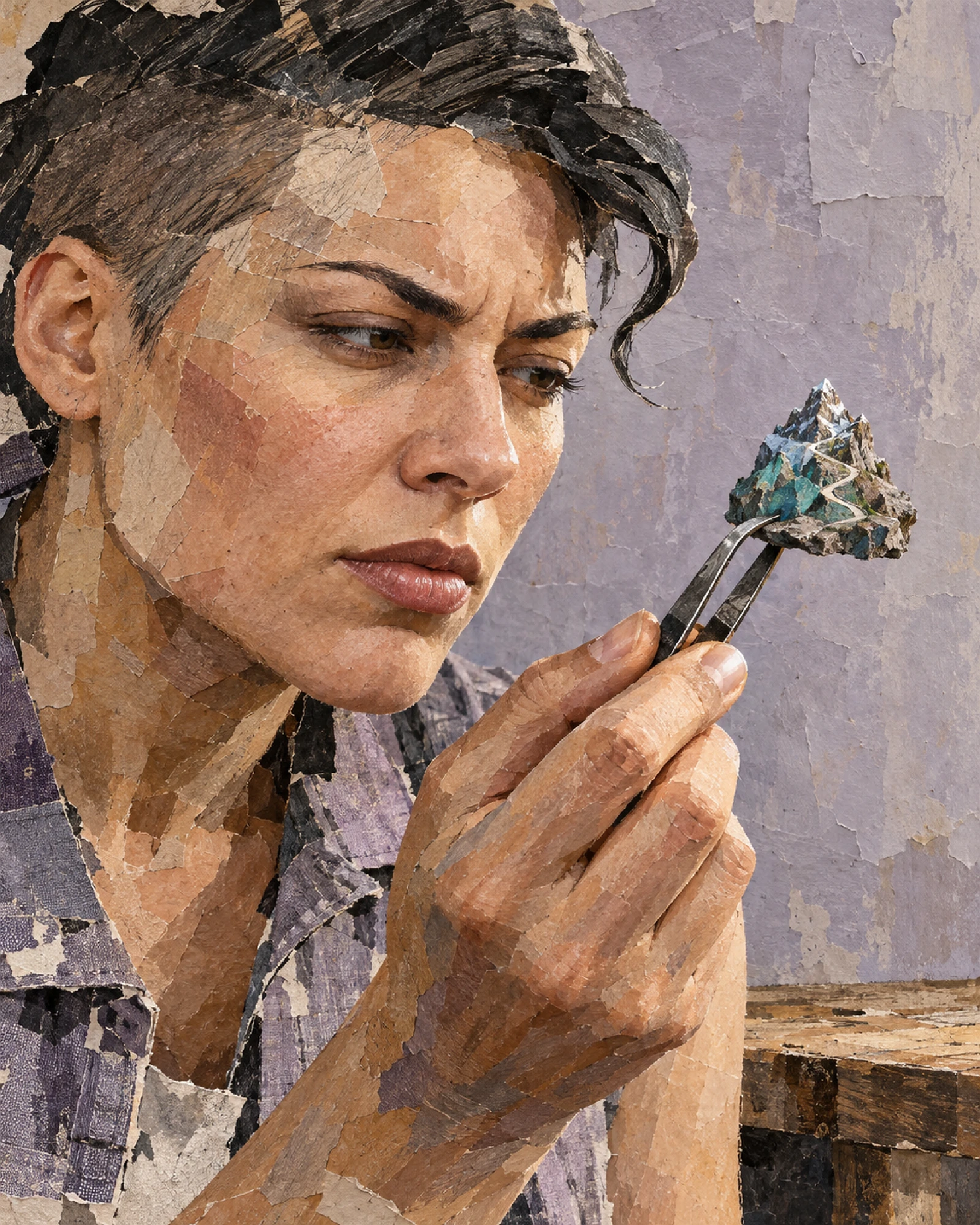
A Woman Tweezing a Mountain
An intimate portrait of a woman inspecting a tiny mountain held in tweezers. Torn photographs, opaque paint, and exposed paper overlaps combine her concentration with an impossibly small landscape in a surreal mixed-media collage.
Remix this referenceA Woman Tweezing a Mountain
- Form language
- Assemble recognizable forms from mismatched photographic fragments and broad painted pieces; let abrupt scale changes remain visibly surreal.
- Contour
- Alternate crisp scissor cuts with fibrous torn edges; allow slight misregistration where adjoining fragments describe a shared outline.
- Mark-making
- Add sparse graphite searching lines and broad gouache interruptions across collage joins; keep the handmade marks irregular and purposeful.
- Surface rendering
- Retain photographic tonal fragments beside opaque paint and exposed paper; use overlapping value patches rather than seamless digital blending.
Priority
The surreal mixed-media collage must retain visible differences between photographic, painted, and torn-paper passages.
What to avoid & what to check
Exact prompt for this example
MODULE OWNERSHIP
subject: Subject count, type, stable proportions and landmarks, resting face geometry, hair shape, physical materials, garment construction and permanent marks. No emotion, movement, color assignment or rendering recipe.
expression: Facial soft-tissue displacement and pupil direction, muscle coordination, regional intensity, asymmetry and onset/peak/release. No head/body pose, stable appearance, skin color or rendering.
gesture: Head/neck/body/limb orientation, joint movement, support, contact and pose-caused occlusion using existing anatomy. No eye/pupil movement, emotion, identity, props inventory or camera.
props: Prop count, type, construction, physical material and scale relative to the subject. Holding/contact belongs to gesture, position to composition, color to palette.
scene: Environment elements, terrain, backdrop/floor presence and structural detail. No canvas positions, camera, lighting, assigned colors or render texture.
camera: Projection, focal-length impression, camera elevation/yaw/roll, viewing distance and crop. No actor pose, world placement, lighting or canvas aspect ratio.
composition: Normalized 0-100% canvas positions, scale in frame, depth/overlap, focal hierarchy and margins. No joint pose, camera projection, rendering, subject/prop inventory or emotion.
palette: Color anchors, hue/saturation/value ranges, colors assigned to parts and approximate color coverage. No illumination direction, shading algorithm, physical material or layout.
lighting: Light-source direction/softness/intensity, ambient illumination, physical shadow direction/length and highlight position. Absence of directional illumination is allowed. No shading technique, palette or material changes.
style: Reusable form abstraction, contour weight/taper/edge quality, medium and mark scale/density/direction, surface rendering and tonal transition technique. No fixed subject proportions, anatomy, identity, expression, pose, palette, light-source direction, camera or layout.
output: Image count, aspect ratio, size, file/alpha requirements and global lettering/logo/watermark restrictions. No background scenery, crop, style, identity or pose.

SUBJECT
inventory: A is one original adult woman, a meticulous collector of impossible geological specimens.
geometry: She has an angular face, a broad nose bridge, a substantial chin, and sturdy, ordinary human hands.
resting-face: Her resting features include straight brows, deep-set eyes, a wide mouth, and a slightly fuller lower lip.
appearance: Closely clipped side hair meets a single hooked forelock; she wears a sleeveless canvas work vest without permanent markings.

PRIORITY


AVOID


CHECK


EXPRESSION — ACTOR A
brows: The inner brows draw slightly together, with one brow fractionally lower.
lids: One eye narrows more than the other for close inspection.
cheeks: The upper cheeks tighten subtly beneath the narrowed lids.
nose: The nostrils remain relaxed, without flaring or wrinkling.
mouth: Closed lips press lightly together, with the lower lip pushed slightly forward.
jaw: The jaw is gently set, without a visible clench.
gaze: Both pupils converge on the mountain.
coordination: Unequal eye narrowing and restrained lip pressure read as precise concentration.
timing: Hold the apex of concentration just before she decides where to place the specimen.

PRIORITY


AVOID


CHECK


GESTURE
head: A inclines her head toward the raised tweezers, keeping her neck comfortably bent.
torso: Her upper torso leans forward slightly, with the working shoulder gently lifted.
limbs: Her visible forearm rises toward her face; thumb and index finger close the tweezers with a delicate pinch.
contact: The tweezer tips grip the mountain at its base; her hand leaves the summit unobstructed.

PRIORITY


AVOID


CHECK


PROPS
inventory: One pair of tweezers and one thumb-sized mountain, unmistakably smaller than A's nose. No additional workbench equipment.
construction: Spring-steel tweezers have broad blunt tips; the rock mountain has a narrow base, one summit, branching gullies, and a tiny switchback path.

PRIORITY


AVOID


CHECK


SCENE
inventory: A specimen workroom is suggested by a plain plaster wall and a narrow wooden workbench edge.
structure: The wall is uninterrupted; the workbench has a worn square lip.

PRIORITY


AVOID


CHECK


CAMERA
projection: Use a natural portrait perspective with a mild short-telephoto impression.
viewpoint: Observe from eye height at a slight three-quarter yaw, with no camera roll.
crop: An intimate bust crop cuts through the outer hair and working forearm while preserving the face, fingers, and mountain.

PRIORITY


AVOID


CHECK


COMPOSITION
placement: The face occupies the left half; the mountain sits near 70% width beside a wedge of open wall.
depth: The hand overlaps the vest; the tweezer shaft bridges the gap toward the face without crossing its features.
spacing: The tiny summit is the first focal stop, followed by the eyes; preserve breathing room between mountain and cheek.

PRIORITY


AVOID


CHECK


PALETTE
colors: Use tobacco brown, dusty lilac, warm ivory, graphite, and a small mineral-turquoise accent.
assignment: Assign tobacco and ivory to skin, graphite to hair and tweezers, lilac to wall and vest, and turquoise to the mountain.
balance: Muted middle values occupy most of the image; the mountain carries the clearest saturation against quieter surroundings.

PRIORITY


AVOID


CHECK


LIGHTING
sources: A broad workroom window lights the scene softly from upper right, supported by low ambient illumination.
shadows: The nose and fingers cast soft shadows toward lower left; shadow under the chin is broader.
highlights: Restrained highlights touch the right cheekbone, upper finger surfaces, and the exposed tweezer edge.

PRIORITY


AVOID


CHECK


STYLE GUIDE
form-language: Assemble recognizable forms from mismatched photographic fragments and broad painted pieces; let abrupt scale changes remain visibly surreal.
contour: Alternate crisp scissor cuts with fibrous torn edges; allow slight misregistration where adjoining fragments describe a shared outline.
mark-making: Add sparse graphite searching lines and broad gouache interruptions across collage joins; keep the handmade marks irregular and purposeful.
surface-rendering: Retain photographic tonal fragments beside opaque paint and exposed paper; use overlapping value patches rather than seamless digital blending.

PRIORITY
The surreal mixed-media collage must retain visible differences between photographic, painted, and torn-paper passages.

AVOID


CHECK


OUTPUT
format: Deliver one opaque PNG, 1600 × 2000 pixels, with a 4:5 aspect ratio.
restrictions: No lettering, logos, slogans, or watermarks, including within photographic fragments.

PRIORITY


AVOID


CHECK


FINAL INTEGRATION
expression + gesture + props: The facial performance and careful handling cooperate to make the impossible specimen feel consequential to A.
camera + composition + style: The close view makes both the scale paradox and the handmade assembly available for immediate inspection.
Model information comes from image provenance. The same prompt may produce a different result.