Text to imageArt stylesStyle guide
One Snail · Paper Quilling
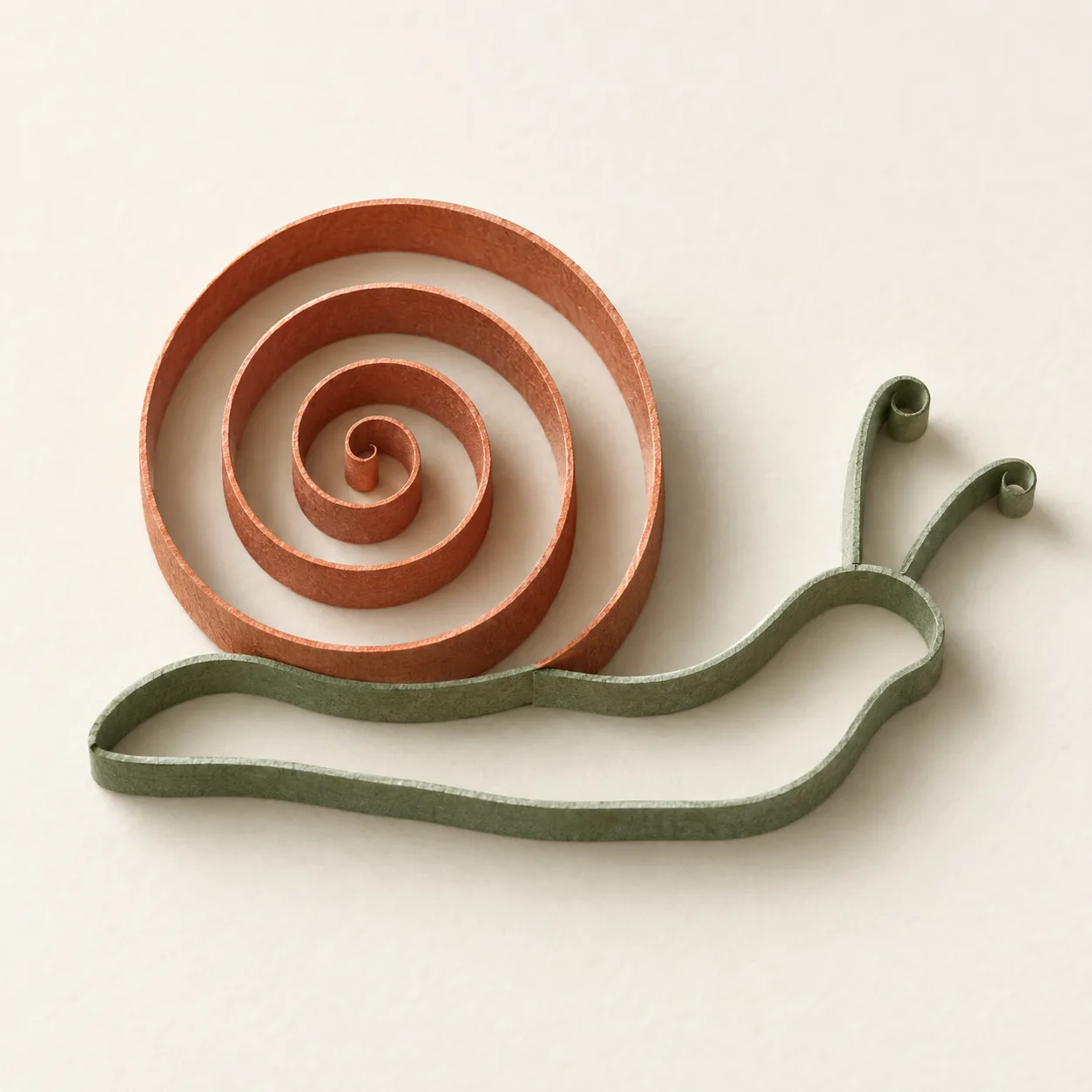
A dimensional paper-quilling study that builds a snail from upright strips and a loose spiral.
One Snail · Paper Quilling
- Shape & line
- Build the silhouette from narrow paper strips standing on their edges. Form the shell with one loose continuous spiral whose turns remain visibly separated; bend the body into a low closed outline and extend two simple curved strips from the head as feelers.
- Color & light
- Use terracotta paper for the shell and muted sage paper for the body against ivory card. Light from image-upper-left so the upper-left strip edges brighten and each raised strip casts a soft short shadow toward image-lower-right onto the card or a neighboring strip.
- Texture & material
- Keep the paper matte, with subtly fibrous cut edges and smooth colored faces. Show consistent strip height and slight handmade bending irregularities; preserve open card-colored gaps inside the coils so the construction reads as curled paper rather than a solid modeled surface.
- Composition
- Place the shell's lower edge against the body's upper outline with a visible meeting point. Keep the head and feelers clear of the shell on image-right, and use the oblique view to reveal both the thin top edges and upright paper faces without obscuring the spiral.
Priority
Prioritize the readable open spiral and the visible height of the paper strips.
What to avoid & what to check
Avoid solid clay forms, flat drawn outlines and dense coils that hide the backing card.
Check that one snail reads clearly and that the raised strips cast shadows toward image-lower-right.
Exact prompt for this example
SUBJECT
One snail made from curled paper strips on an ivory backing card; one large spiral shell rests above a low elongated body, with its head and two feelers pointing toward image-right.

COMPOSITION
Show the entire snail in a close, slightly oblique overhead view, with the shell left of center and the head on image-right. Leave a generous margin of backing card around the silhouette.

STYLE GUIDE
1. Shape & line
Build the silhouette from narrow paper strips standing on their edges. Form the shell with one loose continuous spiral whose turns remain visibly separated; bend the body into a low closed outline and extend two simple curved strips from the head as feelers.

2. Color & light
Use terracotta paper for the shell and muted sage paper for the body against ivory card. Light from image-upper-left so the upper-left strip edges brighten and each raised strip casts a soft short shadow toward image-lower-right onto the card or a neighboring strip.

3. Texture & material
Keep the paper matte, with subtly fibrous cut edges and smooth colored faces. Show consistent strip height and slight handmade bending irregularities; preserve open card-colored gaps inside the coils so the construction reads as curled paper rather than a solid modeled surface.

4. Composition
Place the shell's lower edge against the body's upper outline with a visible meeting point. Keep the head and feelers clear of the shell on image-right, and use the oblique view to reveal both the thin top edges and upright paper faces without obscuring the spiral.

PRIORITY
Preserve the requested identity, count, action, composition and output settings. Apply the style rules within those constraints; a style reference must not replace the subject or layout. Within the style: Prioritize the readable open spiral and the visible height of the paper strips.

AVOID
Avoid solid clay forms, flat drawn outlines and dense coils that hide the backing card.

OUTPUT
One square image of a handmade paper-quilling illustration, with no text, lettering, logo or watermark.

SELF-CHECK
Check that one snail reads clearly and that the raised strips cast shadows toward image-lower-right.
Model information comes from image provenance. The same prompt may produce a different result.