Text to imageCalligraphyStyle guide
Brush Lettering Beneath Broken Rafters
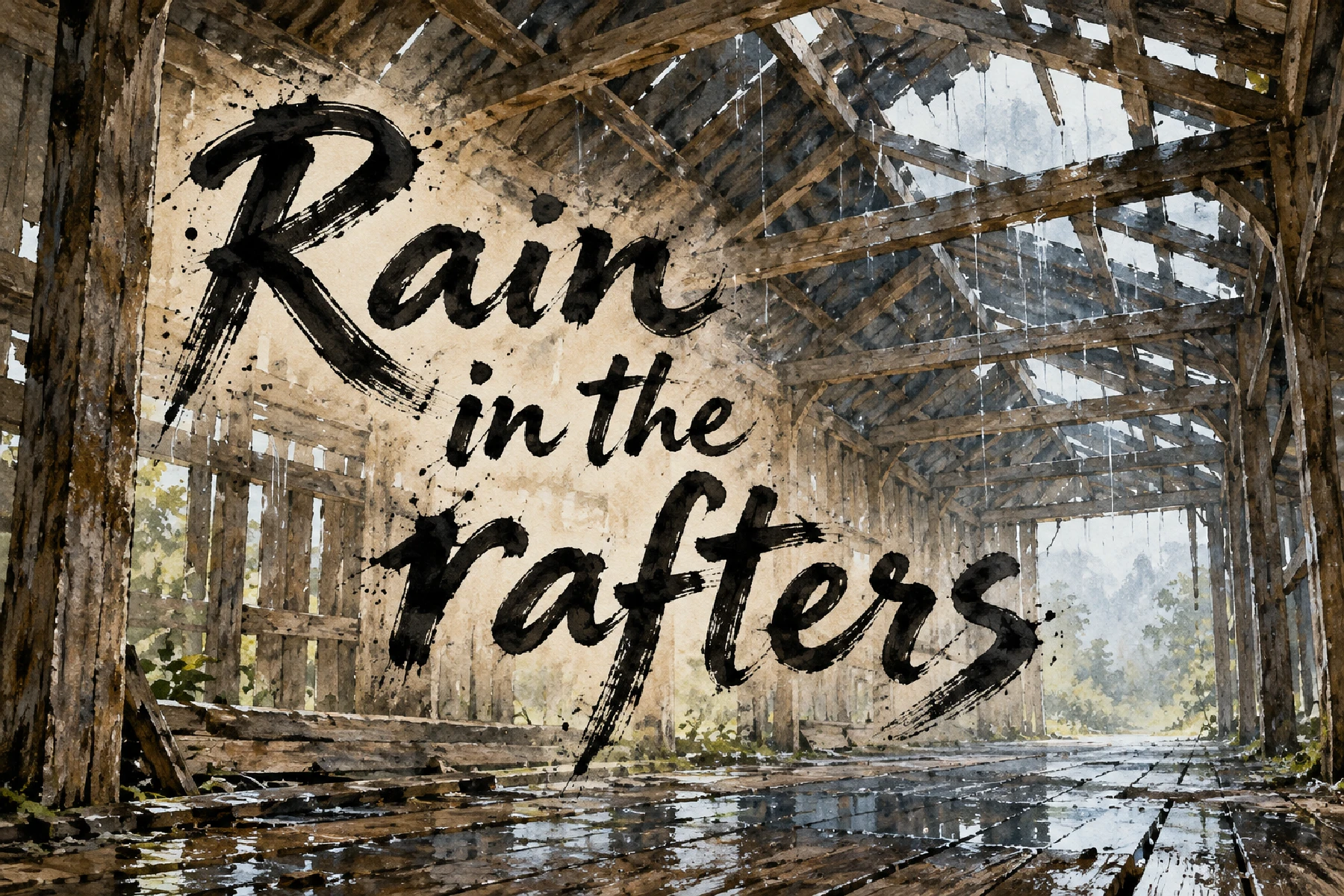
Expressive brush lettering sweeps through an old timber drying shed, its broken ink edges answering the layered rafters and rain entering through roof gaps.
Remix this referenceBrush Lettering Beneath Broken Rafters
- Form language
- Reduce architecture to irregular interlocking bars and open intervals; let small structural details vary within this spare vocabulary.
- Contour
- Use pressure-swollen brush edges that split into broken bristle fringes, with occasional clean tapered exits preserving legible shapes.
- Mark-making
- Drag a broad dry brush through forceful starts and brisk links; expose paper in irregular skips and let fine trails record the stroke direction.
- Surface rendering
- Pair granular opaque ink deposits with thin, uneven wash veils; shift tone through broken coverage, pooled edges and softly bleeding transitions.
Priority
Keep dry-brush calligraphy visibly tactile: broken edges must retain the momentum and readability of each stroke.
What to avoid & what to check
Exact prompt for this example
MODULE OWNERSHIP
subject: Subject count, type, stable proportions and landmarks, resting face geometry, hair shape, physical materials, garment construction and permanent marks. No emotion, movement, color assignment or rendering recipe.
expression: Facial soft-tissue displacement and pupil direction, muscle coordination, regional intensity, asymmetry and onset/peak/release. No head/body pose, stable appearance, skin color or rendering.
gesture: Head/neck/body/limb orientation, joint movement, support, contact and pose-caused occlusion using existing anatomy. No eye/pupil movement, emotion, identity, props inventory or camera.
props: Prop count, type, construction, physical material and scale relative to the subject. Holding/contact belongs to gesture, position to composition, color to palette.
scene: Environment elements, terrain, backdrop/floor presence and structural detail. No canvas positions, camera, lighting, assigned colors or render texture.
camera: Projection, focal-length impression, camera elevation/yaw/roll, viewing distance and crop. No actor pose, world placement, lighting or canvas aspect ratio.
composition: Normalized 0-100% canvas positions, scale in frame, depth/overlap, focal hierarchy and margins. No joint pose, camera projection, rendering, subject/prop inventory or emotion.
palette: Color anchors, hue/saturation/value ranges, colors assigned to parts and approximate color coverage. No illumination direction, shading algorithm, physical material or layout.
lighting: Light-source direction/softness/intensity, ambient illumination, physical shadow direction/length and highlight position. Absence of directional illumination is allowed. No shading technique, palette or material changes.
style: Reusable form abstraction, contour weight/taper/edge quality, medium and mark scale/density/direction, surface rendering and tonal transition technique. No fixed subject proportions, anatomy, identity, expression, pose, palette, light-source direction, camera or layout.
output: Image count, aspect ratio, size, file/alpha requirements and global lettering/logo/watermark restrictions. No background scenery, crop, style, identity or pose.

SUBJECT
inventory: One original English calligraphic inscription; no human or animal subjects.
geometry: Write "Rain in the rafters" with a distinct capital R, open lowercase counters and clearly separated words.
resting-face: No facial geometry applies.
appearance: The inscription has no physical signboard or sculptural carrier; no character appearance applies.

PRIORITY


AVOID


CHECK


PROPS
inventory: No separate props.
construction: No prop construction applies.

PRIORITY


AVOID


CHECK


SCENE
inventory: An old timber drying shed contains exposed roof frames, slatted walls, a worn plank floor and shallow rain puddles.
structure: Repeated timber bays lead to an open end; rain enters through missing roof sections and wets exposed timber edges, while uneven wall gaps reveal vegetation.

PRIORITY


AVOID


CHECK


CAMERA
projection: Moderately wide perspective gives the interior depth while keeping the timber uprights nearly straight.
viewpoint: View from standing eye height, looking diagonally along the shed with a level camera.
crop: Use an expansive interior view, cropping nearby beams while retaining the complete inscription.

PRIORITY


AVOID


CHECK


COMPOSITION
placement: An oversized three-line inscription steps from upper left toward lower right, with the longest final line forming the main sweep.
depth: Lettering leads the hierarchy; foreground beams frame it, while successive roof bays recede behind its readable silhouette.
spacing: Leave generous air around counters and word gaps, a quiet opening at the right, and clear margins around all letter terminals.

PRIORITY


AVOID


CHECK


PALETTE
colors: Use soot black, weathered umber, rain blue-gray, pale flax and a restrained moss green.
assignment: Give the inscription soot black, timber muted umber, open air and puddles blue-gray, light gaps pale flax, and vegetation moss green.
balance: Muted middle values dominate; the inscription carries the deepest darks, with sparse pale openings and minor green accents.

PRIORITY


AVOID


CHECK


LIGHTING
sources: Soft overcast daylight enters through the upper-right roof openings, supported by gentle ambient light from the slatted walls.
shadows: Broad, faint beam shadows fall toward the lower left; the inscription casts no physical shadow.
highlights: Restrained highlights catch upper-facing timber edges and puddle surfaces beneath the roof gaps.

PRIORITY


AVOID


CHECK


STYLE GUIDE
form-language: Reduce architecture to irregular interlocking bars and open intervals; let small structural details vary within this spare vocabulary.
contour: Use pressure-swollen brush edges that split into broken bristle fringes, with occasional clean tapered exits preserving legible shapes.
mark-making: Drag a broad dry brush through forceful starts and brisk links; expose paper in irregular skips and let fine trails record the stroke direction.
surface-rendering: Pair granular opaque ink deposits with thin, uneven wash veils; shift tone through broken coverage, pooled edges and softly bleeding transitions.

PRIORITY
Keep dry-brush calligraphy visibly tactile: broken edges must retain the momentum and readability of each stroke.

AVOID


CHECK


OUTPUT
format: One finished image, landscape 3:2, 1800 × 1200 pixels, opaque PNG.
restrictions: Allow primary lettering; forbid additional text, logos and watermarks.

PRIORITY


AVOID


CHECK


FINAL INTEGRATION
subject + output: The subject inscription "Rain in the rafters" is the primary lettering authorized for the finished output.
Model information comes from image provenance. The same prompt may produce a different result.