Text to imageCharacterStyle guide
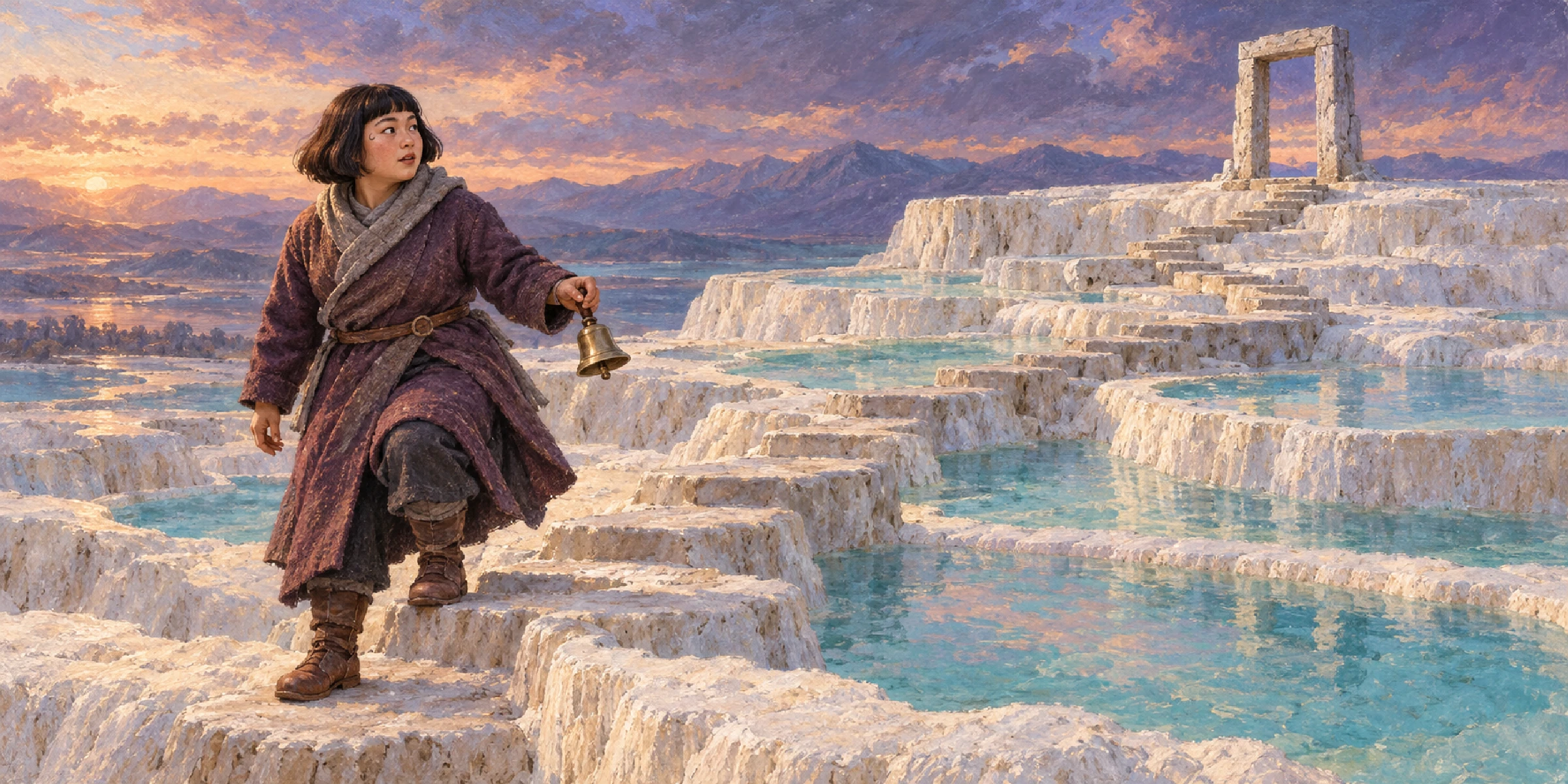
Bell Keeper on the Salt Stair
A bell keeper sounds a small bell while crossing immense salt terraces. Dreamlike rubbed oil pastel and scratched traces carry a winding stair toward a distant doorway.
Remix this referenceBell Keeper on the Salt Stair
- Form language
- Abstract forms into rounded masses interrupted by hooked wedges; preserve useful irregularity rather than polishing every shape into symmetry, allowing minor silhouettes and secondary details to vary.
- Contour
- Use waxy, uneven edges that alternately dissolve through rubbing and return as blunt pastel strokes, with occasional weight changes rather than a continuous uniform outline around every form.
- Mark-making
- Combine broad oil-pastel sweeps, finger-rubbed smears and fine, interrupted scratched arcs; vary their pressure and rhythm naturally so the hand's movement remains evident without a repeated texture pattern.
- Surface rendering
- Build softly rubbed tonal passages beneath broken opaque deposits, allowing rubbed transitions, wax drag and scratched underlayers to coexist visibly; avoid blending the whole image into a uniformly smooth finish.
Priority
Make the contrast between rubbed softness and scratched resistance visibly tactile.
What to avoid & what to check
Avoid a uniform digital blur with decorative scratches pasted over it.
Smears, waxy deposits and revealed underlayers behave as one pastel medium.
Exact prompt for this example
MODULE OWNERSHIP
subject: Subject count, type, stable proportions and landmarks, resting face geometry, hair shape, physical materials, garment construction and permanent marks. No emotion, movement, color assignment or rendering recipe.
expression: Facial soft-tissue displacement and pupil direction, muscle coordination, regional intensity, asymmetry and onset/peak/release. No head/body pose, stable appearance, skin color or rendering.
gesture: Head/neck/body/limb orientation, joint movement, support, contact and pose-caused occlusion using existing anatomy. No eye/pupil movement, emotion, identity, props inventory or camera.
props: Prop count, type, construction, physical material and scale relative to the subject. Holding/contact belongs to gesture, position to composition, color to palette.
scene: Environment elements, terrain, backdrop/floor presence and structural detail. No canvas positions, camera, lighting, assigned colors or render texture.
camera: Projection, focal-length impression, camera elevation/yaw/roll, viewing distance and crop. No actor pose, world placement, lighting or canvas aspect ratio.
composition: Normalized 0-100% canvas positions, scale in frame, depth/overlap, focal hierarchy and margins. No joint pose, camera projection, rendering, subject/prop inventory or emotion.
palette: Color anchors, hue/saturation/value ranges, colors assigned to parts and approximate color coverage. No illumination direction, shading algorithm, physical material or layout.
lighting: Light-source direction/softness/intensity, ambient illumination, physical shadow direction/length and highlight position. Absence of directional illumination is allowed. No shading technique, palette or material changes.
style: Reusable form abstraction, contour weight/taper/edge quality, medium and mark scale/density/direction, surface rendering and tonal transition technique. No fixed subject proportions, anatomy, identity, expression, pose, palette, light-source direction, camera or layout.
output: Image count, aspect ratio, size, file/alpha requirements and global lettering/logo/watermark restrictions. No background scenery, crop, style, identity or pose.

SUBJECT
inventory: A is one original adult human bell keeper, with a compact, sturdy build and a distinctive everyday ceremonial costume.
geometry: Use a broad ribcage, substantial hands and short, strong legs; the long coat makes a generous silhouette around this compact construction.
resting-face: Establish a broad nose, rounded cheekbones, shallow-set eyes and a small mouth with a clearly shaped upper lip.
appearance: Give A a blunt bob with a curved fringe, a wool wrap coat with a broad overlapping front and divided hem, sturdy leather boots, and a small crescent birthmark beside one temple. Minor garment details may vary coherently.

PRIORITY
Make the compact figure and generous wrap coat an immediately recognizable character.

AVOID
Avoid generic heroic armor or elaborate ornamental costume.

CHECK
The bob, broad nose and overlapping coat establish a coherent identity.

EXPRESSION — ACTOR A
brows: Raise both inner brow portions gently, with one slightly higher as attention sharpens farther away in the scene depicted in the image's right side, with no eye rolling.
lids: Open the upper lids enough to reveal attentive eyes; keep the lower lids softly supported rather than stretched wide for alarm or shock, which should not be present.
cheeks: Allow a small lift at the outer cheeks without pronounced smile folds, while keeping the center cheek area relaxed, giving a sense of attentive interest rather than broad cheer.
nose: Keep the nasal bridge smooth and the nostrils relaxed, with no wrinkle or flare, so the nose reads as a resting channel within the attentive expression rather than a tense reaction.
mouth: Part the lips narrowly, with a slight lift at one corner, as if a question is forming, but do not expose teeth or make the opening large enough to suggest speech or surprise.
jaw: Release the jaw slightly while preserving a quiet, nearly closed-mouth silhouette, with no pronounced downward pull or clenching; the small release supports the lightly parted lips.
gaze: Direct both pupils toward the distant right, with a clear shared target beyond the immediate foreground and no direct engagement with the viewer; the gaze should remain readable.
coordination: Let the brow and lid opening lead; mouth and cheeks respond more quietly, with the small asymmetry confined to brow height and one mouth corner rather than a crooked whole-face grimace.
timing: Capture the held instant of recognition, after attention has arrived but before a larger reaction begins; retain the modest facial displacement appropriate to this curiosity apex.

PRIORITY
Read curiosity through attentive eyes and a restrained questioning mouth.

AVOID
Avoid a startled stare or broad celebratory smile.

CHECK
The upper face leads a gentle, readable moment of discovery.

GESTURE
head: Turn the head along the ascending route, with the neck extended lightly above the coat collar.
torso: Keep the torso upright with a small opposing turn through the shoulders, creating a poised pause within the climb.
limbs: Place one boot on the next tread and leave the rear leg supporting the pause; bend the bell arm outward while the other arm hangs loosely.
contact: Close the fingers around the bell handle during a small outward swing; both boot soles retain clear contact with their respective treads.

PRIORITY
Unite the paused ascent and small bell swing into one readable action.

AVOID
Avoid a theatrical lunge or exaggerated load-bearing lean.

CHECK
The grounded feet and outward forearm make the pause believable.

PROPS
inventory: Include one small handbell sized for one-handed use, and no additional carried equipment.
construction: The bell has a cast bronze cup, an internal clapper and a short turned wooden handle sized for one hand.

PRIORITY
Keep the handbell simple and unmistakable.

AVOID
Avoid decorative attachments that compete with the bell shape.

CHECK
The cup and short handle identify a usable handbell.

SCENE
inventory: Build an immense salt-terrace landscape with shallow pools, a winding stair and one freestanding stone doorway.
structure: Broad mineral shelves curl around recessed pools; irregular steps bridge successive shelves, ending at a doorway with nothing built behind it.

PRIORITY
Give the stair a continuous, dreamlike passage through the terraces.

AVOID
Avoid filling the landscape with additional monuments.

CHECK
The mineral shelves, pools and open doorway belong to one environment.

CAMERA
projection: Use natural perspective with a moderately wide focal-length impression and gentle distance recession.
viewpoint: Observe from slightly above standing eye level, looking obliquely across the terrace ascent with a level horizon.
crop: Show A's complete figure within a broad environmental view; retain enough facial detail to read the small reaction.

PRIORITY
Balance environmental breadth with a readable character.

AVOID
Avoid extreme wide-angle stretching at the figure.

CHECK
The view reveals the ascent without sacrificing A's face.

COMPOSITION
placement: Anchor A in the left third, with the figure occupying roughly half the image height; set the distant doorway toward the upper right.
depth: Let a foreground shelf overlap the lowest stair segment; successive stair turns diminish toward the doorway, keeping A as the primary focal point and the handbell as a secondary detail.
spacing: Leave spacious pool intervals between stair turns and breathing room around the bell; the route provides a clear visual journey across the panorama.

PRIORITY
Lead attention from A through the stair turns to the distant doorway.

AVOID
Avoid equally prominent landmarks scattered across the panorama.

CHECK
The character begins a clear journey through spacious depth.

PALETTE
colors: Use cream, muted turquoise, smoky aubergine and a small apricot accent, with subdued saturation and a generous light-value range.
assignment: Assign cream to mineral shelves, turquoise to pools, aubergine to the coat and distant sky, apricot to the face, and muted ochre to the bell.
balance: Let pale terrain dominate, cool passages occupy substantial secondary areas, and warm accents remain scarce and expressive.

PRIORITY
Make the warm face a small living accent within the cool mineral world.

AVOID
Avoid equally saturated color on every terrace.
Avoid deep black cast-shadow colors.

CHECK
Cream and cool hues dominate while the character retains a warm accent.

LIGHTING
sources: Use a broad, soft dusk source from the upper left, with ample ambient illumination across the open landscape.
shadows: Cast shallow, soft-edged shadows toward the right beneath steps, boots and projecting shelf lips.
highlights: Favor broad highlights on upper ledges and the left-facing cheek, with a restrained glint on the bell rim.

PRIORITY
Keep the landscape gently illuminated enough to sustain its dreamlike openness.

AVOID
Avoid hard theatrical spotlights.

CHECK
Broad leftward illumination agrees with the soft rightward shadows.

STYLE GUIDE
form-language: Abstract forms into rounded masses interrupted by hooked wedges; preserve useful irregularity rather than polishing every shape into symmetry, allowing minor silhouettes and secondary details to vary.
contour: Use waxy, uneven edges that alternately dissolve through rubbing and return as blunt pastel strokes, with occasional weight changes rather than a continuous uniform outline around every form.
mark-making: Combine broad oil-pastel sweeps, finger-rubbed smears and fine, interrupted scratched arcs; vary their pressure and rhythm naturally so the hand's movement remains evident without a repeated texture pattern.
surface-rendering: Build softly rubbed tonal passages beneath broken opaque deposits, allowing rubbed transitions, wax drag and scratched underlayers to coexist visibly; avoid blending the whole image into a uniformly smooth finish.

PRIORITY
Make the contrast between rubbed softness and scratched resistance visibly tactile.

AVOID
Avoid a uniform digital blur with decorative scratches pasted over it.

CHECK
Smears, waxy deposits and revealed underlayers behave as one pastel medium.

OUTPUT
format: Deliver one finished landscape image, 2:1 aspect ratio, 2400 × 1200 pixels, as an opaque PNG.
restrictions: Include no lettering, logos, signatures or watermarks, keeping the image suitable as a finished visual reference.

PRIORITY
Deliver a complete panoramic illustration.

AVOID
Avoid contact sheets or alternate versions within the image.

CHECK
One opaque image meets the requested dimensions and lettering restrictions.

FINAL INTEGRATION
expression + camera + composition: Keep facial acting readable at the environmental viewing distance while preserving the composition's visual journey.
style + lighting + palette: Let the medium's varied transitions interpret the illumination without obscuring the palette's focal contrast.
Model information comes from image provenance. The same prompt may produce a different result.