Text to imagePortraitStyle guide
Close-Cropped Adult · Form-Following Stubble
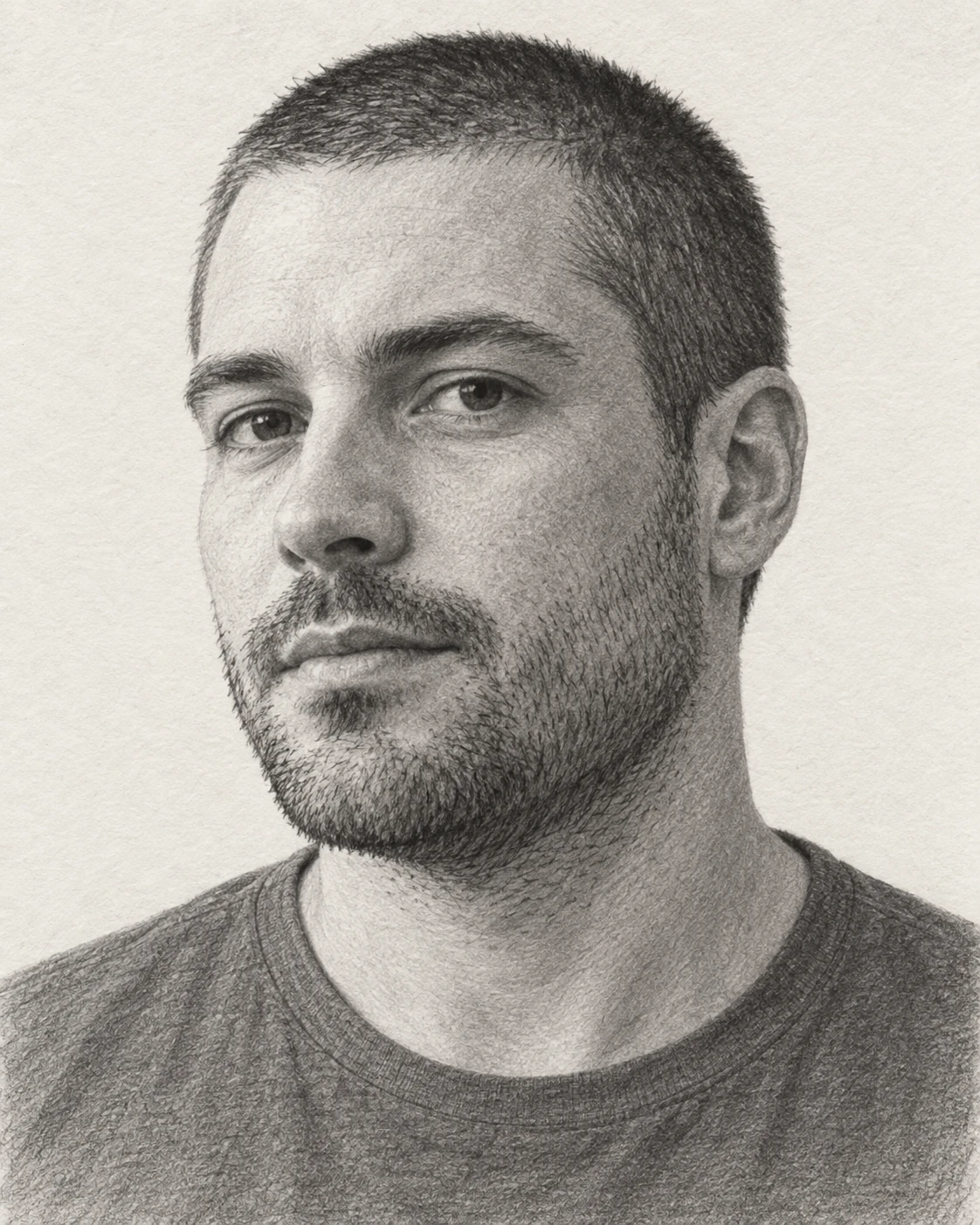
A graphite portrait that reveals cheek, chin, and jaw curvature through the direction and density of short stubble.
Close-Cropped Adult · Form-Following Stubble
- Shape & line
- Draw stubble with short tapered strokes: angle cheek hairs down toward the jaw, turn chin hairs downward around its rounded surface, and compress stroke spacing as the jaw curves away on image-left. Keep each mark rooted in the facial form rather than repeating one direction across the beard.
- Color & light
- Use graphite grays with soft light from image-upper-left. Leave the upper forehead and image-left cheek lighter, shade the image-right lower cheek and underside of the chin more deeply, and keep stubble darker than the skin immediately beneath it without merging the beard into a solid black patch.
- Texture & material
- Build skin with broad, lightly blended graphite tones that retain a little paper grain, then add crisp stubble marks over them. Leave visible skin gaps between hairs, thin the marks toward the upper cheeks, and increase their density beneath the chin so the surface reads as short growth rather than soft fur.
- Composition
- Place the head near the center with a small margin above the hair and generous clear space beside the lower face. Make the wider image-right cheek and jaw the clearest area of stubble detail, while simplifying the shirt and background so the changing hair directions remain easy to compare.
Priority
Prioritize stubble direction that makes the curved lower face readable.
What to avoid & what to check
Avoid uniform dots, long beard strands, and an unbroken dark beard mass.
Check that cheek and chin strokes change direction with the form and retain visible skin between them.
Exact prompt for this example
SUBJECT
One adult with close-cropped hair, short dark facial stubble, a relaxed closed mouth, and a plain crew-neck shirt. The stubble grows across the lower cheeks, upper lip, chin, and jaw as part of the skin surface.

COMPOSITION
A vertical head-and-shoulders portrait at eye level. Turn the face slightly toward image-left so the image-right cheek and jaw occupy more visible width. Keep the entire chin and both shoulder tops inside the frame against a plain pale background.

STYLE GUIDE
1. Shape & line
Draw stubble with short tapered strokes: angle cheek hairs down toward the jaw, turn chin hairs downward around its rounded surface, and compress stroke spacing as the jaw curves away on image-left. Keep each mark rooted in the facial form rather than repeating one direction across the beard.

2. Color & light
Use graphite grays with soft light from image-upper-left. Leave the upper forehead and image-left cheek lighter, shade the image-right lower cheek and underside of the chin more deeply, and keep stubble darker than the skin immediately beneath it without merging the beard into a solid black patch.

3. Texture & material
Build skin with broad, lightly blended graphite tones that retain a little paper grain, then add crisp stubble marks over them. Leave visible skin gaps between hairs, thin the marks toward the upper cheeks, and increase their density beneath the chin so the surface reads as short growth rather than soft fur.

4. Composition
Place the head near the center with a small margin above the hair and generous clear space beside the lower face. Make the wider image-right cheek and jaw the clearest area of stubble detail, while simplifying the shirt and background so the changing hair directions remain easy to compare.

PRIORITY
Preserve the requested identity, count, action, composition and output settings. Apply the style rules within those constraints; a style reference must not replace the subject or layout. Within the style: Prioritize stubble direction that makes the curved lower face readable.

AVOID
Avoid uniform dots, long beard strands, and an unbroken dark beard mass.

OUTPUT
One image in a 4:5 aspect ratio, rendered as a graphite drawing on off-white paper, with no lettering, captions, or watermark.

SELF-CHECK
Check that cheek and chin strokes change direction with the form and retain visible skin between them.
Model information comes from image provenance. The same prompt may produce a different result.