Text to imageComicsStyle guide
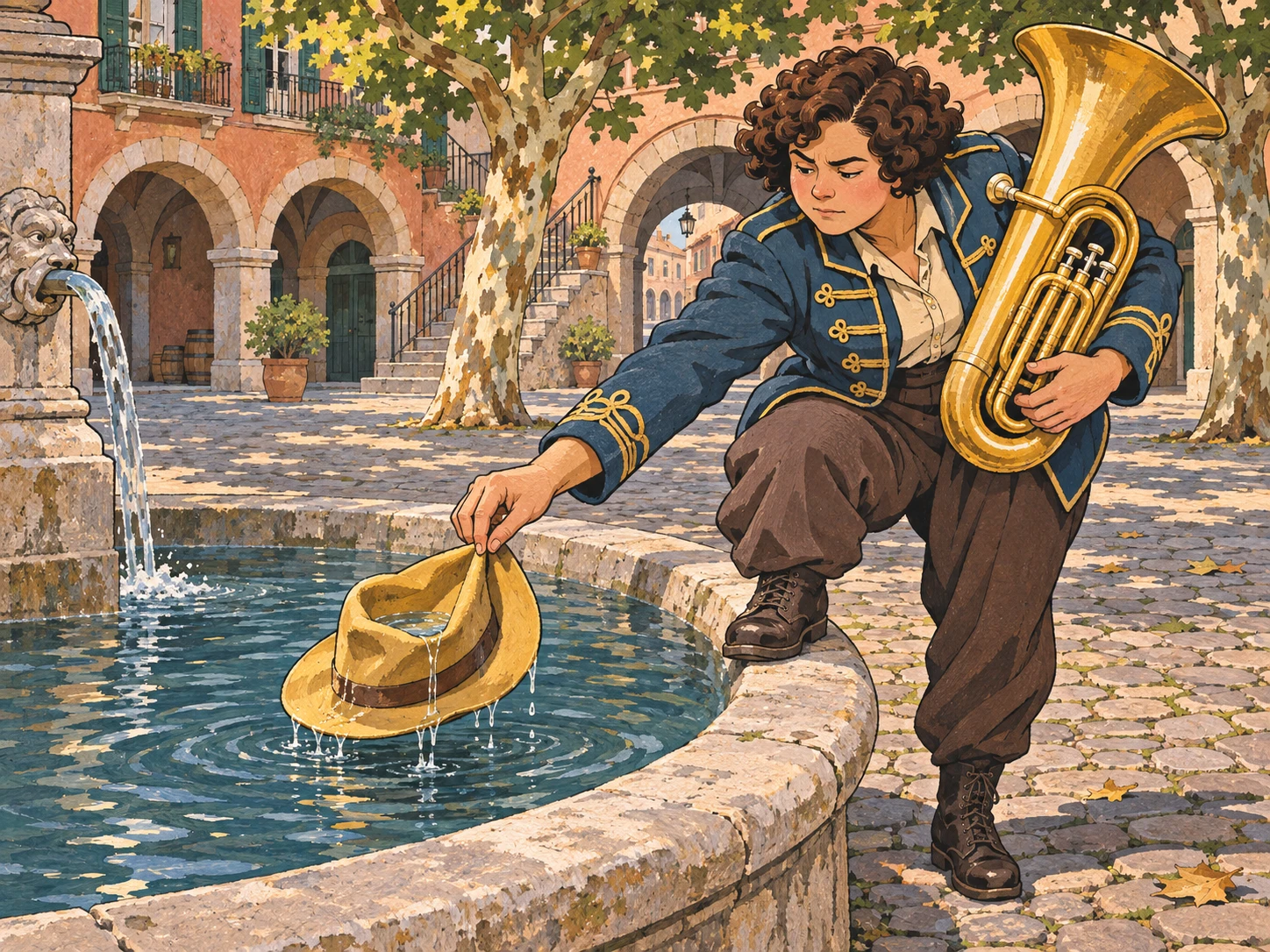
A Tuba Player Retrieving a Soaked Hat
A musician balances on a fountain rim, cradling her tuba while retrieving a hat full of water. Clear pen contours and opaque color turn the small mishap into an expressive comic illustration within a layered, tree-lined arcade square.
Remix this referenceA Tuba Player Retrieving a Soaked Hat
- Form language
- Use lucid, gently simplified shapes with specific silhouettes; describe complicated structures through selected readable divisions.
- Contour
- Draw closed, clean pen contours of nearly even weight, with slight taper at endings and fine interior lines that stop before cluttering.
- Mark-making
- Use economical ink notches and short curved strokes for local detail; allow small hand-drawn irregularities without rough sketch scaffolding.
- Surface rendering
- Lay opaque gouache in bounded areas, retaining subtle brush variation; use a few stepped tonal shapes instead of continuous modeled gradients.
Priority
Rendering medium: clear-line European comic illustration in pen ink and opaque gouache.
What to avoid & what to check
Exact prompt for this example
MODULE OWNERSHIP
subject: Subject count, type, stable proportions and landmarks, resting face geometry, hair shape, physical materials, garment construction and permanent marks. No emotion, movement, color assignment or rendering recipe.
expression: Facial soft-tissue displacement and pupil direction, muscle coordination, regional intensity, asymmetry and onset/peak/release. No head/body pose, stable appearance, skin color or rendering.
gesture: Head/neck/body/limb orientation, joint movement, support, contact and pose-caused occlusion using existing anatomy. No eye/pupil movement, emotion, identity, props inventory or camera.
props: Prop count, type, construction, physical material and scale relative to the subject. Holding/contact belongs to gesture, position to composition, color to palette.
scene: Environment elements, terrain, backdrop/floor presence and structural detail. No canvas positions, camera, lighting, assigned colors or render texture.
camera: Projection, focal-length impression, camera elevation/yaw/roll, viewing distance and crop. No actor pose, world placement, lighting or canvas aspect ratio.
composition: Normalized 0-100% canvas positions, scale in frame, depth/overlap, focal hierarchy and margins. No joint pose, camera projection, rendering, subject/prop inventory or emotion.
palette: Color anchors, hue/saturation/value ranges, colors assigned to parts and approximate color coverage. No illumination direction, shading algorithm, physical material or layout.
lighting: Light-source direction/softness/intensity, ambient illumination, physical shadow direction/length and highlight position. Absence of directional illumination is allowed. No shading technique, palette or material changes.
style: Reusable form abstraction, contour weight/taper/edge quality, medium and mark scale/density/direction, surface rendering and tonal transition technique. No fixed subject proportions, anatomy, identity, expression, pose, palette, light-source direction, camera or layout.
output: Image count, aspect ratio, size, file/alpha requirements and global lettering/logo/watermark restrictions. No background scenery, crop, style, identity or pose.

SUBJECT
inventory: One adult woman, a brass-band musician; no other people or animals.
geometry: A sturdy adult build with broad hands and a compact, square-jawed head; recognizable everyday proportions.
resting-face: Straight brows, rounded eye openings, a short broad nose and a fuller lower lip define her resting face.
appearance: A tightly curled bob, a shirt beneath a wool band jacket with braided cuffs, loose trousers and leather lace-up boots.

PRIORITY


AVOID


CHECK


EXPRESSION — ACTOR A
brows: Brow heads draw inward, with one slightly lower than the other.
lids: Upper lids lower slightly; lower lids tighten without squeezing shut.
cheeks: Cheeks remain mostly relaxed, with a slight lift beneath the eyes.
nose: Nostrils remain relaxed, with no visible flare or wrinkle.
mouth: Closed lips press lightly together, one corner tucked inward.
jaw: Jaw held gently firm, without a protruding chin or clenched teeth.
gaze: Pupils point toward the hat brim.
coordination: Brow and lid tension carry the effort; mouth tension stays quieter.
timing: At the peak of a brief effort, hold the small facial tensions together.

PRIORITY


AVOID


CHECK


GESTURE
head: Head tips down and turns slightly toward the reaching arm; neck extends naturally from the bent torso.
torso: Torso reaches out over the basin while the hips stay back as a counterbalance.
limbs: Left knee rests on the rim, right boot stays planted; right arm lifts the hat while the left cradles the tuba.
contact: Right fingertips pinch the hat brim; left forearm secures the tuba against her hip, keeping her face unobstructed.

PRIORITY


AVOID


CHECK


PROPS
inventory: One adult-sized brass tuba and one soft felt hat with a broad brim.
construction: The tuba has continuous curved tubing, valves and an open flared bell; the soaked hat has a dented crown holding water and a flexible brim.

PRIORITY


AVOID


CHECK


SCENE
inventory: An old town square with a circular fountain, cobblestones, arcaded buildings, exterior stairs and plane trees.
structure: A low stone basin contains rippled water and a small falling stream; arches reveal passages, balconies and recessed doors.

PRIORITY


AVOID


CHECK


CAMERA
projection: Natural perspective with a moderately wide lens impression and restrained edge distortion.
viewpoint: A slightly elevated three-quarter view, close enough to read the face and the hand contact.
crop: Show the whole musician and both props; let the nearest fountain edge and outer buildings extend beyond the crop.

PRIORITY


AVOID


CHECK


COMPOSITION
placement: Place the musician right of center and the hat near the middle; hand and hat lead, then face and tuba. Use one undivided composition.
depth: The fountain rim sweeps across the foreground; successive arches and glimpsed passages build a deep, inhabited setting.
spacing: Leave open water around the hand; irregular architectural overlaps frame the action without crowding it.

PRIORITY


AVOID


CHECK


PALETTE
colors: Petroleum blue, terracotta, buttery yellow, warm ivory and near-black, with muted green as a supporting accent.
assignment: Blue jacket and water; yellow tuba and hat; terracotta masonry; ivory stone and shirt; green foliage; near-black contours.
balance: Muted architectural colors occupy most of the image; clearer yellow and deeper blue give the musician a lively accent.

PRIORITY


AVOID


CHECK


LIGHTING
sources: Broad afternoon daylight comes from the upper left, softened by open sky and tree cover.
shadows: Soft, moderately short shadows fall toward the lower right; arcade recesses receive little direct light.
highlights: Broad highlights touch upper-left-facing curves, with a few small glints on the tuba and hat brim.

PRIORITY


AVOID


CHECK


STYLE GUIDE
form-language: Use lucid, gently simplified shapes with specific silhouettes; describe complicated structures through selected readable divisions.
contour: Draw closed, clean pen contours of nearly even weight, with slight taper at endings and fine interior lines that stop before cluttering.
mark-making: Use economical ink notches and short curved strokes for local detail; allow small hand-drawn irregularities without rough sketch scaffolding.
surface-rendering: Lay opaque gouache in bounded areas, retaining subtle brush variation; use a few stepped tonal shapes instead of continuous modeled gradients.

PRIORITY
Rendering medium: clear-line European comic illustration in pen ink and opaque gouache.

AVOID


CHECK


OUTPUT
format: One finished image.
restrictions: One 4:3 landscape image, 2048 × 1536 pixels, opaque PNG; no lettering, dialogue, logos or watermarks.

PRIORITY


AVOID


CHECK


FINAL INTEGRATION
gesture + composition: Let the reach connect the layered setting to the small incident, with enough breathing room to read the contact.
style + scene: Carry the same selective line vocabulary through both the figure and the setting, allowing incidental details to vary coherently.
Model information comes from image provenance. The same prompt may produce a different result.