Text to imageCharacterStyle guide
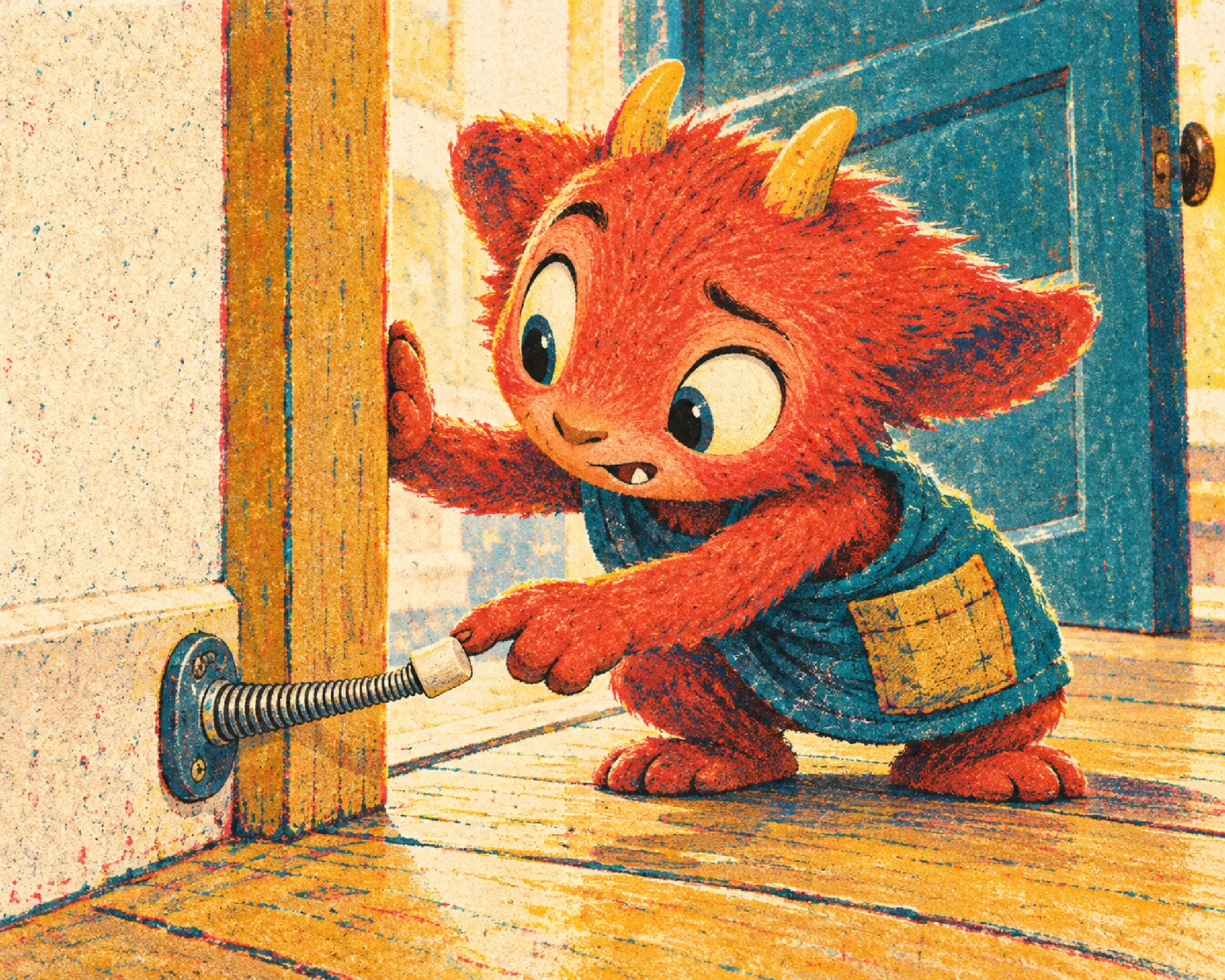
Fork-Crested Creature Plucking a Doorstop
A small fork-crested creature crouches at a doorway to pluck a spring doorstop. Overlapping forms and wandering print registration enliven its curious investigation.
Remix this referenceFork-Crested Creature Plucking a Doorstop
- Form language
- Build chunky interlocking shapes with compressed minor detail; allow small shape variations within the same playful vocabulary.
- Contour
- Use blunt, slightly ragged outlines with occasional gaps; let separate printing plates wander beyond selected edges.
- Mark-making
- Riso grain varies naturally between powdery speckles, rubbed patches and short directional scribbles.
- Surface rendering
- Use translucent spot-ink overlaps and coarse broken tonal bands, retaining uneven ink density and small paper breaks.
Priority
Make grain, translucent overprints and playful registration offsets visibly establish the riso print treatment.
What to avoid & what to check
Exact prompt for this example
MODULE OWNERSHIP
subject: Subject count, type, stable proportions and landmarks, resting face geometry, hair shape, physical materials, garment construction and permanent marks. No emotion, movement, color assignment or rendering recipe.
expression: Facial soft-tissue displacement and pupil direction, muscle coordination, regional intensity, asymmetry and onset/peak/release. No head/body pose, stable appearance, skin color or rendering.
gesture: Head/neck/body/limb orientation, joint movement, support, contact and pose-caused occlusion using existing anatomy. No eye/pupil movement, emotion, identity, props inventory or camera.
props: Prop count, type, construction, physical material and scale relative to the subject. Holding/contact belongs to gesture, position to composition, color to palette.
scene: Environment elements, terrain, backdrop/floor presence and structural detail. No canvas positions, camera, lighting, assigned colors or render texture.
camera: Projection, focal-length impression, camera elevation/yaw/roll, viewing distance and crop. No actor pose, world placement, lighting or canvas aspect ratio.
composition: Normalized 0-100% canvas positions, scale in frame, depth/overlap, focal hierarchy and margins. No joint pose, camera projection, rendering, subject/prop inventory or emotion.
palette: Color anchors, hue/saturation/value ranges, colors assigned to parts and approximate color coverage. No illumination direction, shading algorithm, physical material or layout.
lighting: Light-source direction/softness/intensity, ambient illumination, physical shadow direction/length and highlight position. Absence of directional illumination is allowed. No shading technique, palette or material changes.
style: Reusable form abstraction, contour weight/taper/edge quality, medium and mark scale/density/direction, surface rendering and tonal transition technique. No fixed subject proportions, anatomy, identity, expression, pose, palette, light-source direction, camera or layout.
output: Image count, aspect ratio, size, file/alpha requirements and global lettering/logo/watermark restrictions. No background scenery, crop, style, identity or pose.

SUBJECT
inventory: One original small bipedal creature, actor A.
geometry: A broad wedge-shaped head, two short forked hornlets, a bean-shaped torso, paddle hands and broad soft feet.
resting-face: Wide-set oval eyes, short arched brows, a blunt muzzle and a small off-center lower tooth.
appearance: Short plush fur and smooth hornlets; a sleeveless woven tunic with a roomy patch pocket.

PRIORITY


AVOID


CHECK


EXPRESSION — ACTOR A
brows: The nearer brow lifts higher than the farther brow.
lids: Upper lids open attentively while lower lids stay soft.
cheeks: A faint lift gathers beside one mouth corner.
nose: The muzzle stays unwrinkled and the nostrils remain still.
mouth: The lips part narrowly, revealing the small lower tooth.
jaw: The jaw drops just enough for the narrow mouth opening.
gaze: Both pupils converge on the doorstop's free tip.
coordination: Uneven brows and a barely emerging smile suggest discovery.
timing: Catch curiosity at onset, before surprise or laughter develops.

PRIORITY


AVOID


CHECK


GESTURE
head: The head dips forward with a small sideways cant toward the spring.
torso: The torso compresses into a low crouch and leans toward the doorway.
limbs: One knee folds outward, both feet support the crouch, and the nearer arm reaches across the body.
contact: One hand braces against the jamb; a fingertip of the other hand bends the spring tip sideways.

PRIORITY


AVOID


CHECK


PROPS
inventory: One spring doorstop, about the length of A's hand.
construction: A tapered steel coil on a screw-mounted base, finished with a rounded rubber cap.

PRIORITY


AVOID


CHECK


SCENE
inventory: A workshop doorway with a timber jamb, an open door, a plaster wall and a worn plank floor.
structure: A plain baseboard meets the jamb; broad floorboards continue through the threshold.

PRIORITY


AVOID


CHECK


CAMERA
projection: Moderate perspective with an ordinary lens impression and no exaggerated wide-angle distortion.
viewpoint: A low three-quarter viewpoint near the creature's crouched face height, with a level horizon.
crop: Show the complete creature and the doorstop, with only a partial doorway.

PRIORITY


AVOID


CHECK


COMPOSITION
placement: Set A around 62% across the canvas; the doorstop occupies the lower-left approach to the figure.
depth: The near jamb overlaps one shoulder; the reaching arm crosses the tunic, with the open door layered behind.
spacing: The face leads to the fingertip and spring; uneven gaps around the crouch keep the overlapping scene lively.

PRIORITY


AVOID


CHECK


PALETTE
colors: Warm cream paper, tomato red, deep teal and sunflower yellow, with darker mixed hues.
assignment: Red defines the fur, teal the tunic and door, yellow the hornlets and floor; cream opens the wall and eyes.
balance: Cream remains generous; red and teal form the main contrast, with yellow as a linking accent.

PRIORITY


AVOID


CHECK


LIGHTING
sources: Broad soft light enters through the doorway from the upper left, with ample ambient fill.
shadows: A short soft shadow extends rightward beneath the crouch; contact shadows ground the feet and spring base.
highlights: Restrained highlights touch the upper-left horn edges and the spring's exposed upper curve.

PRIORITY


AVOID


CHECK


STYLE GUIDE
form-language: Build chunky interlocking shapes with compressed minor detail; allow small shape variations within the same playful vocabulary.
contour: Use blunt, slightly ragged outlines with occasional gaps; let separate printing plates wander beyond selected edges.
mark-making: Riso grain varies naturally between powdery speckles, rubbed patches and short directional scribbles.
surface-rendering: Use translucent spot-ink overlaps and coarse broken tonal bands, retaining uneven ink density and small paper breaks.

PRIORITY
Make grain, translucent overprints and playful registration offsets visibly establish the riso print treatment.

AVOID


CHECK


OUTPUT
format: One finished image, landscape 5:4, 2000 × 1600 pixels, opaque PNG.
restrictions: No lettering, logos, signatures or watermarks.

PRIORITY


AVOID


CHECK


FINAL INTEGRATION
expression + gesture + props: The investigative expression and spring interaction should establish a readable small discovery.
style + composition: Printing irregularities should energize the overlaps while preserving the face-to-spring reading path.
Model information comes from image provenance. The same prompt may produce a different result.