Text to imageIllustrationStyle guide
Three Cards · Overlap Through T-Junctions
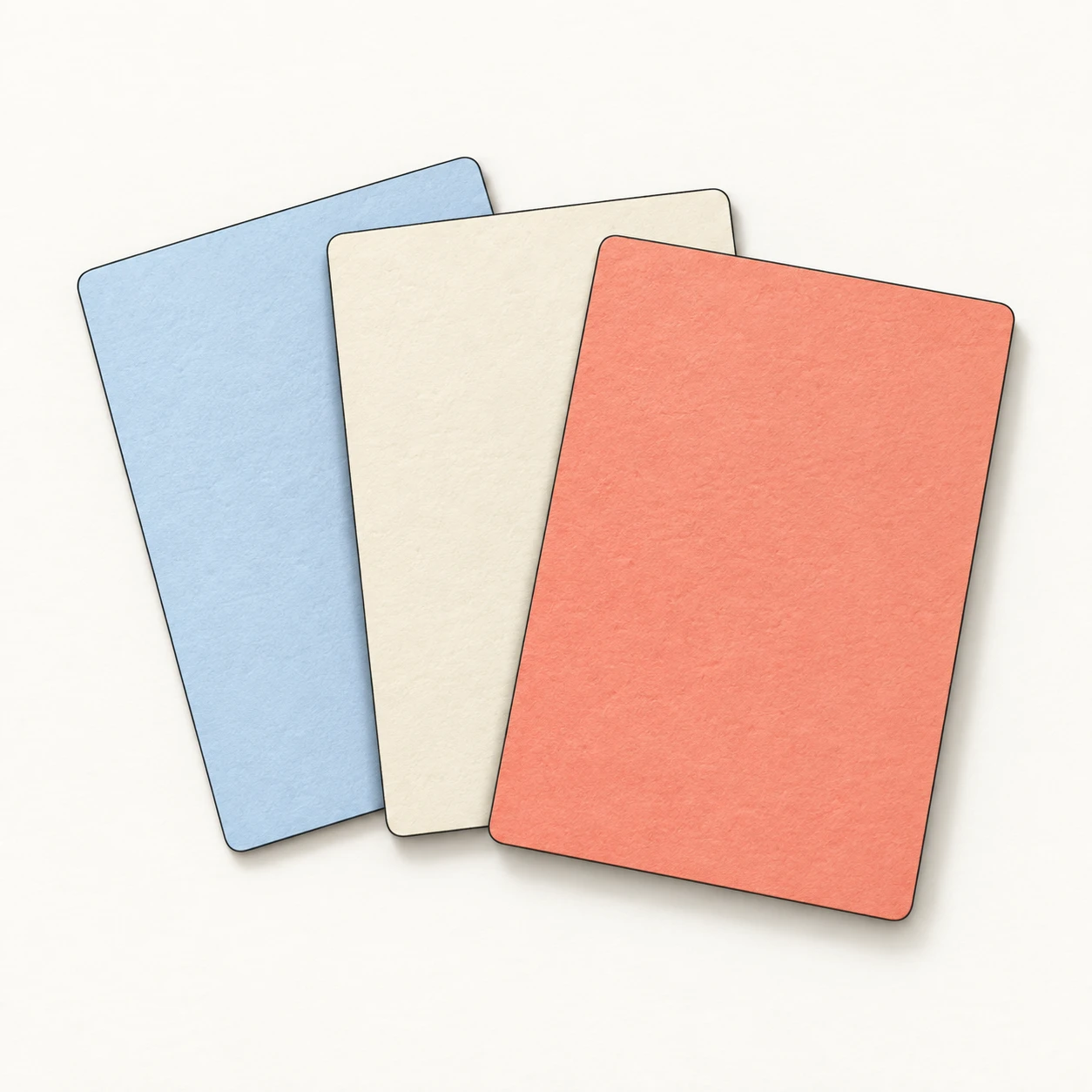
An illustration that reveals the stacking order of three cards by stopping rear contours against continuous front edges.
Three Cards · Overlap Through T-Junctions
- Shape & line
- Draw the cards with thin, even dark contours and gently rounded corners. At every overlap, keep the nearer card's edge continuous and stop the rear card's contour exactly where it meets that edge, forming readable T-junctions without lines passing through the front surface.
- Color & light
- Fill the left rear card with pale blue, the middle card with cream, and the right front card with muted coral. Suggest light from image-upper-left with a narrow, soft shadow falling toward image-lower-right onto the exposed rear paper beside each overlapping edge.
- Texture & material
- Render matte cardstock with restrained, irregular paper grain inside the color fills. Keep the cut edges crisp and the surfaces flat enough that grain and shading support the overlap rather than obscuring the contour junctions.
- Composition
- Spread the three cards across the image from left rear to right front with modest differences in rotation. Expose a corner and a broad strip of each rear card, and place the clearest T-junctions near the center so the stacking order reads immediately.
Priority
Prioritize unbroken front edges and clearly terminated rear contours.
What to avoid & what to check
Avoid transparent cards, crossing contours, and shadows that conceal the junctions.
Check that all three cards are countable and their stacking order is clear from the contour junctions.
Exact prompt for this example
SUBJECT
Exactly three blank rectangular paper cards overlap in a shallow fan: a pale blue card at image-left lies behind a cream card in the middle, and a coral card at image-right lies in front of both. Each card retains enough exposed surface to read as a separate rectangle.

COMPOSITION
Use a nearly overhead view on a plain warm-white background. Center the compact fan with generous margins, keeping all exposed corners inside the frame and the overlapping edges large enough to inspect.

STYLE GUIDE
1. Shape & line
Draw the cards with thin, even dark contours and gently rounded corners. At every overlap, keep the nearer card's edge continuous and stop the rear card's contour exactly where it meets that edge, forming readable T-junctions without lines passing through the front surface.

2. Color & light
Fill the left rear card with pale blue, the middle card with cream, and the right front card with muted coral. Suggest light from image-upper-left with a narrow, soft shadow falling toward image-lower-right onto the exposed rear paper beside each overlapping edge.

3. Texture & material
Render matte cardstock with restrained, irregular paper grain inside the color fills. Keep the cut edges crisp and the surfaces flat enough that grain and shading support the overlap rather than obscuring the contour junctions.

4. Composition
Spread the three cards across the image from left rear to right front with modest differences in rotation. Expose a corner and a broad strip of each rear card, and place the clearest T-junctions near the center so the stacking order reads immediately.

PRIORITY
Preserve the requested identity, count, action, composition and output settings. Apply the style rules within those constraints; a style reference must not replace the subject or layout. Within the style: Prioritize unbroken front edges and clearly terminated rear contours.

AVOID
Avoid transparent cards, crossing contours, and shadows that conceal the junctions.

OUTPUT
Produce one square illustration with no lettering, numbers, logos, captions, or watermark.

SELF-CHECK
Check that all three cards are countable and their stacking order is clear from the contour junctions.
Model information comes from image provenance. The same prompt may produce a different result.